

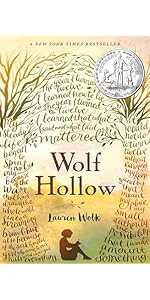
Wolf Hollow
Product ID: 65740398
Desertcart purchases this item on your behalf and handles shipping, customs, and support to France.
A Newbery Honor Book New York Times Bestseller A Kirkus Reviews Best Middle Grade Book of the Century “ Wolf Hollow has stayed with me long after I closed the book. It has the feel of an instant classic." —Linda Sue Park, Newbery Medalist and New York Times bestselling author of A Long Walk to Water “This book matters.” —Sara Pennypacker, New York Times bestselling author of Pax Despite growing up in the shadows cast by two world wars, Annabelle has lived a mostly quiet, steady life in her small Pennsylvania town. Until the day new student Betty Glengarry walks into her class. Betty quickly reveals herself to be cruel and manipulative, and though her bullying seems isolated at first, it quickly escalates. Toby, a reclusive World War I veteran, soon becomes the target of Betty’s attacks. While others see Toby’s strangeness, Annabelle knows only kindness. And as tensions mount in their small community, Annabelle must find the courage to stand as a lone voice for justice. The brilliantly crafted debut of Newbery Honor– and Scott O'Dell Award–winning author Lauren Wolk ( Beyond the Bright Sea, Echo Mountain) , Wolf Hollow is a haunting tale of America at a crossroads and a time when one girl’s resilience, strength, and compassion help to illuminate the darkest corners of history. Review: Stories like Wolf Hollow are so fantastic because the remind us ... - Stories like Wolf Hollow are so fantastic because the remind us that while we hold to nostalgia that other times were "simpler," times, life is never simple, and the truth, when held back can sometimes be more complicated than anything you could imagine. Comparisons have already been made to Harper Lee's classic To Kill a Mockingbird, and rightfully so. This novel has a similar feeling in its beautiful, and easy prose and in, Annabelle, and it's earnest and charming narrator. What's so wonderful about Wolf Hollow, and is another echo back to Lee's incredible work, is, you can feel that it is timeless. Yes, it is set in 1943, but the experiences, the life lessons, and the heart are true in any era. Annabelle's clear-eyed naivety, but overall desire for good are tempered by her independence, and wilful insistence to seek the truth at any cost. This is a novel I can see easily becoming a new classic, studied and loved in classrooms around the country. Lauren Wolk does such a fantastic job showing you Wolf Hollow through the eyes of Annabelle it's not difficult to see the ridge where Betty, the local bully, waits to torment her classmates. Nor is it difficult to imagine a sociopathic little girl desperate for power and control in her life spinning her web of lies to cover her own misdeeds. Meanwhile, the classic lesson of not judging a person based on his appearance makes the rounds with Toby, the town hermit, who is, of course, far more than meets the eye. I will admit Betty's conniving and hurtful behavior somewhat frightened me at times, but Wolk does a great job at balancing Annabelle's rightful indignation at Betty's foul behavior, with her limited understanding that Betty is another child who has been irrecoverably damaged. Her relationship with Toby is sweet, and gentle, and so good hearted that your heart will break along with Annabelle to learn that the truth isn't always enough to truly set you free in the eyes of your peers, and that life is hardly fair. Annabelle has a strong family unit that sees her though this growth between the year she is eleven and the year she turned twelve, and each character has his and her own role, that is fully realized, and not simply glossed over. From her strong-willed and kind hearted mother and father, to her wily younger brothers, to her bitter, cold-hearted aunt. The writing in Wolf Hollow has such a clear voice that I found this novel easy to read, and its rhythm a steady drumbeat throughout the story. Nothing felt overly hurried, and nothing felt too drawn out - you could feel the pace of life in Wolf Hollow, as sure as you could see Annabelle and her classmates playing in the school-yard, or running down the path to Cob Hollow. It is rare these days that a single line of prose catches me, but with Wolf Hollow, one passage did just that. I'd like to leave you with this in the hopes it will inspire you to pick up the book and enjoy your journey. "If my life was to be just a single note in an endless symphony, how could I not sound it out for as long and loudly as I could?" - Wolf Hollow (p.226 Kindle edition) Review: During ww2 but not in Germany - This was a really good book. I read it as my daughter will be reading it for homeschool. Never read it before. It’s perfect. It talks about bullies, the outcomes from lies, knowing someone before judging them, following instincts. Soo good. I was teary towards the end too. The version I have has questions for discussion to which makes my job easier to teach my daughter!




| Best Sellers Rank | #26,072 in Books ( See Top 100 in Books ) #19 in Children's Country Life Books #41 in Children's 1900s American Historical Fiction #47 in Children's Books on Bullying |
| Customer Reviews | 4.6 out of 5 stars 2,700 Reviews |
C**T
Stories like Wolf Hollow are so fantastic because the remind us ...
Stories like Wolf Hollow are so fantastic because the remind us that while we hold to nostalgia that other times were "simpler," times, life is never simple, and the truth, when held back can sometimes be more complicated than anything you could imagine. Comparisons have already been made to Harper Lee's classic To Kill a Mockingbird, and rightfully so. This novel has a similar feeling in its beautiful, and easy prose and in, Annabelle, and it's earnest and charming narrator. What's so wonderful about Wolf Hollow, and is another echo back to Lee's incredible work, is, you can feel that it is timeless. Yes, it is set in 1943, but the experiences, the life lessons, and the heart are true in any era. Annabelle's clear-eyed naivety, but overall desire for good are tempered by her independence, and wilful insistence to seek the truth at any cost. This is a novel I can see easily becoming a new classic, studied and loved in classrooms around the country. Lauren Wolk does such a fantastic job showing you Wolf Hollow through the eyes of Annabelle it's not difficult to see the ridge where Betty, the local bully, waits to torment her classmates. Nor is it difficult to imagine a sociopathic little girl desperate for power and control in her life spinning her web of lies to cover her own misdeeds. Meanwhile, the classic lesson of not judging a person based on his appearance makes the rounds with Toby, the town hermit, who is, of course, far more than meets the eye. I will admit Betty's conniving and hurtful behavior somewhat frightened me at times, but Wolk does a great job at balancing Annabelle's rightful indignation at Betty's foul behavior, with her limited understanding that Betty is another child who has been irrecoverably damaged. Her relationship with Toby is sweet, and gentle, and so good hearted that your heart will break along with Annabelle to learn that the truth isn't always enough to truly set you free in the eyes of your peers, and that life is hardly fair. Annabelle has a strong family unit that sees her though this growth between the year she is eleven and the year she turned twelve, and each character has his and her own role, that is fully realized, and not simply glossed over. From her strong-willed and kind hearted mother and father, to her wily younger brothers, to her bitter, cold-hearted aunt. The writing in Wolf Hollow has such a clear voice that I found this novel easy to read, and its rhythm a steady drumbeat throughout the story. Nothing felt overly hurried, and nothing felt too drawn out - you could feel the pace of life in Wolf Hollow, as sure as you could see Annabelle and her classmates playing in the school-yard, or running down the path to Cob Hollow. It is rare these days that a single line of prose catches me, but with Wolf Hollow, one passage did just that. I'd like to leave you with this in the hopes it will inspire you to pick up the book and enjoy your journey. "If my life was to be just a single note in an endless symphony, how could I not sound it out for as long and loudly as I could?" - Wolf Hollow (p.226 Kindle edition)
J**H
During ww2 but not in Germany
This was a really good book. I read it as my daughter will be reading it for homeschool. Never read it before. It’s perfect. It talks about bullies, the outcomes from lies, knowing someone before judging them, following instincts. Soo good. I was teary towards the end too. The version I have has questions for discussion to which makes my job easier to teach my daughter!
F**G
I usually like the books I read, but not this one.
I only give four stars because I understand how hard it is to write a full length book (so that’s an accomplishment right there), but the plot is disturbing. I actually liked it up until the middle, that’s when things went downhill. I think death is a harsh punishment for a bully regardless of what they’ve done. The author justs kills off one of the main characters, it was as if they said “well I can’t get anywhere with them anymore KILL HIM!” Honestly, death is fine a book as it shows how life actually is, but such a large amount of it in a young girls life is disturbing. I personally did not like it. Lauren wolk could have done better, beyond the bright sea is a great book, but wolf hollow isn’t. Save your money and try something else that’s better.
C**E
Deep and moving
I didn’t take notes on this book because I was too busy reading it in two sittings, so bear with me as I stumble through my jumbled thoughts. Let’s see…topics Wolf Hollow deals with (excellently): Bullying, standing up for what you believe is right, trauma, dealing with the consequences of your actions, lying, friendship, grief, prejudice and supporting your family. This book handles a lot of heavy topics and while it’s not an entirely easy read, I think it has the right mix of honesty, tough themes and positive moments. I don’t know what I’m trying to say. I sound silly. This book was excellent, ok!? Annabelle is a young girl whose head and heart are in the right place. She’s a mature twelve to be sure (far more mature than many of the protags found in YA), though that’s to be expected of one who’s grown up on a farm during WWII. She has her “young” moments too – while I would have believed her to be fourteen, I don’t think her behavior was too mature. Better examples than my babbling are quotes from Annabelle. On Toby’s experience in WWI: “Even though I was only eleven, I knew enough about fear to conclude that being completely afraid, body and soul, was probably enough to make a person strange forever after.” In talking about how the bullying situation spiraled out of control: “It happened in little bits, not all at once, and it wasn’t easy to figure out what to do along the way.” On living: “If my life was to be just a single note in an endless symphony, how could I not sound it out for as long and as loudly as I could?” I cried a little towards the end, as I suspected I would, and I really love when books move me to tears. I’m happy I made this book a priority and I would highly recommend it to anyone who loves middle-grade, American History and tears.
S**.
Her biggest worries are her annoying little brothers and the unruly older boys at school
This review is by Jennifer Donnelly and appeared in the New York Times Book Review on May 8, 2016. I cannot improve on this review so I am submitting it here in full. Hard truths abound in “Wolf Hollow,” Lauren Wolk’s haunting coming-of-age novel, her first book for young readers. The hardest of all is this: Doing right can go very wrong. “The year I turned 12, I learned how to lie,” Annabelle, the main character, tells us as the story opens. That year is 1943. World War II is raging, and families in Annabelle’s rural Pennsylvania community have lost sons, but the conflict is a distant one. Annabelle’s life, bounded by her family’s farm and a one-room schoolhouse, is sheltered and safe. Her biggest worries are her annoying little brothers and the unruly older boys at school. She’s never had cause to lie. Until the day Betty Glengarry arrives. A city girl, Betty has been sent to live with her grandparents because she’s incorrigible. Her mother can’t handle her; her father’s gone. Betty’s a bully — and much worse, it turns out, than incorrigible. “I didn’t know a word that described Betty properly,” Annabelle says, “or what to call the thing that set her apart from the other children in that school.” Betty is a “dark-hearted girl,” one without morals or remorse, who beats Annabelle with a stick and breaks a bird’s neck. Annabelle is afraid of her, but she’s also at an age where children are eager to prove their mettle, and decides to handle the threat herself. “Betty was mine to fear, and I decided that she was mine to disarm. If I could. On my own.” She can’t, though, and when Betty’s cruelty escalates — with devastating consequences — Annabelle confides in her parents. When they confront Betty and her grandparents, the wily girl lies her way out of trouble and directs suspicion toward Toby — a reclusive, shellshocked veteran. Betty’s determination to frame an innocent thrusts Annabelle into a predicament far more difficult than deciding whether or not to tattle on a bully. With a child’s single-mindedness, she decides that the right thing to do is to protect Toby — even if pulling that off requires a few wrongs. That lies sometimes succeed while truth fails is only one of the tough complexities Annabelle must face. Early in the book, she recalls asking her grandfather how Wolf Hollow got its name. Long ago, he explains, the people who lived here dug pits to trap wolves. They shot the wolves that were getting “too brave and too many,” and turned their ears in for a bounty. Thinking of the wolves in the pits saddens Annabelle, but her grandfather, “a serious man who always told me the truth, which I didn’t always want,” points out that she didn’t mourn the snake he killed last spring. She replies that copperheads are poisonous, and “that’s different.” “Not to the snake, it isn’t,” her grandfather says. “Or to the God who made it.” This god — the god of wolves, snakes and Betty Glengarry — is an ancient, feral deity, one unconcerned with human constructs of right and wrong, and Annabelle soon realizes that pitfalls dark and deep lie hidden on the path to adulthood, some of them large enough to swallow us whole. “Wolf Hollow” is beautifully written, with spare, simple language perfectly suited to its subject and setting. Annabelle narrates in the past tense, and Wolk uses this device to great effect, masterfully balancing a mood of aching regret with an electric sense of ominousness. Painting rural life with an even hand, she shows its beauty and its hardship, the strong ties that bind people who live in the country and the intolerance that sometimes finds root there. The book’s narrative builds suspensefully toward an ending that’s wrenching and true, and in its final pages, Annabelle learns to abide by life’s complexities. She thinks of Wolf Hollow as “a dark place, no matter how bright its canopy, no matter how pretty the flowers that grew in its capricious light,” but also the place “where I learned to tell the truth in that year before I turned 12: about things from which refuge was impossible. Wrong, even. No matter how tempting.” With a precociously perceptive girl as a main character; a damaged, misunderstood recluse; and themes of prejudice and bigotry, comparisons to Harper Lee’s “To Kill a Mockingbird” will abound. But Wolk gives us her own story — one full of grace and stark, brutal beauty. To read the review at the NYTimes: [...]
S**!
Could easily be for adults
Possibly 4.5 stars but I just finished via Audible and though have not yet fully processed can say that this story is quite gripping, at one point even rendering me breathless to learn what would happen next -an intensity of interest that snuck up on me- the tension is that thick and not a little bit vexing. I cringed at some accounts of what I'm calling sadism rather than bullying, somewhat surprised by the dark nature detailed in a book for middle-graders but finding, upon relief of it giving way to other intriguing aspects of story, it to be the right amount depicted to clearly capture the often unexplainable -even if (one hopes is) rare- mean and evil that can emerge in and be acted out by humans, including young humans. Lovely characters and relationships, too plus a notably refreshing respect for children by the adults. That the 11 year old protagonist is smart and tenacious as compassionate is satisfying. Still, there is a twinge of disappointment and sorrow left with me in the end, which is not consoled by recognition that there is no lack of truth shown here. "Sometimes things come out right and sometimes things don't."
D**N
Great Book !!
My son heard about this book and ask me to get it for him.....and now he's hooked lol great book for teens
J**E
a somewhat hollow book on bullying
A girl moves to a rural Pennsylvania town in 1943 and starts bullying other girls and boys. Her cruel behavior sets in motion a story that obviously will not end well for at least one person. Lauren Wolk's focused, persistent writing style is what is charming about this book, but her narrative voice is somewhat deceiving, too. While reading the book, I knew Wolk was spinning a story of sadness, cruelty with some redemption, the importance of understanding and kindness to strangers. I felt quite manipulated. I also feel manipulated in all the positive reviews for a book with a depressing story that ends in a way that fairy tales often end, satisfying but unbelievable. I would not recommend this book to any middle grade reader unless I knew them quite well. We live in an age of trigger warnings and this book definitely needs one. All of these adults who love this book should be careful recommending a book that is more for adults thinking back about their childhood (and how they wish they had overcame a bully) than a book for middle grade readers who may be confused by many aspects of this book (a homeless man who lives in a smoke shed, holes to catch wolves, a strict aunt who seems almost like a stereotype). This is one of those books that librarians love but I am not sure if numerous children or young adults readers will like it. Some will, but many will not. Those who do not like the book should not be bullied because their taste is not the same as certain librarians and educators.
L**L
Einwandfrei
Einwandfrei
S**S
Libro
Más económico que la librería
B**M
5 Star thrill
I loved this book. The plot- the plot is gripping and enticing, where Betty, an unknown bully comes to live near Wolf Hollow near Annabel. There is a man, Toby, who is mysterious. Betty makes herself seem innocent for extremely bad things, we know that it isnt Toby who did it, we know it is betty, but the characters do not and thta what makes this book so great. You want to read on because you want the characters ro find out thta it is Betty not Toby!! Characters- Annabel, the main character, very likeable, curious and brave. Toby- Mysterious, and used for blame Betty- Horrible bully, blackmaler, dangerous really. Aunt Lily,- Annabels aunt, who thinks it is Toby, a real obstacle character. All the other characters are really good, but these are the characters who root the book. Style of writing- Lauren Wolk writes in a style that is the same as how you think, so it is enticing and believable. the language is amazing!! Age- I would recommend this for extremely good 10 year old readers+, a book for everybody, from ten to extremely old. I am an advanced 10 year old reader and this book was amazing!!
K**Y
Five Stars
very nice book got it at very nice condition
C**N
Perfetto il libro e ottimo il servizio di consegna
Perfetto
Trustpilot
5 days ago
1 month ago