
DOWNLOAD THE APP


Customer Services
Copyright © 2025 Desertcart Holdings Limited
DOWNLOAD THE APP
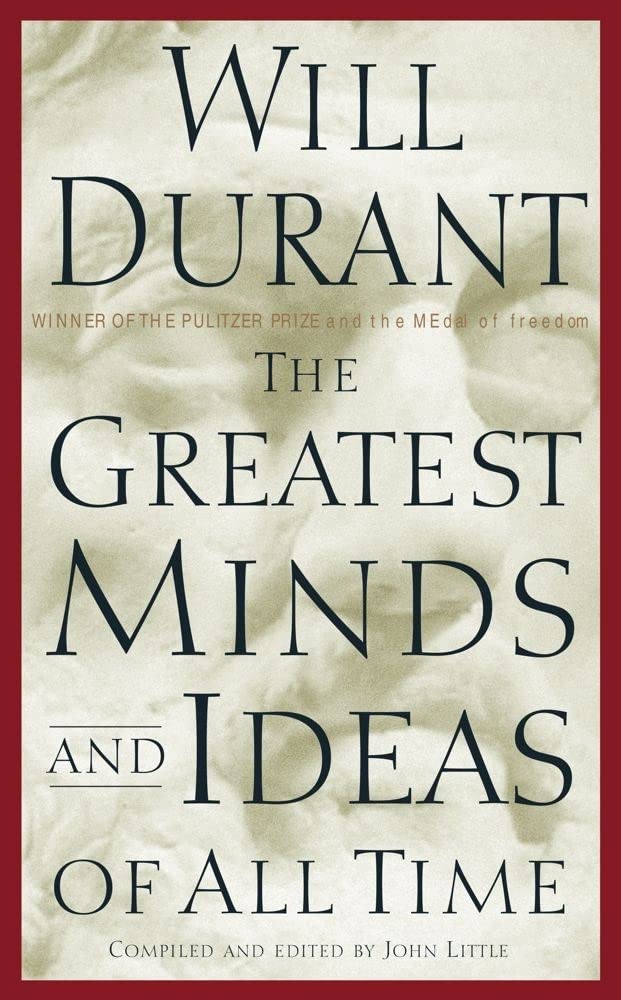
The Greatest Minds and Ideas of All Time [Durant, Will] on desertcart.com. *FREE* shipping on qualifying offers. The Greatest Minds and Ideas of All Time Review: Dated, Personal but Wonderful - Will Durant, who died in 1981, has been a guiding light in education since he published "The Story of Philosophy: The lives and opinions of the world's greatest philosophers from Plato to John Dewey" in 1926, and thereby introduced philosophy to America. He is a learned man with a charming, witty, easy to read and human style that is both endearing and inspirational. This book contains five articles previously published long ago in un-named magazines. Surprisingly (and unforgivably) John Little, founder and director of The Will Durant Foundation, who compiled and edited this delightful little book, does not bother to disclose the date and original place of publication. This is a great pity for many reasons. It is also not clear how much editing Mr. Little has done to the original essays. I have been able to track Durant's first essay to "The Rotarian" magazine of February 1955. That version is somewhat different from what appears in the book. It is ironic that such a scholar as Durant would be reproduced in such an unscholarly way. Durant's list of ten "greatest" thinkers is the least idiosyncratic, a list that most educated people will probably agree. He defines his criteria and then briefly introduces Confucius, Plato (who subsumes Socrates in a cute twofer), Aristotle, Aquinas (OK, OK, so the Western bias is clear already), Copernicus, Bacon, Newton, Voltaire (!), Kant, Darwin, He is generous in his description of other great thinkers who do not make his list and the reasons why. Buddha and Christ were teachers not thinkers, Spinoza's thinking was too esoteric to have influenced any but the most intellectual. Democritus, Epicurus, Marcus Aurelius, and others - even Mary Wollstonecraft and Susan Anthony, get a passing nod. Personally, I was disappointed that Heraclitus, Franklin, Jefferson and Einstein failed to merit even such "honorable mention". Durant admits that his list of ten "greatest" poets is quite personal. Fair enough; there are no objective criteria that would support another approach. His favorites: Homer, David, Euripides, Lucretius, Li Tai Po, Dante, Shakespeare, Keats, Shelly and Whitman. This section is nicely embellished with some of his favorite passages by these great writers. In his defense of nominating tragic Keats, Durant also produces a credible list of other great poets but strangely omits Cervantes. Elsewhere in the book poor Emerson is trashed for being "a trifle thin today". Ouch. Next are presented Durant's 100 "best" books for an education, in which he provocatively promises a first class education to anyone who will devote seven hours a week for four years to his proposed reading program. Wonderful, thrilling idea. His approach mixes original material with survey texts. While Herodotus, Solomon and Homer are timeless, old texts on science are not likely to be useful. The reader might benefit from his own efforts to find more modern publications to fill these parts in Durant's program. As bad, Durant's approach is shamelessly parochial. Asia and Africa are grouped together in one of his 12 sections. The Middle East (including Persia and the terrific contributions of Islam) seem ignored altogether. One could probably find a more recent outline to achieve the excellent goal that Durant proposes. Still, Durant's perspective that education is a lifelong process that begins when college finishes is wonderfully refreshing, especially today when college is seen as a stepping stone for career, like a trade school. Durant's ten "peaks" of human progress is also excellent and thought provoking. These include: speech, fire, animal domestication, agriculture, social order, morality, tools, science, education and writing/printing. A critic could nit-pick that agriculture, horticulture and tool development are part of science or that social order and morality are overlapping. A more legitimate comment would be that his list mixes actual peak events (discovery of fire, urbanization, even plant and animal domestication) with processes that span the full timeframe of humanity (tool development, education, science). Still, the list is, as intended, thought provoking and useful. The final chapter presents 12 vital dates in world history, and is intellectually the most muddled part of the book, as it mixes up personalities and dates. Many of the dates are placeholders for Great Teachers, Buddha, Confucius, Socrates, Christ, Mohammed, even Sir Francis Bacon and might have been more usefully approached in a different way. Certainly the first three of these (and others such as Moses, Zoroaster, Patanjali and indeed the development of the Vedas) might have better been combined as one date in a thoughtful essay on the Axial Age. Only the invention of the Egyptian calendar in 4241 BC, the printing press in 1554, steam in 1769, and the discovery of the New World in 1492 seem to fit the topic well. Oddly, Durant adds the failed French Revolution to this list, but ignores the successful American Revolution. Hammurabi is ignored, as is Marathon. Personally, it seems that the Magna Carta and the Bill or Rights deserve some mention too. This book makes for easy reading and would make a delightful gift to any student or educated person. It also provides an excellent template for discussion, in which you and your friends each prepare your own lists first, compare them with each other and with Durant's. The light style and breezy manner of this work contrasts dramatically from the book that made him famous, "The Story of Philosophy", which is dense, profound and very slow reading. Greatest Minds and Ideas will be enjoyed by all educated people. By contrast "The Story of Philosophy" is suited to dedicated philosophers looking for a good sample of some of the deepest thinkers of our culture. Review: A Great Introduction To The Wisdom Of Will Durant - It's said that good things come in small packages. Sometimes great things do, too. This book may be only 118 pages long, but between these covers you will find reasoned and inspired discussion of some of the people and works who have truly ennobled mankind. Will Durant, in partnership with his wife Ariel, spent his lifetime celebrating our highest and best achievements as a people. His essays on the greatest thinkers, greatest poets, best books, peaks of human progress and vital dates in world history should not only serve as a compact education, it should also fill you with a sense that for all of humanity's folly and waste, we have actually accomplished much that is worthwhile these past few thousand years. It's also very likely this book will spark within you a desire to know and to learn more about our rich heritage. My only wish for this book is that compiler John Little had included the dates these works were originally written. The chapter on the best books for an education, for example, while including many timeless classics, also includes some volumes which have been surpassed by later works--including the Durant's own magisterial lifework, the "Story of Civilization." But this a minor quibble over what is on the whole an exceptional work.--William C. Hall
| Best Sellers Rank | #90,771 in Books ( See Top 100 in Books ) #36 in Epistemology Philosophy #60 in General Books & Reading #293 in Essays (Books) |
| Customer Reviews | 4.4 4.4 out of 5 stars (1,002) |
| Dimensions | 5 x 0.6 x 8 inches |
| ISBN-10 | 0743235533 |
| ISBN-13 | 978-0743235532 |
| Item Weight | 9.6 ounces |
| Language | English |
| Print length | 127 pages |
| Publication date | November 7, 2002 |
| Publisher | Simon & Schuster |
A**M
Dated, Personal but Wonderful
Will Durant, who died in 1981, has been a guiding light in education since he published "The Story of Philosophy: The lives and opinions of the world's greatest philosophers from Plato to John Dewey" in 1926, and thereby introduced philosophy to America. He is a learned man with a charming, witty, easy to read and human style that is both endearing and inspirational. This book contains five articles previously published long ago in un-named magazines. Surprisingly (and unforgivably) John Little, founder and director of The Will Durant Foundation, who compiled and edited this delightful little book, does not bother to disclose the date and original place of publication. This is a great pity for many reasons. It is also not clear how much editing Mr. Little has done to the original essays. I have been able to track Durant's first essay to "The Rotarian" magazine of February 1955. That version is somewhat different from what appears in the book. It is ironic that such a scholar as Durant would be reproduced in such an unscholarly way. Durant's list of ten "greatest" thinkers is the least idiosyncratic, a list that most educated people will probably agree. He defines his criteria and then briefly introduces Confucius, Plato (who subsumes Socrates in a cute twofer), Aristotle, Aquinas (OK, OK, so the Western bias is clear already), Copernicus, Bacon, Newton, Voltaire (!), Kant, Darwin, He is generous in his description of other great thinkers who do not make his list and the reasons why. Buddha and Christ were teachers not thinkers, Spinoza's thinking was too esoteric to have influenced any but the most intellectual. Democritus, Epicurus, Marcus Aurelius, and others - even Mary Wollstonecraft and Susan Anthony, get a passing nod. Personally, I was disappointed that Heraclitus, Franklin, Jefferson and Einstein failed to merit even such "honorable mention". Durant admits that his list of ten "greatest" poets is quite personal. Fair enough; there are no objective criteria that would support another approach. His favorites: Homer, David, Euripides, Lucretius, Li Tai Po, Dante, Shakespeare, Keats, Shelly and Whitman. This section is nicely embellished with some of his favorite passages by these great writers. In his defense of nominating tragic Keats, Durant also produces a credible list of other great poets but strangely omits Cervantes. Elsewhere in the book poor Emerson is trashed for being "a trifle thin today". Ouch. Next are presented Durant's 100 "best" books for an education, in which he provocatively promises a first class education to anyone who will devote seven hours a week for four years to his proposed reading program. Wonderful, thrilling idea. His approach mixes original material with survey texts. While Herodotus, Solomon and Homer are timeless, old texts on science are not likely to be useful. The reader might benefit from his own efforts to find more modern publications to fill these parts in Durant's program. As bad, Durant's approach is shamelessly parochial. Asia and Africa are grouped together in one of his 12 sections. The Middle East (including Persia and the terrific contributions of Islam) seem ignored altogether. One could probably find a more recent outline to achieve the excellent goal that Durant proposes. Still, Durant's perspective that education is a lifelong process that begins when college finishes is wonderfully refreshing, especially today when college is seen as a stepping stone for career, like a trade school. Durant's ten "peaks" of human progress is also excellent and thought provoking. These include: speech, fire, animal domestication, agriculture, social order, morality, tools, science, education and writing/printing. A critic could nit-pick that agriculture, horticulture and tool development are part of science or that social order and morality are overlapping. A more legitimate comment would be that his list mixes actual peak events (discovery of fire, urbanization, even plant and animal domestication) with processes that span the full timeframe of humanity (tool development, education, science). Still, the list is, as intended, thought provoking and useful. The final chapter presents 12 vital dates in world history, and is intellectually the most muddled part of the book, as it mixes up personalities and dates. Many of the dates are placeholders for Great Teachers, Buddha, Confucius, Socrates, Christ, Mohammed, even Sir Francis Bacon and might have been more usefully approached in a different way. Certainly the first three of these (and others such as Moses, Zoroaster, Patanjali and indeed the development of the Vedas) might have better been combined as one date in a thoughtful essay on the Axial Age. Only the invention of the Egyptian calendar in 4241 BC, the printing press in 1554, steam in 1769, and the discovery of the New World in 1492 seem to fit the topic well. Oddly, Durant adds the failed French Revolution to this list, but ignores the successful American Revolution. Hammurabi is ignored, as is Marathon. Personally, it seems that the Magna Carta and the Bill or Rights deserve some mention too. This book makes for easy reading and would make a delightful gift to any student or educated person. It also provides an excellent template for discussion, in which you and your friends each prepare your own lists first, compare them with each other and with Durant's. The light style and breezy manner of this work contrasts dramatically from the book that made him famous, "The Story of Philosophy", which is dense, profound and very slow reading. Greatest Minds and Ideas will be enjoyed by all educated people. By contrast "The Story of Philosophy" is suited to dedicated philosophers looking for a good sample of some of the deepest thinkers of our culture.
C**L
A Great Introduction To The Wisdom Of Will Durant
It's said that good things come in small packages. Sometimes great things do, too. This book may be only 118 pages long, but between these covers you will find reasoned and inspired discussion of some of the people and works who have truly ennobled mankind. Will Durant, in partnership with his wife Ariel, spent his lifetime celebrating our highest and best achievements as a people. His essays on the greatest thinkers, greatest poets, best books, peaks of human progress and vital dates in world history should not only serve as a compact education, it should also fill you with a sense that for all of humanity's folly and waste, we have actually accomplished much that is worthwhile these past few thousand years. It's also very likely this book will spark within you a desire to know and to learn more about our rich heritage. My only wish for this book is that compiler John Little had included the dates these works were originally written. The chapter on the best books for an education, for example, while including many timeless classics, also includes some volumes which have been surpassed by later works--including the Durant's own magisterial lifework, the "Story of Civilization." But this a minor quibble over what is on the whole an exceptional work.--William C. Hall
M**D
Good book
This book was a tough read for me, I wish I knew the writing style before I had bought the book many years ago.
T**Y
No Regrets Reading Durant!
Phenomenal. This is a collection of six essays which do not disappoint. Buzzfeed would be proud at Durant's lists of "ten greatest thinkers" "ten greatest poets" "One hundred best books for an education" "ten peaks of human progress" and "twelve vital dates in world history" Chapter 4, the 100 best books for an education is a good review of his choice of 100 books. But what is most beautiful is his intro on his ideal library and his conclusion on why we should read. Despite his wide reading he remained an optimist. We should look towards his writings for hope that humanity can get better. He certainly believed it. Chapter 5's "ten peaks on human progress" is the best part of the book. Durant does for humanity what St. Paul did for 1st century Christianity/Judaism. They both surveyed the literature of their time and boiled it down to the reasons it was written. I find myself going back to what Durant said is progress. His optimism is contagious. I want to work toward the things he talks about. His writing offers compelling reasons to live! This was the first "complete" work I read of Durant's and I'd say it was actually not quite the best intro to his work, though chapter 5 can stand by itself really well. I am currently reading his first book "transition" (1927) about his transition out of studying to be a priest and the dual autobiography he wrote with his wife. Fascinating, widely read scholar.
E**S
One the greatest books by the Durants
I purchased my first copy ten years ago and loan it to a student. who used it to write a report. I never thought about the book until a colleague and I was discussing great minds and I thought about the book again. I turned to look for the book and would you believe I never got it back from the student. I was shocked and decided that I needed to replace that book because it is among the greatest book by Will Durant. I have referenced his work since my first purchase of the Ten Volumes on civilization and the Lessons of History. Mr. Durant presents a thorough look into the world and events and this book is the consumite book on leaders and their thoughts. I highly recommend this work and all of the works of the Durants.
S**S
Could be one the best books you ever read Drant with his seamless prose and erudition
A**I
Average
R**N
I just wish I could write like Will Durant. Almost every sentence is beautifully constructed and contains an original thought. And yet he is not difficult to read (even if he has the alleged failing of occasionally starting sentences with "and" like me). Reading this makes one feel though that one has missed out on a proper education because he covers more than you are likely to be familiar with if one has followed a typical modern education. Highly recommended. This is the second book by Will Durant I have read with pleasure and I may pursue some of the recommendations of the "one hundred best books" contained in this one, even if many are clearly going to be archaic.
A**Z
Why are we not taught the way Durant teaches? A true love for the developing endeavors of our race in the world, shown through heroes and art, wars and religion, moral and economics, as one logic step after the other.
J**P
Probably the best introducyion to philosophy ever written. Very accessible.
Trustpilot
1 week ago
2 months ago