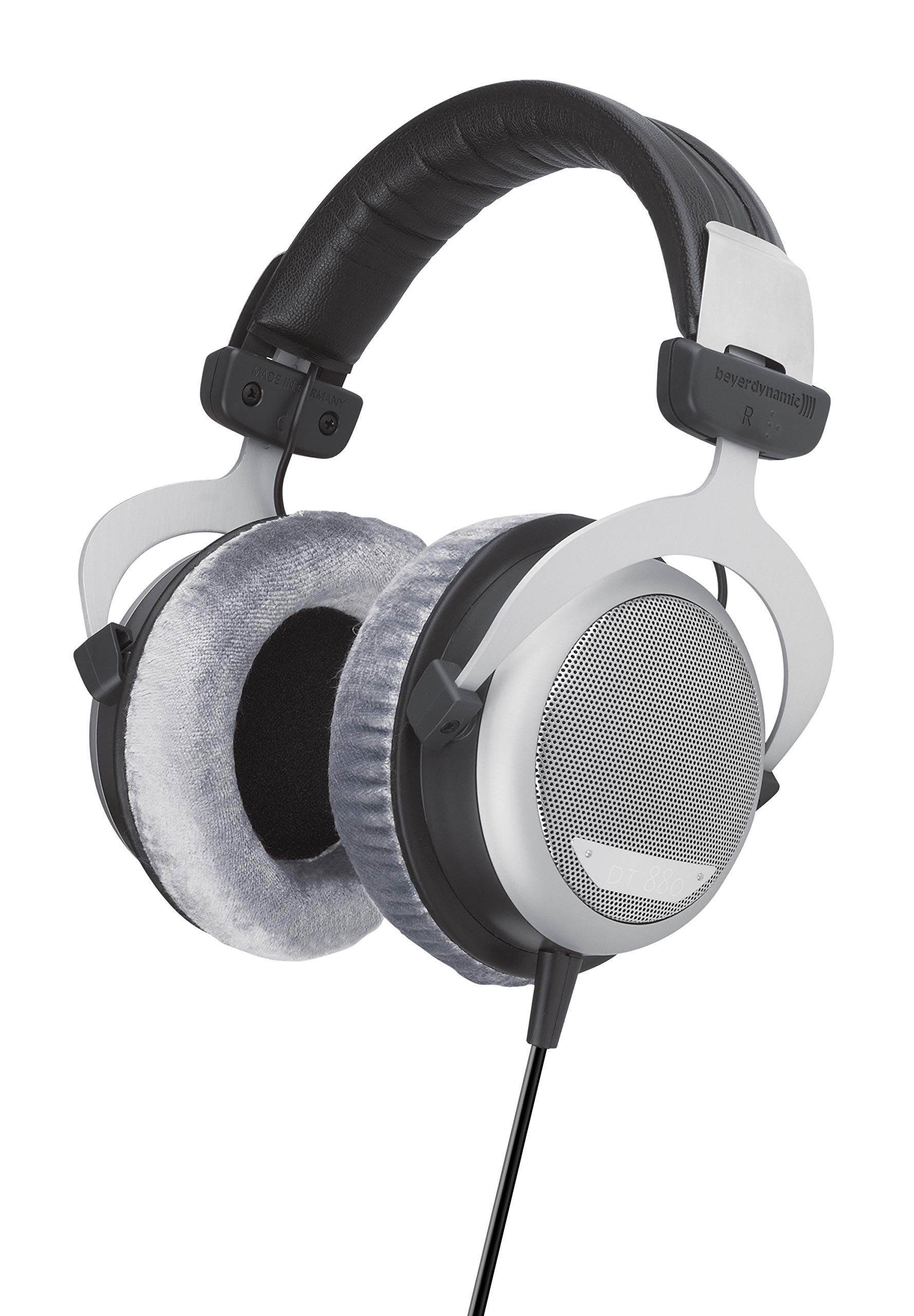
🎶 Elevate your audio game with precision and comfort — don’t just listen, experience every note!
The beyerdynamic DT 880 Edition Semi-Open Hi-Fi Headphones (32 Ohm) combine German engineering with a semi-open design to deliver detailed, immersive sound. Lightweight and comfortable, they are ideal for professionals and audiophiles seeking clarity and a wide soundstage. Compatible with a range of devices thanks to their 32 Ohm impedance, these headphones are perfect for studio work and home entertainment alike.


| ASIN | B0024NK358 |
| Age range (description) | Adult |
| Best Sellers Rank | 3,580 in Headphones & Earphones |
| Cable feature | Tangle Free |
| Compatible devices | Laptops, Desktops, Tablets, Smartphones |
| Connectivity technology | Wired |
| Control method | Remote |
| Control type | Volume Control |
| Customer Reviews | 4.6 4.6 out of 5 stars (2,266) |
| Date First Available | 24 Aug. 2010 |
| Hardware Interface | 3.5mm Audio |
| Included components | Headband |
| Item Weight | 681 g |
| Item model number | DT 880 Premium 32 |
| Item weight | 0.68 Kilograms |
| Material | Aluminium |
| Material Type | Aluminium |
| Number of items | 1 |
| Package type | carrying bag |
| Product Dimensions | 17.78 x 10.16 x 21.59 cm; 681 g |
| Recommended uses for product | Studio |
| Specific uses for product | Studio, Home Entertainment |
| Style | impedance 32 Ohm |
| Unit count | 1.0 count |
| Wattage | 100 watts |
| Wireless communication technology | Bluetooth |
A**J
600ohm - a million positive stars
I like everything about this - made me a complete fanboi. I have an Audiolab 6000a integrated amp and this headphone’s 600 ohm as per my Audiolab’s manual is on the upper end of what the amp can accept - however once connected it manages this headphone brilliantly. My speakers are Kef R3 with a Kef 10 subwoofer. I wished a headphone that would reproduce the same sound via headphones when the family is sleeping, and it sure can!!! If anything this headphone helped me clarify the sound better so that I could then calibrate my subwoofer better when I took the headphones off. I note it seems to play the song as is - ie with no extra colourations - ie when there is good bass, it plays that, etc. However do remember the quality of most recordings is not great - this will clearly show everything as is. But just wait till you hear a good recording and then heaven! On another note, I had no bright treble - but reading reviews on YouTube, some people say if the amp powering this is not powerful enough then only will it sound bright - again not the case for me, unless a particular song is specifically recorded that way. I also like that the ear compression is minimal and the pads do not make my ears hot and with the relatively light weight for this type of headphone - so comfortable that I can fall asleep listening to music. My headphone journey - Sennheiser HD599 which in my opinion sounds garbage in comparison to this. Then I had a Sundara which was very clear but did not have a good soundstage and also my ears became hot after a while with that. Also Sundara heavy. With this DT 880 - loving the improvement in horizontal soundstage even though it has the clarity of the Sundara but not sounding as bright. In a nutshell, if you have something that can power 600ohms, you will not regret buying this and hopefully be most happy having gone for this, as I currently am.
L**R
Stunning detail (600 ohms)
I also have a pair of Sennheiser HD599SE headphones (50 ohms). Similarly priced. I wanted a set of high impedance headphones because the volume is too loud for normal headphones when connected to an Audiolab 8000A amplifier. The DT 880 headphones are a better match to the amp's headphone socket and are significantly quieter than the Sennheisers for the same volume level. When used with a laptop via a Focusrite audio amp, they are too quiet. 600 ohms headphones are, therefore, to be used with either a good quality hi fi amp or via a dedicate headphone amp. The good: these headphones are very detailed and revealing. It is true that they have a brightness to them but that is not the same as saying they are 'bright'. It is easy to pinpoint instruments in the mix and hear them with a distinct quality that is lacking in the Sennheisers. Upon comparison, the instruments can be heard with the Sennheisers but not with the same precision and tonal quality. Percussion is handled extremely well and it is easy to hear intricate high hat details which are lost with the Sennheisers. There is a noticeable flavour to the skin of each drum. Strings are gloriously open. Bass notes are easy to hear without them blending into an overall bass boom. In particular, they excel with upright bass - the decay of each note can be heard and the characteristic of each string heard. You can tell instantly if a bass is electric or upright. The bass register seems to go lower than the Sennheisers too but it is not noticeably pronounced. Piano notes similarly benefit from hearing the acoustic properties of each note. Vocals are superb and intimate. The not so good: These are not 'rock' headphones. They are not bass heavy and thus lack a rock sound stage presence. The stereo sound stage can sometimes lack focus and sound too wide. Pink Floyd was very detailed but suffered from being too left ear/right ear. The headphones benefit greatly from good quality recordings and mixes. They are breathtakingly good with small jazz ensemble, Sinatra, swing and any well recorded acoustically based genre. Some rock/pop recordings sound better than the Sennheisers and it would not be fair to say they are not good for other types of music. Overall, with my somewhat eclectic recording collection, I would say the Beyers sound better with about 70% of my music. When I prefer the Sennheisers, it is not because they ‘sound’ better, it is generally because they handle the sound stage better and tend to smooth any harshness in the production/mix which the Beyers reveal too honestly. Summary: the headphones might sound 'bright' if used after listening to something 'warm'. The same is true vice versa. The 600 ohms version is not suitable for portable devices, laptops, phone etc. as they are too quiet. They excel with tonal quality, detail and musicality. When partnered with good source material, they are superb. The Sennheisers are ideal for YouTube HD listening and other 'device' sourced material. They have a warm balance, are easy to live with deliver a solid all round performance. When that moment to listen to great source material arrives and stunning replication of detail, tone and total immersion is required, the Beyer DT 880 headphones deliver. Build quality is excellent. They are light and very comfy. I wish they had a detachable lead like Sennheiser headphones. When they are good (which is the majority of the time) they are simply excellent. For other times, I would buy a pair of modest headphones.
W**R
Great Cans for the money.
So far so good, I have run them in for about 30 hours and started making a new track using them. The artist I have been listening to so far are Anthony Hamilton Gregory Porter Jagged edge Oliver Heldon London Elektricity Danny Bird Diana Krall Ranging through House, jazz, garage, Soul, folk, drum & Bass, R&B... so a wide selection. Here is what I have found so far. The first thing I noticed was these are very comfortable and could easily be used for a good few hours at a time. The band clings to your head with confidence but never tight enough to make you think your eyes are going to pop out. The sound is warm but not bloated, clear and detailed. You can hear reverb tails on individual sounds fade away to nothing. Kick drums, snares, rim shots etc all start and stop quickly with minimal overhang. Perfect for picking faults out in recordings and mixs. A few things that stand out as negative points, The sound is not as open or articulate as my Grado's. Although the these Beyerdynamic have detail and good stereo imaging, even the cheaper £100 Grado's have a bigger/wider soundstage, and give a better impression that the sounds are in the room with you. Something these Beyerdynamics can only do to a certain point. The Beyerdynamic do have better bass extension then the Grado's though and can go very low without woolyness or bloat. Great Cans, glad I got them but if your after soundstage width and more deep clinical detail try the Grado's..
T**R
To start with, readers of this review must realize that the 250-ohm version of these phones was designed by beyerdynamic to be used with a fairly powerful home audio system. The 32-ohm version was designed to be a better match for the iPod/laptop crowd... of which I am not a member. For me, the reason for this purchase was rather specific: I have a moderately high-end 5.1 home theater setup (Yamaha / Klipsch / Philips / Toshiba / 58" Samsung Hi-Def Plasma), and for quite a while now, I've been looking for a way to watch DVDs and listen to CDs late at night, without disturbing my neighbors (I live in a fairly upscale 55+ mobile home park)... but also without losing the incredibly accurate sound fidelity to which I have become deeply and happily accustomed. Finally -- having read almost every online review that exists of the 880's and their chief competitors -- based on my listening tastes, I decided on the 880 Premiums. Upon first listening to them, I will admit that they seemed to be very slightly treble-heavy -- and a bit light on the bass end. Even so... without any break-in at all, I thought they sounded REALLY amazing -- very clear and clean -- and initially, I honestly could not have been more surprised and pleased. That was two weeks ago. Since then -- while I've listened to a number of CDs and watched several DVDs -- in order to more rapidly burn them in, I've been playing CDs through them almost around-the-clock, with them mounted on a foam cushion, instead of my head. As of this evening, they have accumulated just over 200 hours of use, so I consider the burn-in to have reached completion, and -- as I'd hoped -- the further into the burn-in process the 880's have gone, the more even, smooth and true they've ended up sounding. So, amazingly, what started out as being phenomenally good -- to my ears, at least -- has gotten INFINITELY better! While my DVD collection includes every type of film imaginable, my CDs and music-concert DVDs are primarily jazz and classical. Last night, I watched Pat Metheny's "Speaking of Now: Live" DVD, and even though the spacial representation of DTS 5.1 is lost, the accuracy of sound reproduction through the 880's was flawless, and their sound stage is open enough that I never felt as though I wasn't "in" the film. I also found this to be true while watching my Blu-Ray of "Avatar" the night before; COMPLETELY realistic. Tonight, I watched my Blu-Ray of "Jeff Beck - performing this week... live at Ronnie Scott's", featuring the 20-something phenom Tal Wilkenfeld on electric bass. Let me just say... while many reviewers seem to feel that the 880's bass response is somewhat lacking, I personally am ASTOUNDED at their ability to so clearly define, express, and reproduce every nuance of intonation and touch in the playing (for instance) of acoustic standup bass... right down to the lowest notes of which the instrument is capable. At the same time, neither deep electric bass notes nor loud, low drumtones are ever the least bit harsh, distorted, or uncomfortable in any way... yet they are fully, perfectly, and accurately THERE. Pure pleasure! And while the 880's certainly can't reproduce the (literally) earth-shaking Low Frequency Effects of which my 12-inch Klipsch sub-woofer is capable, the very-low-frequency response of these phones, in the midst of explosive, calamitous film action, is FAR beyond my expectations. Several times now, in fact, in the middle of some on-screen battle or disaster scene, I honestly have spontaneously taken the 880's off my ears, just to make sure that my sound system really was NOT on! Final evaluation: WOW. I absolutely LOVE them! Update, December 13, 2012: By way of reinforcing my conclusions, as represented in the above review, I'd like to add that, over the past eighteen months, I have become so enthralled with the accuracy of sound reproduction of the 880 Premiums, and with how incredibly comfortable they are (again -- so as not to disturb my neighbors late at night -- I often wear them for four or five hours at a time), that I bought a second pair of them a few weeks ago, so that a visiting friend can enjoy a (sometimes exceedingly loud) late-evening film or CD with me. And what's truly nice about that, is that even though we're both wearing headphones, it remains a genuinely "shared" experience... which would not be possible if we were wearing "closed" headphones. Because of the "semi-open" design of the 880s, we are still able to make comments to each other during the film, or carry on normal conversation, without having to remove our headphones or pause the film or CD -- just as we would if we weren't wearing headphones at all. Allow me to repeat myself: W-O-W. I absolutely LOVE these things!
C**R
...das ist eine Frage, die sich in Anbetracht des aktuellen Preisgefüges sicher so einige stellen werden. Auch ich musste mich entscheiden, und habe sie daher aktuell beide hier zum Probehören. Zunächst mal zum Äußeren: Der DT 880 Edition (~160€) tritt hier gegen den DT 990 Pro (~120€) an. Optisch ist der DT 880 der klare Sieger. Abgerundete Kanten, silber, mit Lochblech macht er einen sehr hochwertigen Eindruck. Dagegen der DT 990 Pro mit seinem etwas kantigeren, recht altbacken wirkenden Kunststoffgrill. Einzig das Kopfbügel-Polster des DT 990 Pro gewinnt eindeutig: Es ist weicher und hat schöne Druckknöpfe. Dagegen steht eine art „Zip-Lock“ beim DT 880 Edition und ein insgesamt etwas festeres Material. Möglicherweise ist letzteres ja haltbarer, das wird sich zeigen. Ansonsten ist es ja problemlos möglich, das Polster der Pro-Reihe als Ersatzteil zu kaufen und an den Edition zu knüpfen. Das Spiralkabel der Pro-Reihe ist mir ehrlich gesagt zu schwer und sperrig, ich bevorzuge das gestreckte Anschlusskabel der Edition. Beide sind übrigens mit einem hochwertigen Silikonmantel geschützt, der sich schön anfasst. Insgesamt ist das Kabel aber ein bisschen zu steif für meinen Geschmack. Robust ist es allemal. Im Studio-Einsatz ist ein Spiralkabel aber sicher die bessere Wahl. Ich will den Kopfhörer aber hauptsächlich für Home Recording einsetzen und zum Musik hören. Viel relevanter dürfte aber der Klang sein. Was nützt die schönste Optik, wenn der Sound nicht stimmt. Ich habe so einiges im Vorfeld gelesen: Der 880 sei der ausgewogenste und klangtreuste der Reihe, der 990 habe dagegen gefällig-dezent angehobene Bässe. Manche sagen, beide haben dein „Beyer-Peak“, manche sagen, beim 880 sei er nicht vorhanden oder weniger stark ausgeprägt. Auch über das Thema offen oder halboffen gehen die Meinungen auseinander. Fangen wir hinten an: Gegen Kopfhörer anderer Hersteller würde ich die „Geräuschbelästigung“ der Umwelt sowohl beim 880 als auch beim 990 eher im Bereich „offen“ ansetzen. Halboffene Modelle anderer Hersteller dämpfen das Umgebungsgeräusch meiner Meinung nach stärker. Ob der 880 den Beyer-Peak nun hat oder nicht, vermag ich mangels Vergleichsmöglichkeit oder Messtechnik aktuell nicht genau zu sagen. Klanglich trifft er jedoch genau meinen Geschmack, einen eventuell vorhandener Peak bei 7-10kHz vermag ich nicht wahrzunehmen. Der 990 hingegen klingt unangenehm schrill und harsch in den Höhen, was mir erst richtig bewusst geworden ist, als ich ein bisschen Elektronisches konsumiert habe. Ich komme eher aus der Metal- und Rock-Ecke, und in diesen Genres fallen diese Höhen nicht so extrem auf. Die „dezent“ angehobenen Bässe des 990 sind in meinen Ohren alles andere als dezent. Zunächst mal sei für die weniger versierten Hörer kurz gesagt: von beiden Kopfhörern kann man prinzipbedingt keine Basswiedergabe wie bei In-Ears oder einem Subwoofer erwarten. Klingt der 880 auch „untenrum“ angenehm neutral und ausgewogen, empfinde ich den 990 einfach nur als störend. Ja, es ist deutlich mehr „Punch“ zu hören, aber der „Wow“-Faktor wie bei In-Ears bleibt trotzdem aus. Die Überbetonung liegt eher im Bereich der Tiefmitten statt im Bass und ist schon nach kurzer Zeit extrem Ohrermüdend. Ich habe ein unangenehm drückendes Gefühl im Kopf, wenn ich den 990 höre, während ich den 880 auch nach langer Zeit mit gutem Pegel als sehr angenehm und stressfrei empfinde. Zum Mischen taugt der 990 auf keinen Fall, denn man wird den entsprechenden Bereich unbewusst kräftig beschneiden, um die Hörermüdung zu vermeiden. Auch die harschen Höhen werden den Anhängern der elektronischen Musik matte Mixe bescheren, wenn sie ihr Werk dann auf anderer Abhöre belauschen. Somit ist das „Experiment 990“ für mich gescheitert. Ich war neugierig auf bessere Basswiedergabe und wurde auch noch in den Höhen enttäuscht. Der 880 klingt insgesamt in meinen Ohren sehr ausgewogen und abgerundet und erfüllt alle Erwartungen, die ich hatte. Meine Lieblingsstücke klingen genau so, wie ich es von anderen guten Abhören gewohnt bin. Die Wiedergabe ist nuanciert und detailgetreu im gesamten Spektrum. Beide Kopfhörer habe ich im Übrigen in der 250 Ohm-Version verglichen. Die Treiber sollten zwischen Pro und Edition übrigens identisch sein, sodass die klanglichen Unterschiede für alle 880 und 990 gelten dürften. Kurz noch zur Impedanz: Sogar mein MacBook Air (Anfang 2015) liefert genug Pegel für recht anständige Lautstärke. Ich denke, ein Kopfhörerverstärker ist hier unterwegs gerade so entbehrlich. Klanglich habe ich keinen wirklichen Unterschied zu meinem M-Audio Fast Track bei gleichem Pegel wahrgenommen. Da das Fast Track auf keinen Fall den tollsten DAC hat, werde ich mich beizeiten noch mal auf die Suche nach einem schönen DAC und/oder Kopfhörerverstärker machen und das Ergebnis hier nachtragen, falls sich etwas mit gutem Preis/Leistungs-Verhältnis finden lässt. Kurz noch zum Tragekomfort: Anderswo liest man, dass die Pro-Versionen einen höheren Anpressdruck besäßen als die Edition. Das kann ich zumindest beim DT 990 Pro im Vergleich zum 880 Edition nicht bestätigen. Beide sitzen angenehm leicht auf dem Kopf, aber fest genug, als dass ich nicht das Gefühl habe, dass ich sie in Bewegung verlieren könnte.
F**E
Premessa: questa cuffia che nel mio caso è la versione Edition da 600ohm (ma probabilmente il discorso vale per tutta la linea 880) va accoppiata assolutamente ad un amplificatore hifi, che nel mio caso è, anzi sono: Denon pma1055r e Nad 3240pe. Infatti a differenza di quanto scritto da molti questa cuffia essendo molto lineare quasi trasparente, una volta accoppiata ad un ampli hifi degno di questo nome, va a nozze con musica Rock/Blues; perché ripeto, se si trova l'ampli capace di spingerla quel tantino (visti i 600 ohm) la rendono perfetta a tipi di musica più energici. Aggiungo inoltre che, essendo il sottoscritto anche possessore di una altrettanto meravigliosa Beyer 990 pro da 250 ohm, posso affermare, che questa ultima si trova come taglio sonoro esattamente all'estremo opposto della 880 edition; infatti mentre la 990 pro, che mi accompagna da una decina di anni, ha sempre avuto un accentuato effetto loudness con un enfatizzazione degli estremi di banda che necessitano di un alleggerimento dell'eq (soprattutto se si ascolta appunto Rock) mentre va a nozze con jazz ed acustica in quanto gli dona naturalmente quella leggera spinta che questi tipi di musica (spesso) non hanno, la 880 si trova, ripeto, all'estremo opposto, essendo una cuffia frizzante si ma molto più lineare della 990. Attenzione però: i miei discorsi sono riferiti a chi ha un amplificatore hifi, non a chi le accoppia a schede audio o ad ampli per cuffie (cinesi) molte volte scarsini in corrente e non proprio vigorosissimi. Quindi, se avete un ampli hifi da accoppirgli, ascoltate Rock, blues, forse anche elettronica vigorosa, andate tranquilli, anzi consigliatissima. Al contrario se amate jazz, fusion, acustica, new age andate di 990 pro! Quello su cui mi sento di concordare con le altre recensioni è una certa frizzantezza sulle frequenze alte, ma non eccessiva come riportato da molti, medie al loro posto, bassi un filo arretrati, transienti spaziali, sound stage da cuffia top, insomma se dovessi consigliare una cuffia intorno ai 150 euro sarei incerto tra la Beyer 880 e la 990 pro; dipende in fin dei conti molto dal tipo di musica. Se si vuole però una sola cuffia tuttofare, consiglierei la 880 se si possiede in un ampli hifi, la 990 se si ha solo una scheda audio o un ampli per cuffia. Aggiungo che sono possessore anche di una Sennheiser hd599, una cuffia che proprio non digerisco e che non fa per me, e che proprio non si accoppia ai miei ampli, ma che grazie ai suoi 40 ohm si riscatta un filino accoppiata al mio ipad; ma come per molte altre cose dipende sempre dai gusti. Diciamo che per chi ama il suono "fun" delle Beyerdinamic e non ama il suono "relax" delle Sennheiser queste 880 edition si piazzano in mezzo. Ps: costruzione top! Padiglioni della 880 edition leggermente più piccoli della 990 ma con lo shell in alluminio, cavo dritto fisso: senza infamia e senza lode, archetto buono forse un po' più strettino della 990pro, nel complesso sul versante costruttivo 9,5/10
P**A
Llevo 1 año y cacho de mi compra y les puedo decir que son excelentes no se escuchan tan fuertes por lo mismo de sus ohms pero se soluciona con un amplificador de audífonos
F**S
J'ai pu évaluer ce modèle par une autre voie que l'achat Amazon, car le DT880 reçu était en 32 Ohms. Cette évaluation concerne bien le DT880 en 600 Ohms. L'impédance élevée fait que ce modèle va s'exprimer pleinement sur un bon système sédentaire avec un amplificateur de casque assez puissant, et de qualité. Là, je dois dire que ce DT880 dans les médiums, et par rapport à l'homogénéité globale de la restitution est absolument magnifique, c'est le casque que je garde pour mes écoutes. Tous les genres de musique lui conviennent. Il est un peu sec dans les graves mais par contre ceux-ci ne sont jamais envahissants sur les médiums, et c'est une qualité assez rare en fait. Par contre, il n'est pas physique dans les graves (dans les médiums, si, beaucoup), mais il est capable d'impacter fort sur des grosses caisses, et sur des contrebasses ou autres. L'extrême grave existe, mais si vous recherchez le niveau et le ressenti physique, ce n'est pas le modèle pour cela. Ce DT880 a la pointe à 8000 Hz commune à beaucoup de Beyerdynamic, mais qui reste contenue (rien à voir avec le T90 ou même le DT990). Mon modèle de plus ne doit pas être au bout du rodage, et pour les connaisseurs avertis, il peut gagner avec un recâblage, le cordon Beyer d'origine ne mettant pas complètement en valeur la qualité de ces drivers qui sont d'un très haut niveau. Je le sais, car je connais beaucoup de casques Beyer, dont un 990 250 Ohms recâblé avec du 1877Phono, ce qui lui donne des médiums et des aigus magiques. Le 990 présente une grosse emphase dans le grave et le haut grave qui lui donnent du charme, mais voile le message sur les enregistrements optimistes dans ces fréquences. Il existe des professionnels spécialisés dans le recâblage des casques. La version 600 Ohms du DT880 apporte une rapidité qui s'approche des drivers Tesla de chez Beyer, mais avec plus de naturel, d'homogénéité dans le médium, de sensation de son analogique. Il n'existe pas de phénomènes de halo dans le médium, même sur les forte de piano, ou d'accordéon par exemple, qui sont des instruments qui ne pardonnent pas. Je ne peux pas affirmer que le rendu du DT880 va plaire et convenir à tout le monde, certains vont préférer du Grado, d'autres du Sennheiser, de l'AKG etc... Le DT880 doit être associé à un très bon système pour le mettre en valeur, mais là je vous assure que c'est vraiment un des meilleurs modèles réalisés par Beyerdynamic. C'est LE modèle qui m'apporte le plus de plaisir, et il ne me fatigue pas sur des séances d'écoutes longues. Il nécessite de pousser le volume sur l'ampli, beaucoup plus qu'avec les drivers Tesla par exemple, il a une tenue en puissance importante et est capable de passer la dynamique sans altération avec un niveau impressionnant. Excellente séparation dans les parties très chargées en informations musicales, avec une restitution restant douce, précise, esthétique, incroyable! Un gros défaut, la musique jouée passe énormément à l'extérieur, l'entourage en profite aussi. Si l'on met du volume, on entend à l'autre bout d'une pièce, même le 990 de type ouvert ne me fait pas ça! Cet avis est subjectif, avant tout d'un passionné. Je connais aussi des modèles d'autres marques que Beyerdynamic, mais pas du très haut de gamme comme Audeze ou similaires. Je ne prétendrais pas que le DT880 va égaler ou dépasser des casques high end, mais je suis certain que c'est un très bon modèle, et pour un prix demeurant abordable. Par contre il faudra rajouter bien plus pour l'ampli casque et la source que le prix de ce DT880, il faut le savoir. Sur un smartphone, le 600 Ohms donne un petit niveau sonore avec le volume à 95%. Je déconseille la version en 32 Ohms, prendre le 250 Ohms pour la polyvalence et la qualité. Sur un PC avec carte son correcte, entre un 250 et un 600 Ohms, pas de différence de qualité sonore perçue, volume à 70% sur le 600 Ohms, à 25% sur un 250 Ohms.
Trustpilot
2 months ago
2 weeks ago