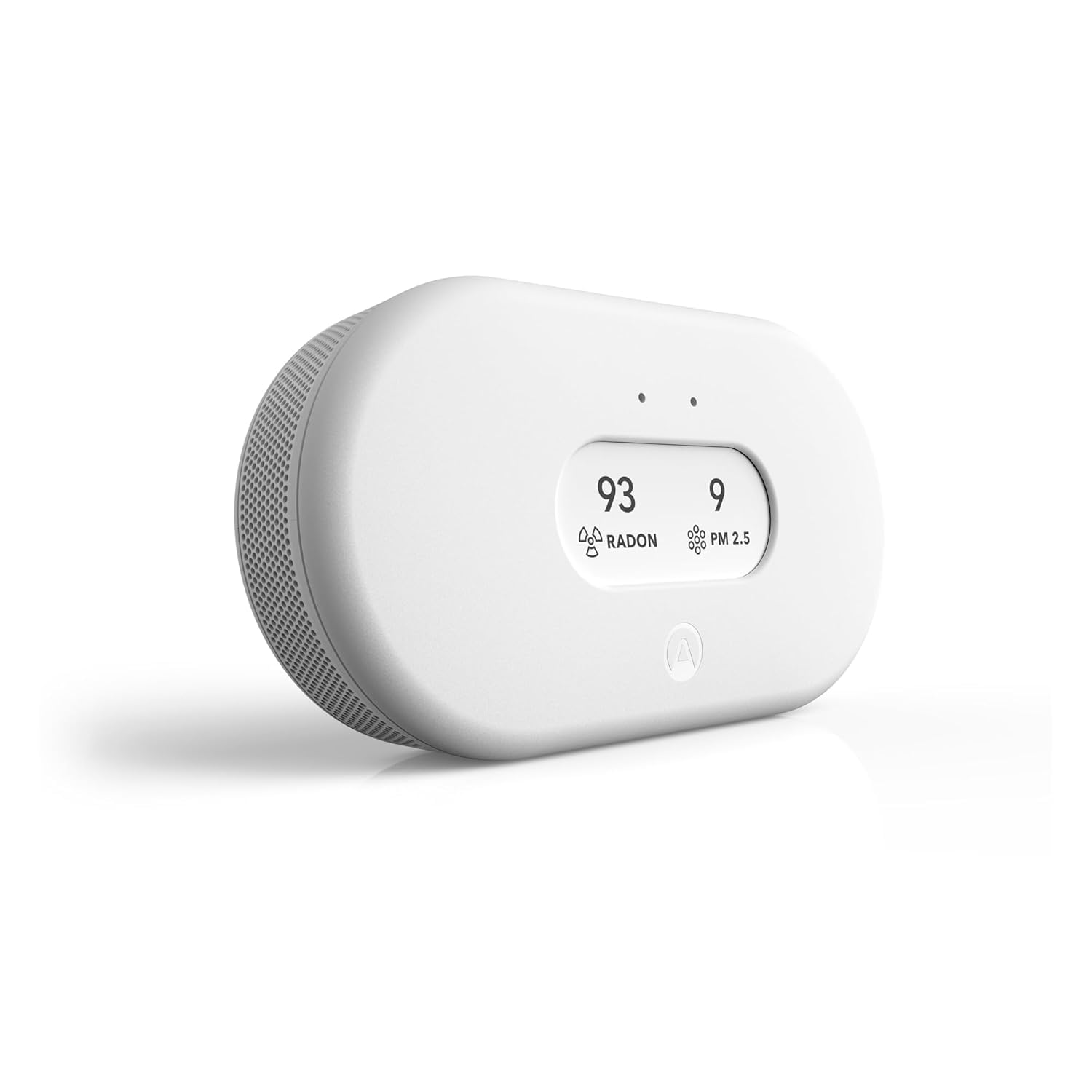


🌬️ Breathe smarter, live better — your home’s air guardian awaits!
The Airthings 2960 View Plus is a premium, battery-powered indoor air quality monitor featuring WiFi connectivity and seven advanced sensors measuring radon, PM2.5, CO2, VOCs, humidity, temperature, and air pressure. Trusted by over a million users and backed by 15 years of expertise, it offers continuous, accurate radon detection—the leading cause of lung cancer among non-smokers—alongside comprehensive air quality tracking. With real-time alerts, a user-friendly app, and cable-free design, it empowers professionals to optimize their home environment for health and comfort with data-driven insights.


| Brand | Airthings |
| Color | white |
| Item Weight | 5.76 ounces |
| Power Source | Battery Powered |
| Product Dimensions | 4"D x 4"W x 2"H |
| Style | View Plus |
J**S
Great product after 6-8 months use, worth the $$$
Purchased this to track radon in our mostly-finished basement area. Wanted (1) A product that was wifi connected that could (2) track radon and humidity levels over a long period of time, (3) offered some kind of long-term dashboard/UI that was easy for human consumption, and (4) gave some level of warning if levels were astronomical. While spendy, this product was one of the only ones to check off all the boxes. I considered going with the bluetooth-only model to save money, but I'm really glad I didn't. The convenience of getting alerts from anywhere, seeing results any time of day or night is really worth the extra coin. I'll admit, Airthings really needs to work on their alerting system. Getting alerts about CO2 when working out in its vicinity, particulate matter alerts when cleaning, it's a bit annoying when the main alerts I want to see are radon and humidity, and I really wish they would allow you to set your own thresholds, but the smartphone app's UI and usability is exceptionally good and the product is easy to work with. My other nitpick would be battery life and/or no rechargeable batteries. The supplied batteries lasted for a solid 100-120 days or so. I replaced with my normal Energizer long-life battery and got maybe 75 days out of those before changing a couple weeks back to the next set. I usually can tell when the batteries are going because sometimes the results get a little crazy. I'd also like smartphone app alerts when the battery levels are, say, below 20% but I don't see that option. I mean, I'd love to just plug the unit into a power adapter and forego batteries totally, but I don't recall if it was an option on this unit, and batteries have sufficed. I may look into that later. Overall though, yes, it's expensive. But for constant monitoring, with alerts, to monitor all sorts of airborne levels, ACCURATELY, there isn't another product on the market I could find. I'm a satisfied customer, with a little polish in a few places, I could really see Airthings becoming a household name to the level that Ring and Nest have become. Great little product here!
M**E
Price was steep, but worth it.
I was hesitant because of price and the description for their own products could be written much better. Everything seems to work well. Takes a week to get Radon and CO2 readings, but it seems accurate or agrees with other sensors I have, and the green/yellow/red alerts lights appear to be set at reasonable levels. Monitoring air quality can tell you much more about what happens in the house than for health and comfort. I use these devices to know when people have the furnace or air condition running with the windows open, and other things are awry once you know how the climate behaves in your house under certain circumstances. Bought a not much cheaper brand INK*** before buying this to replace an Awair, it was defective out of box and alarm lite indicators settings were not practical, so it was returned. Was using the Awair brand a few years before getting this Airthings, then Awair decided to stop supporting the product, so web interface and readings no longer worked. Awair offered to sell an updated unit at cost reduction, I was willing to pay but never happened - Never Awair again. This Airthings unit is same price as Awair products and Airthings appears of better quality, offers more readings and has a little more functionality with respect to the data. I think the display could be better, difficult reading in low light. Nice to have no touch, so less chance to get finger residue on it. Air quality monitoring product cost have skyrocketed in price (now that this is more popular), far more costly then cost to make, this Airthings unit appears to be the best buy for what you get.
A**X
Good until it broke three months later
Initially my View Plus worked great - pairing and setup was simple and the device reported data without any issues. The results looked accurate when compared to other air quality and temperature/humidity sensors that I have in my home. I like the UI in the app and the alerting features. The fact that only two metrics can be displayed on the View Plus device itself is a little annoying, but generally not a problem if you are mostly using the app. All was good until I needed to reconnect the device to my wifi network. At this point, the device was unable to ever find any wifi networks again. This is clearly a device problem since my phone displays 10+ networks available to connect to. After trying the various troubleshooting guides on Airthings support site, trying factory resets, trying to connect with a different phone, using an older app, etc.. the View Plus device is still stuck in a state where it can’t detect any wifi networks and hence can’t finish the setup process. This renders it completely useless and it is not just sitting there as an expensive paperweight. After trying everything, I contacted the customer support via the app. Airthings support is completely abysmal. You will be lucky to get a generic response from them within a week. At this point, I’ve been in a conversation with them where I am lucky to get a response. If it does come - a week later typically after I follow up - the response always begins with “Sorry for the late response” followed by basic troubleshooting instructions that I have mentioned already trying. I have asked for a refund or a replacement device as mine is still covered by their one-year warranty, but this request has completely been ignored by their support team. Bottom line is the device works great initially, but if there is ever a failure with it you are almost guaranteed to be out $300+ while trying to contact an almost non-existent support staff.
N**K
YYYYup
I have had this unit for almost 2 years now, I will buy another. It literally saved my life! If you work from home, like I do, then you need this unit or something like it. I had Radon levels above 7pCi/L and had been living with it without knowing it, for almost 3 years. For those that don't know, Radon is a radioactive breakdown of uranium, thorium, or radium in rocks, soil, and groundwater. The CDC and EPA claim that levels above 4pCi/L are considered highly toxic and proper mitigation should be taken to reduce the levels. This is why Radon mitigation systems are installed in nearly every home across the United States. If you don't know, educate yourself about Radon and understand that radon causes over 21,000 lung cancer deaths in the United States each year and 2,900 of those deaths are people that have never smoked a day in their lives! For me, every now and then, I would cough and a small spat of blood would sometimes appear and i could never figure out why... Now, do you NEED this system? - Absolutely not, there are plenty of radon detectors out there and they are pretty cheap. Why do I recommend this system and why did I choose it? - Historical Data: This bad boy tracks all of your air quality metrics over time. This is extremely important when you want to understand cause and effect in anything in life. Many of the "bad reviews" talk about how some of the metrics displayed are inaccurate when compared to another device that specializes in one or many of the metrics this unit does display. Accurate comparisons only matter when comparing against a controlled environment and are purely for the sake of argument. This is important to understand because no unit needs to be 100% accurate, it just needs to be accurate to itself so that when you make a change, you can properly see that the change is affecting the metrics in a way that makes sense for what you meant to accomplish. For example, I had high radon (the value of the metric didn't matter other than the fact that it is higher than 0... it's radioactivity, is anything above 0 TRULY acceptable?) When I installed my radon mitigation system, I could watch my Radon levels drop tremendously over time, which proved that my radon mitigation system was actually working as expected! Also, I haven't had any spots of blood appear when I cough... I call this a success. - Dashboard: Airthings has a nice application and semi-customizable dashboard which makes viewing really easy to do, and from anywhere in the world. When my pets are home while the family is away, I can notify my neighbor to open a window to let some fresh air in, while we're away. - Alerts: Always cool to have alerts so you don't even need to "monitor" the metrics. Fun fact, CO2 builds up pretty rapidly in a well-sealed home. When you go through insulation techniques to seal off cracks and crevices to improve your HVAC efficiency in the thermal zone, it is easy to forget that CO2 has no easy escape. Needless to say, this little guy alerted my phone and I was able to crack a window and keep my family safe. I later installed a fresh air intake on my HVAC system and again, could watch the metrics historically, as they fell to a more than acceptable range, yet again proving that my air intake installation was actually doing its job. I hope this helps anyone looking to decide on this purchase. It has been an absolute godsend to have in our home and I didn't even get into some of the other things it helped me solve that had been plaguing us.
M**E
Good idea and nice integration
The View Plus (2960) measures radon, PM, CO2, VOC as well as humidity, temperature and pressure. It also can display outdoor weather and temperature in areas where that service is available. We have it in our bedroom to keep track of indoor air quality where we spend 1/3 of every day. It's also great to see the outdoor temperature next to the bed when we wake up in the morning. I originally purchased the View Plus (2960) and one Wave Radon (2950) detector because we live in a high radon area (central Ohio). The 2960 has Wi-Fi and will collect data from other AirThings products and upload it to the AirThings dashboard. The wireless communication between the 2960 hub and the 2950 sensors is a proprietary protocol using the IEEE 802.15.4g standard. This is similar to Zigbee, INSTEON and Nest Protect home automation products. Based on my experience with other home-tech devices, I downloaded the app, and had all the devices near each other when I configured them. So, I had no difficulty setting them up. But wireless interference could be a problem and all of mine are within 50 feet of the hub. We put the 2950 in the basement. The dashboard is very helpful with radon because radon varies from hour to hour, day to day and seasonally. It is the long term average that indicates whether a health risk exists. I have a home office in the basement, and I've included a snippet from the dashboard of the radon levels recorded from late January through November 2022. This shows the variation, and how bad the levels were (over 22 pCi/L). Once we installed a mitigation system, the levels have dropped below 2 pCi/L. After the initial two weeks and I saw how bad the radon was, I purchased a second Wave Radon (2950) detector to have units in two parts of the basement (crawlspace and home office). After three months of monitoring, I was convinced we had a problem and we scheduled a radon mitigation contractor which was completed a few months later. After 8 months, I had a problem with the 2960. It showed really large numbers, then 0. I had already installed a mitigation system, so this was confusing. I purchased an AirThings Corentium to put side by side with the 2960, and proved to myself that the unit indeed was defective. The support person who originally picked up the ticket did nothing, and email for warranty service was ineffective. So I mentioned this in my previous review (since replaced with this one), and within two days a good support agent picked up the ticket, and helped me with the RMA process. It was disappointing that the unit failed, and that initial support was not helpful. However, the second agent was proactive, professional and communicated well and I was able to return the 2960 for a replacement unit. I've had the replacement for a week now, and it seems to be working fine. Based on the excellent response from the second agent, I will continue to recommend these products to friends. I can't quite give the product 5 stars because of the failure of the first agent, and the initially nonresponsive warranty process. However, if the product continues to do well, I can see myself raising the rating back to 5 stars at some future date. As a final note, if you are not sure if you need radon mitigation, and are wondering whether you should spend the money or are just technologically afraid, the AirThings Corentium is a great product too. It has no smart phone or Wi-Fi integration, but is a simple-to-use product that utilizes the same sensor that is in the 2950 and 2960 and gives 1 day, 7 day and 30 day average readings.
A**R
Multiple sensors with good user interface
Tl:dr I recommend this product. I believe that it is currently the best on the market and provides a good array of sensors for the price. I have not received any financial or other consideration for this review. I have no connection to the company. Details, positive and negative, are found in the review. Intro: In operation (after 7-day calibration) for three weeks beginning October 2021. Unit is located indoors in the bedroom of a small single-story home in northern California. I purchased View Plus after an online evaluation of competitive units. The purchase decision was based on the array of sensors, acceptable display of sensor parameters, appearance of a good user interface, ability to easily download the data in Excel .csv file format, designed in Norway, and assembled in Tunisia (visible in product photos). I expect that this is the first product that I’ve ever owned that was assembled in Tunisia. There were no Amazon reviews as I purchased the unit as soon as it became available. My primary motivation for purchase was to measure indoor particulate pollution during the wildfires. I wanted a more quantitative measure than the colored indicators on our air purifiers. However, I have since become more interested in the carbon dioxide (CO2) and VOC levels. The inclusion of Radon, temperature, humidity, and atmospheric pressure sensors is a plus. Particulates: I have had an extended conversation with Airthings via the app. They are responsive, although it may take a few days or even a week, if you ask technical questions as these need to go to the engineering team. As this is a consumer and not scientific device, there are cost limits on the nature of the particle sensor. Airthings does calibrate the particulate sensor to a scientific instrument. However, the Airthings sensor is most likely not able to distinguish between different particle size and scattering distributions that give the same overall signal. I had plans to do a cross correlation study with a scientific instrument, but circumstances conspired against me. At this time, I am satisfied that Airthings has done enough work that the threshold limits (green <10, yellow <25, and red >25 µg/m3) for the PM 2.5 sensor are reasonably close to the equivalent limits used by the US EPA and European PM 2.5 AQI. For the data that I’ve collected, there is very little difference between PM 2.5 and PM 1 signals. I have not investigated why. One caveat is that the data collected so far has an average PM 2.5 and PM 1 values of only 2 µg/m3 and only a single peak greater than 25. Since the rains have (finally) come, I don’t expect to have the opportunity to check against more polluted air conditions in the near term. Carbon dioxide: This provided the most surprise about the conditions in our home. I found that ventilation in our bedroom is insufficient to keep levels in the green without the window(s) being open at night. I am looking into ways to ameliorate this problem when keeping the windows open is not an option. When I first received the unit, I placed it outdoors to see if it would read the expected value of about 400+ ppm for average CO2. The unit read about 550, but it was before the 7-day calibration was completed. Over the course of the past month, when the room was well ventilated, I observed readings as low as 469 ppm. The unit will show the increase in CO2 when either 1 or 2 people are in the unventilated room for any significant period of time. VOC (volatile organic compounds): The measurement is in parts per billion, ppb. This is my first experience with VOC data recording. The unit is certainly responsive and exhibits significant signal when we are cooking, especially frying. As there are many different types of VOC, I cannot comment on whether one should take significant actions based on the results in the home. Do fry-cooks have career related health issues? At a work environment, such as an organic chemistry lab, there may be many types of VOCs that are clearly harmful to health. Radon: All the values that I have recorded are below the green threshold limit of 2.7 pCi/L (picocuries per liter). The average value over 2000 measurements is 0.7 and has a standard deviation of ±0.4. Temperature: Comparing the value to household sensors indicates that the temperature displayed by the Airthings sensor maybe between 1- or 2-degrees F high. However, I consider that within measurement error for accuracy given the nature of the other sensors. Precision appears to be excellent. Relative Humidity: Comparison only with household sensors. Appears to be within a few percent. Atmospheric Pressure: Excellent agreement (within 0.5 mBar) with external values (local weather data). Range of data recorded between 1001 mBar and 1022.5 mBar. User Interface (Unit): There is an E-Ink type display that is not illuminated. This is a very low power display and conserves battery. No power used to maintain the current display reading. It has high contrast and easy readability. You can choose 2 sensors to display via the app (Phone or PC). When you wave your hand in front of the unit, it indicates its assessment of the overall air quality (good, fair, or poor) and shows any of the readings that cause a fair or poor result. It then returns to the standard readout. I have not found the lack of illumination to be detrimental. User Interface (Phone): I’m using a Samsung Galaxy A51 with Android 11. The software allows you to choose among several devices that you might have. As I have only one, it displays a summary that is in the attached photo. You can then tap “VIEW IN WEB DASHBOARD” to get graphic displays for different periods of time. You can choose to get notifications via the app, if values exceed the Airthings recommended thresholds. You can choose the sensors for which to have notifications sent. These thresholds cannot be changed. I think it would be good to be able to change the thresholds with the understanding that one is responsible for the values used. User Interface (PC/Web): I’m using an Intel-based PC running Windows 10 Pro and MS Edge for this unit. See attached photo. The graphing is generally quite good. I’d prefer to be able to choose the order in which the different sensors are displayed. It might be possible to do this by deleting sensor graphs (called tiles) and then adding them back. I’ve not tried that. The vertical scaling is automated and determined by the range of values of the data being displayed. The scale cannot be changed, but you can zoom using touch, if your computer/phone has that capability. Adding the historical data (not shown in the photo) will expand the vertical size of each graph and give the minimum and maximum value for the data range. Bug: You can add a tile for the outdoor weather, but only for Oslo, Norway! They have given me instructions for changing the location, but the software for the View Plus is not the same as for the software shown in the instructions. I have made them aware of this. It is unclear to me whether they can and will offer software updates. Downloading Data: The .csv file contains the time and sensor data for the entire time the system has been recording for that location. If I don’t do something to re-start history, the data file will eventually grow to unmanageable size. They should allow you to specify the range or use the range chosen for the graphing display. The file name is also fixed as the serial number of the unit. These are serious limitations given the extra work caused for the user, I consider them bugs. The data are separated by semi-colons, so converting from text to columns in MS Excel is easy. The data are recorded with a UTC time stamp. Since I’m in California, it is easy enough to subtract 7 hours and put the local time in the next column. The headers have a few character-conversion bugs: “μ” instead of “µ.” The character “” is inserted in the Temperature column header. These are minor. The date/time format is 2021-09-30T20:04:28. The “T” separator is a nuisance and prevents Excel from recognizing the form of the data. If they would replace the “T” with a space, then Excel would have no trouble. I use the replace function to do this. Again, it is no big deal, but should be a simple fix. I have made Airthings aware of these bugs. I will append this review, if I find additional information that may be pertinent to other users. I hope this has been helpful. Appendix 1: I've added a comparison of the PM2.5 data from the Airthings View Plus (indoors near an open window) to Purple Air data from an outdoor sensor (not mine) about 100 meters from my home. The Purple Air data are shown in the US and European scales. The data are for the 24 hours of October 29, 2021. Correlation is excellent for the main peak.
A**R
Great all-in-one air quality monitor
I’ve been using this to keep an eye on indoor air quality in our house, and I’m really glad I got it. It tracks radon plus CO₂, VOCs, particles, humidity, etc., which is exactly what I wanted without having multiple devices. Setup was easy and I like that it’s battery powered so I can move it between rooms. The app is straightforward and the trend data is helpful — it’s less about one random number and more about seeing what’s actually happening over time. It just sits there quietly doing its job, which I appreciate. If you care about what the air inside your home looks like (especially with kids), this feels like a solid, no-drama option.
J**E
Awesome App and Pretty Accurate sensors. Overall a great monitor for the home
I have three of these, one for each of the floors in my home. It wasn't cheap, but I wanted to understand level by level how my air quality and radon moved throughout my house. It's been really insightful to see how cooking on the main floor affects the other floors, and see the radon start in my basement and get trapped on the top floor by my HVAC when it kicks on. Having the app and online historical data also allows me to see how pressure affects radon when the weather changes and how opening a window in the basement affects the other floors in the house. Lastly, the alerts are really nice. At some point you'll stop checking the app every 10 minutes and you'll get an alert letting you know that VOCs have spiked and you'll realize you didn't turn on the fan when cooking. Those little things all help you understand air quality and correlate your actions/items in your house to changing air quality. Overall I'm very satisfied and love the Airthings View Plus. I use all of them as stand-alone reporting, and none of them are hubs. The one thing that I've been disappointed with is the battery life. The batteries it comes with only lasted 6 months in the two units that are further away from my wifi, and the third unit that's very close has about 15% battery life currently and is 7 months in. So I suspect it might last 8 or 9 months if I'm lucky. I put better Duracell batteries in for replacements, so we'll see if that makes a difference, but I was hoping for at least a year out of them. I'll update this review maybe when they're at 50% battery life on the more reliable Duracell batteries with their projected life span. I've recommended these to a lot of friends and family. There may be a little more accurate units with sensors in them, but for ease of use, reliability, and consistency... I'd definitely buy these again. 10/31/2023 Update. Everything working as expected. I continue to appreciate this purchase. Of the two units that are further away from my wifi, their batteries are dead again, giving me about 7 months out of the Amazon Basic batteries I put in them. I noticed that Airthings added an option within their settings for Battery Life Extension. They can now send data every 60 minutes vs every 10 minutes. They project this will give you 36 months of battery life vs "8 months of battery life" with sending data every 10 minutes. I appreciate this option and it seems they have adjusted their battery life expectations to something more realistic and that aligns with what I'm experiencing.
Trustpilot
4 days ago
1 month ago