
DOWNLOAD THE APP


Customer Services
Copyright © 2025 Desertcart Holdings Limited
DOWNLOAD THE APP
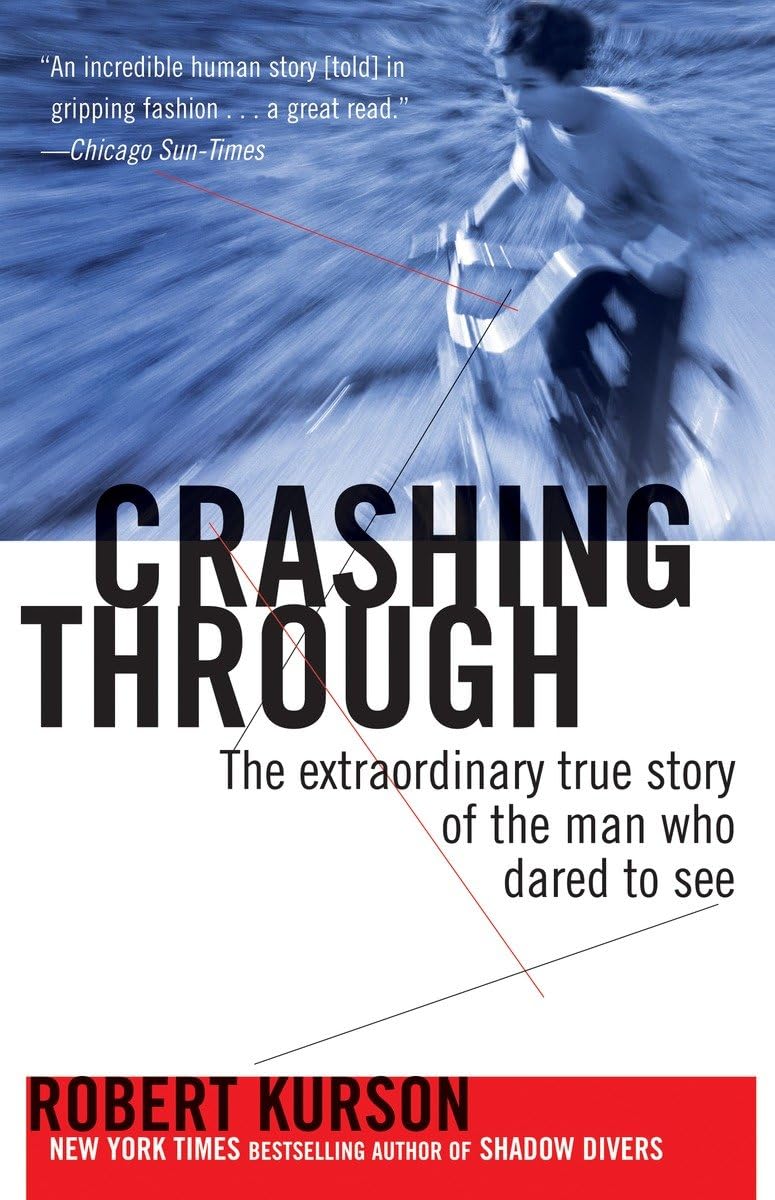
Crashing Through: The Extraordinary True Story of the Man Who Dared to See [Kurson, Robert] on desertcart.com. *FREE* shipping on qualifying offers. Crashing Through: The Extraordinary True Story of the Man Who Dared to See Review: Great read - Read this book during a college course on visual impairments and at the time I wasn’t into reading but I found this to be a great book. Inspiring, written well, gives you perspective, I’d recommend! Review: Another outstanding read - Crashing through is Kurson's second book. His first book, Shadow Divers, is a must read for all men. 'Crashing Through' is very well written and educates the reader about sight, seeing, and all that goes into that complicated process as well as describes the heroic life of one who moves from blindness to sightedness. I enjoyed the history and education of the various medical approaches to sight and what it was like for one to have lived in both worlds The book moves quickly, keeps the readers attention, as well as educates.
| Best Sellers Rank | #555,370 in Books ( See Top 100 in Books ) #187 in Disability Biographies #275 in Scientist Biographies #287 in Medical Professional Biographies |
| Customer Reviews | 4.5 4.5 out of 5 stars (644) |
| Dimensions | 5.19 x 0.74 x 8 inches |
| Edition | Reprint |
| ISBN-10 | 0812973682 |
| ISBN-13 | 978-0812973686 |
| Item Weight | 9.4 ounces |
| Language | English |
| Print length | 328 pages |
| Publication date | August 19, 2008 |
| Publisher | Random House Publishing Group |
B**.
Great read
Read this book during a college course on visual impairments and at the time I wasn’t into reading but I found this to be a great book. Inspiring, written well, gives you perspective, I’d recommend!
R**E
Another outstanding read
Crashing through is Kurson's second book. His first book, Shadow Divers, is a must read for all men. 'Crashing Through' is very well written and educates the reader about sight, seeing, and all that goes into that complicated process as well as describes the heroic life of one who moves from blindness to sightedness. I enjoyed the history and education of the various medical approaches to sight and what it was like for one to have lived in both worlds The book moves quickly, keeps the readers attention, as well as educates.
S**U
Do not take 'seeing' for granted!
This is the incredible true story of Mike May who, at age four, lost his sight to a chemical explosion. All doctors had told him then that he would never again regain his sight. And he didn't particularly want to. He often said at lectures that being blind was great. Some in the audience believed him; others were skeptical. Being blind did not stop him from enjoying the everyday activities we all take for granted. He would travel by airline; walk in the woods, and venture anywhere he desired without fear. He often said that getting lost is discovering. He loved the adventure of finding his way. He even went snow skiing. Amazingly, he holds the blind skiing speed record of 65 miles an hour. Despite being blind, Mike May lives the full life. According to May, most blind people do not want to see. He asks, "Would you want to have a psychic power?" This question made me think a lot. If a doctor today told me that he could perform surgery on me and make me communicate telepathically with other people, would I want to do it? The answer is not as simple as one would suppose. When a blind man is confronted with the possibility of seeing, to him or her seeing becomes like an added psychic power. Another analogy would be the inner eye, or what Hindus would refer to as the third eye. Most of us cannot `see' with the inner eye, let alone know of its existence. Yet we are quite satisfied with our current vision of the world. Hypothetically speaking, if you were offered to see with your inner eye, would you jump at such an opportunity or are you content with your current sight? I do not find it hard to believe that many blind people are quite content being blind, and won't particularly jump at the opportunity of seeing. In fact, many blind people who did end up seeing became severely depressed and even suicidal. In one famous case, a blind man who suddenly was given back his sight became so depressed that he died shortly thereafter. May's early life is quite fascinating. When he was still in school, he volunteered to flag children to cross the road. At first the headmaster categorically refused, thinking such an idea preposterous. But May convinced him, citing his sharp hearing. He could actually hear cars coming. Furthermore, there was always an adult teacher present at the road crossing. May became a school Crossing Patrol Officer! His brothers were pretty mean to him. They sometimes gave him dog food to eat, and gave him socks with each pair a different color to wear to school. They also cheated on board games when they played with him. Being blind he was at a disadvantage with his brothers, but it seems like he enjoyed every minute of it. Chris May gained a scholarship to study in Ghana as part of a student exchange program. He says that people there were scared of his walking dog, and some thought his dog was food! While in Ghana, May also became the first blind CIA employee. What better agent for the CIA than an inconspicuous blind man? He also helped build a school. His stay in Ghana however did not last long. He contracted malaria, and if it wasn't for the quick intervention of a man said to possess supernatural powers, May could have died. However, his left eye became infected, and had to be replaced with a prosthetic eye. May loved beautiful women, and he liked to be in their company, for this made no one think he did not know better. He never pretended to touch women's breasts by pretending he thought it was the doorknob, like some mischievous blind men did. He married Jennifer and had kids. His first business selling music LPs went bankrupt as music CDs took over the market. He then went into the business of selling GPSs for the blind, but this business too was soon in trouble. He couldn't sell any to governmental agencies. They saw no use to a GPS guiding the blind when using a cane was cheaper! May also had problems in his marriage. His marriage became a hassle, and it just wasn't working. He and Jennifer were not happy together, and they ended up seeing a counselor. But they did manage to survive this rocky time in their life. When May was 46, an ophthalmologist told him a new stem-cell and cornea transplant could restore his vision, but that it carried risks with it. One side effect of the drugs he would have to take was cancer. May weighed all the cons and pros of such a surgery, and finally agreed to have a go at seeing. He wanted to know what seeing was all about. The book really gains steam after May regains his sight. His description of what he saw and how he felt about what he saw is just poetic. For example, he found beauty in a simple rug at the doctor's office that most patients didn't even notice. In other words, we take our sight so much for granted that we stopped enjoying the beauty of seeing! He describes people as, "they come in all sizes." The heavy people looked like two people stuck together (just fun fact: Waist to hip ratio should be 0.67). He had never seen a blind man before, and was amazed at how differently they walked, and at their facial expressions. To him, their faces looked like they were battery-powered. He cried when he saw a homeless person, not believing our society could let down people to such a desperate state. He describes his first sexual experience with his wife after regaining his sight. Sex became a sensual and visual experience for him. He describes his feelings when he first saw his own blood and urine. He tells us how, despite seeing, he did not want to abandon his seeing dog Josh, and always took him with him when he went walking. He tells us how shadows were a real problem to him, for he saw them as solids. For example, curbs in the street looked flat, so he often stumbled on them. Furthermore, when he skied, shadows from the cable cart above and from other skiers looked like a solid thing moving towards him. Seeing was like learning a new language. Faces meant nothing to him. He distinguishes between a male and a female by their shoes--he knows that females wear colorful shoes. On flights, he didn't know how to tell flight attendants from passengers. He later differentiated them from the passengers by singling those who wore the same clothes! He explains how he was ordering the world to come to his eye, rather than the other way around. Furthermore, May needs to touch things to really see them. The book goes on to talk about the science behind seeing, and that chapter was probably the most fascinating of all. A third of the brain is involved with seeing. May is poor at seeing detail. This is because his brain takes a low resolution picture, and it can only sharpen the edges. He only really sees when the object is moving, for this produces depth. But what is really fascinating is that knowledge is needed to really see. For example, why can't we differentiate between the faces of animals? Shephards, in fact, can recognize sheep by their faces. This is because they spend so much time with them that the sight of them becomes linked to the knowledge of them. Neurons in our brain record this knowledge and help us see the thing we are looking at for what it is, based on our knowledge of it. Since Chris May did not have this knowledge recorded in his brain for over 43 years, his brain could not `see'. His brain did not have the neurons with this knowledge, and no new neurons could be generated by his brain (only the brain of children can generate new neurons). This is why to May seeing was exhaustive. Sounds a bit complicated, but the book will make it quite clear to you. After 9 months of seeing, his body was rejecting his cornea. Rejection came on as a storm. He started on immune-suppressant drugs, and he feared that he might lose his sight again. He felt guilty that he too took his sight for granted, and neglected to see the great pyramids in Egypt, the Galapagos Islands, and the school he helped build in Ghana. Luckily, though, the drugs helped, and his body accepted his eye. `Having vision is great. Being blind is great too!' says May.
D**Y
Can't Recommend this Book Highly Enough!
Crashing Through by Robert Kurson is a simply monumental achievement. Kurson did an amazing amount of work in the course of composing this book, from the extensive interviews with Mike May and his wife, friends, doctor and vision researchers, to the reading of several scientific books, articles, papers, and pamphlets in the field of vision research and restoration, and it shows in the finished product. The story of Mike May's loss of sight, his life without sight, and his courageous decision to work through the process of regaining sight is an engaging page-turner of a story. The man and the way he lived are fascinating, and the way he "crashed through" his obstacles is inspiring, as he would repeatedly state, "There's always a way." Kurson brings a great deal of technical explanation and anecdotal background into the middle of the story, as he describes, in detail, and in ways understandable to the layman, the procedures and difficulties involved in methods used to restore sight, and the perceptual problems faced by those who regain their sight after a long period of blindness. Reading of the cases of Mike May and others who regained sight after long-term blindness was fascinating and deeply thought-provoking for me. What more can really be said? Read this book. It is absolutely a 5 out of 5. Crashing Through is uplifting, fascinating, inspiring, and profound. There's very little, if anything, in it that could offend anyone, and I'd recommend it to really everyone, teen and above, across the board.
J**S
Read. This. Book!
I'm sitting here with tears running down my face (some books make me tear up a little or choke up but not very often will I have tears running down my face!) because I've been so moved by his conversations with his sons, and then the next paragraph has me laughing. It's truly a wonderful book. Very scientifically interesting but explained simply. Very emotionally engaging, in this man's relationship with his wife and two boys, and his myriad friends. Very sexy in appropriate places. Yet tasteful. This man, as other reviewers have said, is an amazing person. I haven't finished the book yet; I just felt compelled to write a review while it was fresh in my mind. It definitely makes me appreciate vision more, and want to take care of my eyes. And my brain. The book makes the importance of the brain to vision, really come alive. And makes what our eyes and brain do all the time without conscious thought, so awe-inspiring.
J**O
Problem- blindness. Simple Solution-? Sight. Before reading this book I thought of being blind as a negative- its not! I also thought that seeing was easy- its not! I am genuinely surprised and challenged by what I have learned from this book that is written in such a clear way, explaining the technical superbly. Sometimes we need to hear about awesome people doing awesome things when faced with great challenges, and this book has reminded me of just how intricate and amazing human beings are. A brilliant true story, superbly told.
ア**郎
盲目のスキーヤーが居るということを誰が信じるだろう。 パラリンピックにもそんな種目は無い。 また、視覚情報をごく一般的に認知するために触覚他の知覚が必要だということ、赤ちゃんが何でも口に入れることが成長の過程において必要であることが著者の視力回復という事から分かる。 著者の好奇心に満ちた行動が私たちの好奇心も満たす。 翻訳本はあるのだろうか?
D**S
Arrived undamaged.
P**K
Good story, hard to follow at times.
A**P
amazing story
Trustpilot
5 days ago
1 day ago