
DOWNLOAD THE APP


Customer Services
Copyright © 2025 Desertcart Holdings Limited
DOWNLOAD THE APP


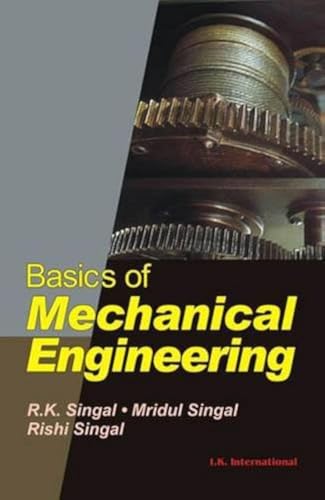

⚙️ Unlock the power of mechanics — your engineering edge starts here!
Basics of Mechanical Engineering by R.K. Singal is a comprehensive 624-page paperback that covers fundamental mechanical engineering principles, including thermodynamics and heat transfer. Highly rated by readers, it serves as an essential resource for engineering students and professionals aiming to master core concepts and excel in their careers.
| Customer reviews | 4.5 4.5 out of 5 stars (58) |
| Dimensions | 15.7 x 2.9 x 23.8 cm |
| Edition | Standard Edition |
| ISBN-10 | 8189866206 |
| ISBN-13 | 978-8189866204 |
| Item weight | 698 g |
| Language | English |
| Print length | 624 pages |
| Publication date | 30 December 2013 |
| Publisher | I K International Publishing House Pvt. Ltd |
S**9
This is a very comprehensive study book for an aspiring engineer, engineering student, or professional engineer. The book is well-laid-out with many graphs, problems, and descriptions of a numerous quantity of topics. It is split into three topics: Thermodynamics, Engineering Mechanics, and Strength of Materials. Each section has numerous sub-sections and the content is very well done! To see the full table of contents, continue down the review past this part of the review. My only complaint is that it is not a hard-cover book, so after a few times reading through it, it is going to be well worn. However, this book is very well put together and I am impressed with the content that is has! I would highly recommend this book to anyone who needs to gather information about mechanical engineering. If this review was helpful, please click the appropriate button below the review. Thanks, and have a great review. Continue reading to see the full table of contents. Table of Contents: PART I: Thermodynamics 1. Fundamental Concepts and Definitions 1.1 Thermodynamics 1.2 Scope of Thermodynamics 1.3 Study of Thermodynamics 1.4 Types of Systems 1.5 Study of System Matter 1.6 Thermodynamic Properties 1.7 Thermodynamic Equilibrium 1.8 Thermodynamic Processes 1.9 Forms of Energy 1.10 Enthalpy of an Ideal Gas 2. Laws of Thermodynamics 2.1 Significance and Scope of Laws 2.2 Classification of THermodynamic Processes 2.3 First Law of Thermodynamics 2.4 First Law Analysis of Processes for Ideal Gas 2.5 Summary of Thermodynamic Relations for Non-flow Processes 2.6 Steady Flow Processes 2.7 Throttling Processes 2.8 Steady Flow Energy Equation 2.9 Applications of Steady Flow Energy Equation 2.10 Performance of Heat Engine 2.11 Equivalence of Second Law Statements 2.12 Carnot Cycle 2.13 Carnot Theorem 2.14 Clausius Inequality 2.15 Concept of Entropy 3. Properties of Steam 3.1 Introduction 3.2 Applications of Steam 3.3 Steam Generation 3.4 Important Constants 3.5 Thermodynamic Properties of Steam 3.6 Mollier Diagram 3.7 Vapour Processes 3.8 Steam Power Plant 3.9 The Carnot Vapour Cycle 3.10 The Rankine Cycle 3.11 Comparison of a Carnot Cycle and a Rankine Cycle 4. Internal Combustion Engine 4.1 Introduction 4.2 Types of I.C. Engines 4.3 Basic Arrangement 4.4 Engine Performance 4.5 Four-stroke Petrol [gasoline] Engine 4.6 Four-stroke Diesel Engine 4.7 Comparison of Petrol and Diesel Engines 4.8 Two-stroke Petrol Engine 4.9 Two-stroke Diesel Engine 4.10 Comparison of 4-stroke and 2-stroke Engines 4.11 Relative Merits and Demerits of a Two-stroke Engine over a Four-stroke Engine 4.12 Air Standard Cycle 4.13 Otto Cycle 4.14 Diesel Cycle Part II: Force and Structure Analysis (Engineering Mechanics) 5. Force and Equilibrium 5.1 Introduction 5.2 Laws of Mechanics 5.3 System of Forces 5.4 Composition of Forces 5.5 Resolution of a Force 5.6 Moment of a Force 5.7 Principle of Equilibrium 5.8 Equilvalent Systems 5.9 Support Reactions 5.10 Free Body Diagram 6. Friction 6.1 Introduction 6.2 Types of Friction 6.3 Coulomb Laws of Friction 6.4 Equilibrium of Bodies Involving Dry Friction 7. Beams 7.1 Introduction 7.2 Types of Beams 7.3 Statically Determinate Beam 7.4 Support Reactions 7.5 Shear Force and Bending Moment 7.6 Shear Force and Bending Moment Diagrams 7.7 SFD and BMD for Standard Cases 8. Trusses 8.1 Introduction 8.2 Types of Trusses 8.3 Analysis of Simple Plane Truss Part III: Stress and Strain Analysis (Strength of Materials) 9. Simple and Coumpound Stresses and Strains 9.1 Introduction 9.2 Loading of an Elastic Material 9.3 Shear Stress 9.4 Comparasion of Normal and Shear Stress 9.5 Stress-strain Curve 9.6 Ductile and Brittle Materials 9.7 Elastic Constants 9.8 Members of Varying Cross-section 9.9 Extension of Bar Under Own Weight 9.10 Strain Energy 9.11 Compound Stress and Strain 9.12 Determination of Principal Stresses and Strains 9.13 Oblique Stresses 9.14 Mohr's Cycle 10. Bending and Torsion 10.1 Introduction 10.2 Theory od Simple Bending 10.3 Bending Equation 10.4 Section Modulus 10.5 Torsion of Shafts of Circular Section 10.6 Power Transmission 10.7 Assumptions in Pure Torsion of Circular Shafts 10.8 Torsional Shear Stress 10.9 Torsion Equation for Hollow Circular Shaft 10.10 Polar Section Modulus 10.11 Strain Energy Due to Torsion 10.12 Comparasion of Solid and Hollow Shafts 10.13 Comparasion of Bending and Torsion
M**G
If you know some calculus and basic physics, this is a very good book. But it does require some math knowledge to fully understand. This books stresses the transfer of heat into mechanical work. I very highly recommend this book for those with math skills, who work with mechanical things, and for those considering engineering school.
A**A
Good introduction into mechanical engineering covering many topics. It is handy for higher-school or college students intending to study mechanical engineering, but it is not quite the content you would find sufficient for students already enrolled in the program.
A**M
Ok.
S**Y
easy to understand with only intermediate level understanding of mechanics. give the math stright to you. and has lots of refernce for many uses. the saler sent a new book happy with the shipping and price.
Trustpilot
2 weeks ago
1 month ago