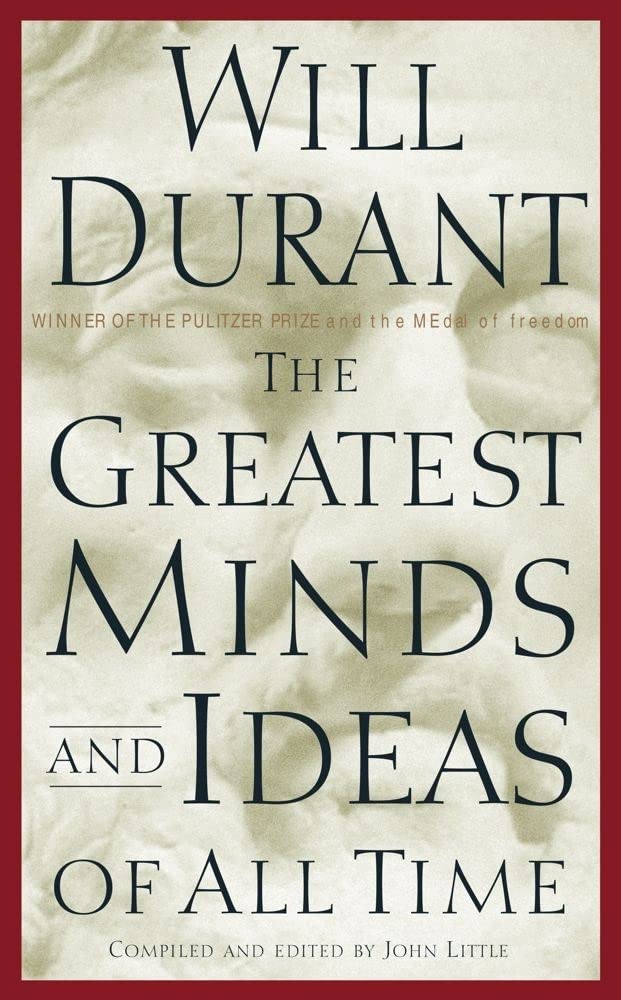
📖 Unlock the genius of history’s greatest minds—don’t miss out on the ideas shaping tomorrow!
The Greatest Minds and Ideas of All Time by Will Durant is a highly rated, bestselling book published by Simon & Schuster. It offers a profound exploration of influential thinkers and their ideas, ranked top 5 in Books & Reading and praised for its cultural and historical insights. Available with fast, free shipping and easy returns, it’s a must-have for intellectually curious professionals.
| Best Sellers Rank | #17,857 in Books ( See Top 100 in Books ) #7 in Books & Reading #86 in Literary Essays & Correspondence #142 in Social & Cultural History |
| Customer reviews | 4.5 4.5 out of 5 stars (479) |
| Dimensions | 12.7 x 1.52 x 20.32 cm |
| Edition | First Printing (by the Numbers) |
| ISBN-10 | 0743235533 |
| ISBN-13 | 978-0743235532 |
| Item weight | 272 g |
| Language | English |
| Print length | 144 pages |
| Publication date | 7 November 2002 |
| Publisher | Simon & Schuster |
S**S
Could be one the best books you ever read Drant with his seamless prose and erudition
A**M
Will Durant, who died in 1981, has been a guiding light in education since he published "The Story of Philosophy: The lives and opinions of the world's greatest philosophers from Plato to John Dewey" in 1926, and thereby introduced philosophy to America. He is a learned man with a charming, witty, easy to read and human style that is both endearing and inspirational. This book contains five articles previously published long ago in un-named magazines. Surprisingly (and unforgivably) John Little, founder and director of The Will Durant Foundation, who compiled and edited this delightful little book, does not bother to disclose the date and original place of publication. This is a great pity for many reasons. It is also not clear how much editing Mr. Little has done to the original essays. I have been able to track Durant's first essay to "The Rotarian" magazine of February 1955. That version is somewhat different from what appears in the book. It is ironic that such a scholar as Durant would be reproduced in such an unscholarly way. Durant's list of ten "greatest" thinkers is the least idiosyncratic, a list that most educated people will probably agree. He defines his criteria and then briefly introduces Confucius, Plato (who subsumes Socrates in a cute twofer), Aristotle, Aquinas (OK, OK, so the Western bias is clear already), Copernicus, Bacon, Newton, Voltaire (!), Kant, Darwin, He is generous in his description of other great thinkers who do not make his list and the reasons why. Buddha and Christ were teachers not thinkers, Spinoza's thinking was too esoteric to have influenced any but the most intellectual. Democritus, Epicurus, Marcus Aurelius, and others - even Mary Wollstonecraft and Susan Anthony, get a passing nod. Personally, I was disappointed that Heraclitus, Franklin, Jefferson and Einstein failed to merit even such "honorable mention". Durant admits that his list of ten "greatest" poets is quite personal. Fair enough; there are no objective criteria that would support another approach. His favorites: Homer, David, Euripides, Lucretius, Li Tai Po, Dante, Shakespeare, Keats, Shelly and Whitman. This section is nicely embellished with some of his favorite passages by these great writers. In his defense of nominating tragic Keats, Durant also produces a credible list of other great poets but strangely omits Cervantes. Elsewhere in the book poor Emerson is trashed for being "a trifle thin today". Ouch. Next are presented Durant's 100 "best" books for an education, in which he provocatively promises a first class education to anyone who will devote seven hours a week for four years to his proposed reading program. Wonderful, thrilling idea. His approach mixes original material with survey texts. While Herodotus, Solomon and Homer are timeless, old texts on science are not likely to be useful. The reader might benefit from his own efforts to find more modern publications to fill these parts in Durant's program. As bad, Durant's approach is shamelessly parochial. Asia and Africa are grouped together in one of his 12 sections. The Middle East (including Persia and the terrific contributions of Islam) seem ignored altogether. One could probably find a more recent outline to achieve the excellent goal that Durant proposes. Still, Durant's perspective that education is a lifelong process that begins when college finishes is wonderfully refreshing, especially today when college is seen as a stepping stone for career, like a trade school. Durant's ten "peaks" of human progress is also excellent and thought provoking. These include: speech, fire, animal domestication, agriculture, social order, morality, tools, science, education and writing/printing. A critic could nit-pick that agriculture, horticulture and tool development are part of science or that social order and morality are overlapping. A more legitimate comment would be that his list mixes actual peak events (discovery of fire, urbanization, even plant and animal domestication) with processes that span the full timeframe of humanity (tool development, education, science). Still, the list is, as intended, thought provoking and useful. The final chapter presents 12 vital dates in world history, and is intellectually the most muddled part of the book, as it mixes up personalities and dates. Many of the dates are placeholders for Great Teachers, Buddha, Confucius, Socrates, Christ, Mohammed, even Sir Francis Bacon and might have been more usefully approached in a different way. Certainly the first three of these (and others such as Moses, Zoroaster, Patanjali and indeed the development of the Vedas) might have better been combined as one date in a thoughtful essay on the Axial Age. Only the invention of the Egyptian calendar in 4241 BC, the printing press in 1554, steam in 1769, and the discovery of the New World in 1492 seem to fit the topic well. Oddly, Durant adds the failed French Revolution to this list, but ignores the successful American Revolution. Hammurabi is ignored, as is Marathon. Personally, it seems that the Magna Carta and the Bill or Rights deserve some mention too. This book makes for easy reading and would make a delightful gift to any student or educated person. It also provides an excellent template for discussion, in which you and your friends each prepare your own lists first, compare them with each other and with Durant's. The light style and breezy manner of this work contrasts dramatically from the book that made him famous, "The Story of Philosophy", which is dense, profound and very slow reading. Greatest Minds and Ideas will be enjoyed by all educated people. By contrast "The Story of Philosophy" is suited to dedicated philosophers looking for a good sample of some of the deepest thinkers of our culture.
R**N
I just wish I could write like Will Durant. Almost every sentence is beautifully constructed and contains an original thought. And yet he is not difficult to read (even if he has the alleged failing of occasionally starting sentences with "and" like me). Reading this makes one feel though that one has missed out on a proper education because he covers more than you are likely to be familiar with if one has followed a typical modern education. Highly recommended. This is the second book by Will Durant I have read with pleasure and I may pursue some of the recommendations of the "one hundred best books" contained in this one, even if many are clearly going to be archaic.
A**Z
Why are we not taught the way Durant teaches? A true love for the developing endeavors of our race in the world, shown through heroes and art, wars and religion, moral and economics, as one logic step after the other.
R**R
Compact hardbound volume on 10 of greatest thinkers, poets, peaks of human progress & 100 best books for an education by the one & only Will Durant. Concise yet wide ranging if Eurocentric view of culture.
Trustpilot
3 weeks ago
2 weeks ago