

Desert Online General Trading LLC
Warehouse # 7, 4th Street, Umm Ramool, Dubai, 30183, Dubai
Desert Online General Trading LLC
Warehouse # 7, 4th Street, Umm Ramool, Dubai, 30183, Dubai
Full description not available
D**T
Polymath tells all
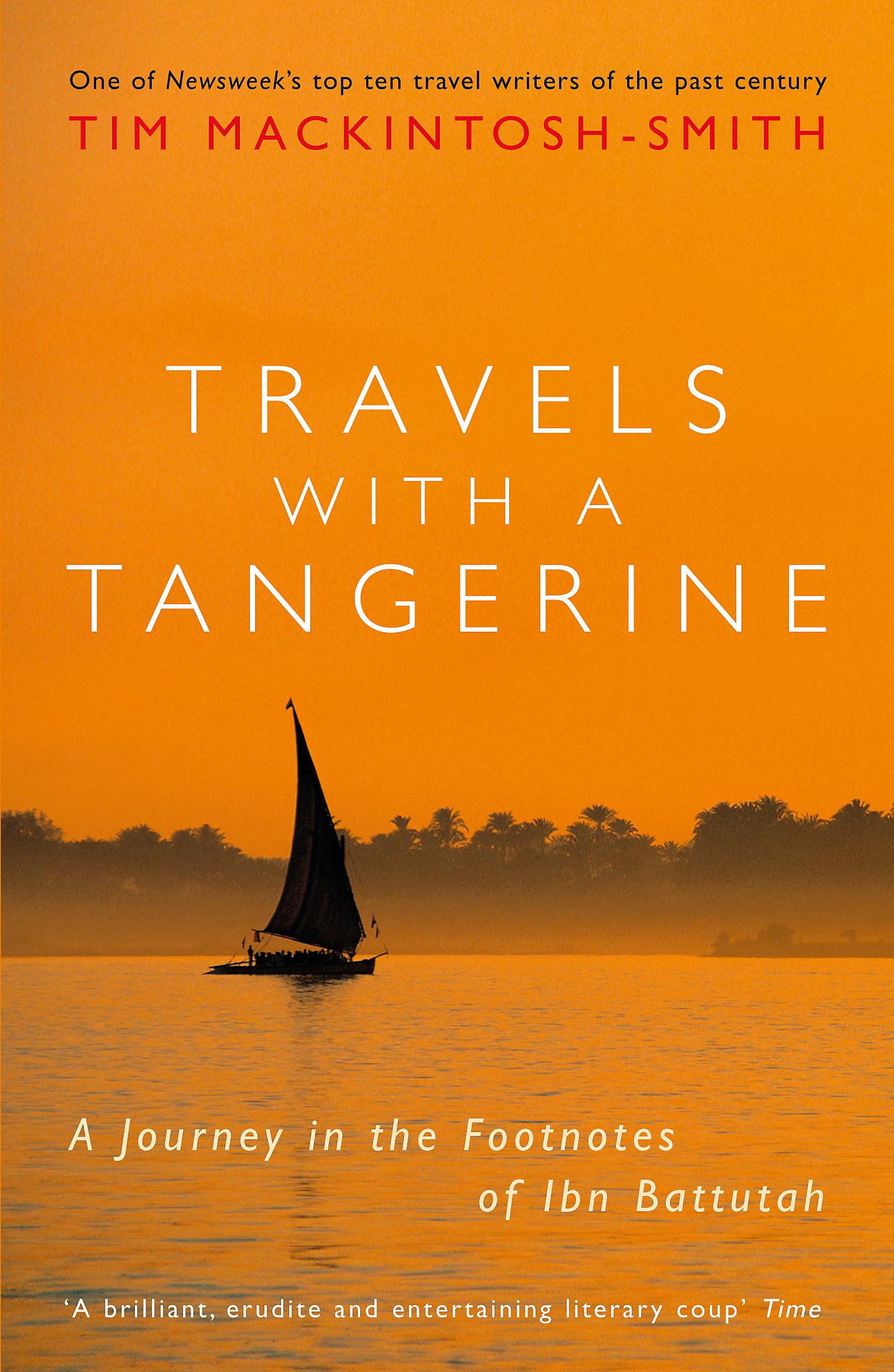
A retracing of some of the journeys (Morocco, Egypt, Syria, Southern Arabia, the Kuria Muria Islands,Turkey and the Crimea)of the fourteenth century traveller, Ibn Battuta.The author is a British born and educated Yemen resident, fluent in classical and colloquial Arabic and deeply learned in history and music. The book contains quotations in French, German, Russian (in the Cyrillic alphabet), Turkish and Greek. I thought I'd caught him misquoting Pliny, but then realized he was making a Latin joke. Some of his polyglot puns are outrageous. In The Umayyad mosque in Damascus he found Ismailis and Shiites at prayer, but that the orthodox were keeping the Sunni side up.The long digressions on obscure Arab writers and religious teachers and the intrusive parade of erudition might put some people off. It's a bit like reading Umberto Ecco where some readers, such as myself, get entranced by the writer's flattering assumption that we are as clever as he is.He travelled rough and travelled alone. He explains at one point that he cannot marry because he is an "ah, orientalist." He shows much interest in, and sympathy with, the Moslem religion but I got the impression that. like his fellow orientalist, TE Lawrence, he likes Arabs best if they are poor and rural, a faintly patronizing attitude.
T**S
Interesting and extensive history
'Travels with a Tangerine' is an excellent travel book and history book that chronicles the adventures of Ibn Battuta, one of the most famous Muslim explorers of the Euroepean 'Middle Ages'. Mackintosh-Smith, a 17-year resident of Yemen, follows "IB's" route from Morocco to Egypt to the Saudi Arabian peninsula to the Crimea and Istanbul, IB's 'Travels' as his main guide. Mackintosh-Smith's adventures are as compelling as IB's, and it is remarkable how much has not changed in the almost 700 years since IB began what was a 25-year journey that took him to China and back. The narrative is both entertaining and informative; however, it was a little dense at times, and I wish I knew more about IB and Muslim history before I started the book. The author gives one of the most balanced accounts of the modern Muslim world that I have ever read, and it's great to read about regular people who respect themselves and others, in contrast to the sensationalistic news reports we are bombarded with every night. A good book and a great adventure.
K**R
MacKintosh-Smith leaves every other (Travel)-writer in the dust
If Travels With A Tangerine (and all books by this author) were the standard that all (travel)- writing had to match, we would be left with precious few books on the subject.
K**L
Fascinating subject and a fun read!
My 1mnyear old is really into ancient culture as well as geography so this is a wonderful book that he enjoys tremendously. The writer is humorous which really makes the (admittedly dry) text take on a more modern tone.Everyone should know about this man - schools rarely mention him - because what he did made Marco Polo look like a homebody.Great book, great price!
J**I
An immensely engaging book...
Tim Mackintosh-Smith is an Englishman who is also an "Arabist," calling Sanaa, in the Yemen, home for over three decades. The Romans called the Yemen "Arabia Felix," the Happy Arabia due to its greenness and its wealth (the far eastern portions of the Yemen - present day Oman - provided the Frankincense that the Romans considered essential for dispatching their loved ones into the next world). TE Lawrence ("Lawrence of Arabia") considered the Yemen to be the primogenitor of the Arab people, with overpopulation in this lush land being the force that drove them over the deserts to Syria, and beyond. More recently, the Yemen is the tribal homeland of the Bin Laden's, including recently departed Osama. Mackintosh-Smith has used this central vantage point to report on this fascinating, and all too topical, area of the world. To do so, he chose the vehicle of following in the footsteps of one of the most peripatetic of our species, certainly in times of yore, Ibn Battutah, who left to wandered the "known" world at the age of 21, starting at its "edge," Tangiers, in 1325, for a period of over a quarter century. The author wrote this book over a decade ago, just prior to the events of 09/11/01, which have changed the West's perceptions of this area as well as their perceptions of us.Mackintosh-Smith displays a remarkable knowledge, and even better, a visceral understanding of the Islamic world. His writing style is fresh, with a knack for selecting a telling anecdote to demonstrate a broader concept. He "drew me in" with his story about a short article on Ibn Battutah in the Royal Air Maroc in-flight magazine. The article claimed that he had been a "Muslim religious official on the Falkland Islands"! How can this be?? A century and a half before Columbus "discovered" the New World, Ibn Battutah is laboring away in the Falklands? Fortunately the author is tri-lingual (at least), as was the magazine, and he realized that there was a confusion between "Malvinas" (the Argentinian name for the islands) and the French "Illes Maldives," the small island nation off the southwest coast of India, where Ibn Battutath was indeed a judge. How could no one have caught this? Anyhow, much of the book is Mackintosh-Smith holding up that proverbial candle, in an effort to dispel Western misconceptions of the region.The author does not attempt to replicate the entire trip of the 14th century wanderer. He figures just the first part, roughly from Tangiers to Istanbul is ambitious enough. For the chapter on his travels in Upper Egypt, he selects an epigraph from Edward Browne's 19th Century book, A Year Amongst the Persians: Impressions as to the Life, Character, and Thought of the People of Persia, Received During Twelve Month's Residence in that Country in the Years 1887-8 (Classic Reprint) : "I suppose that, wherever one goes, one sees in great measure what one expects to see." Later in the chapter, the author again quotes Browne: "Do not, like the majority of Firangis" (i.e., Westerners) "occupy yourself with nothing but dumb stones, vessels of brass, tiles..." Two admonitions Mackintosh-Smith takes to heart, unlike, for example Robert Byron, in his The Road to Oxiana who seemed to move from one "pile of stones to another" utterly oblivious of the present. Mackintosh-Smith makes his own judgments, of the present scene, but never forgetting the historical perspective that makes the past not even the past. All too often he conveys his points with similar situations in the West. Consider: "I lived, of course, in the graveyard of the Ottomans: Yemen, where, a hundred years ago, Anatolian conscripts had died by the thousand; Yemen, whose flower, as I found out later form the dictionary, is bitter cumin; a place whose name is, a century on, as sadly, musically evocative for the Turks as Picardy is for us."Permit me to throw out a few more observations from the author in order to tempt you to read this book. Certainly the first one I wish I had known when I had to deal with some "Beards" in Riyadh: "'In Yemen, where I live,' I said, `there is a saying: "If whiskers meant anything, tomcats would be pashas."' Then there is: "But fecundity and fetidness go together. The Arabic name for the Damascus oasis, al-Ghutah, is cognate with the words for dungheap and defecation." Another retort I wished I had known, the author uses as an epigraph, and it is a quote from Bertram Thomas (the first Westerner to cross the Rub Al-Khali, the Empty Quarter), from his Arabia Felix: "Are you quite sure you are pure-bred?" It is most appropriate for his section on the Dhofar region of Oman.Rich and wonderful is this book, a true joy to behold and read. I had previously read and reviewed Dunn's The Adventures of Ibn Battuta: A Muslim Traveler of the Fourteenth Century, Revised Edition, with a New Preface. Dunn performed a stellar effort in trying to determine the actual route of this Islamic wandered, but I think that Mackintosh-Smith is far more attuned to the spirit, and is a much more astute observer of today's world, as it has been shaped by the past.Speaking of lines that can be used against you, we in the West do have the aphorism that the Devil can quote scripture. Risking that, I think it appropriate to quote Mackintosh-Smith's epigraph for his final chapter, which is taken from the Qur'an: "O mankind! We created you from a single (pair) of a male and a female, and made you into nations and tribes, that ye may know each other (not that ye may despise each other.)Go forth, and wander? If so, M-S is a wanderer to emulate and who will hopefully lead you to see things that you do NOT expect to see. 5-stars, plus.
Trustpilot
2 weeks ago
2 weeks ago