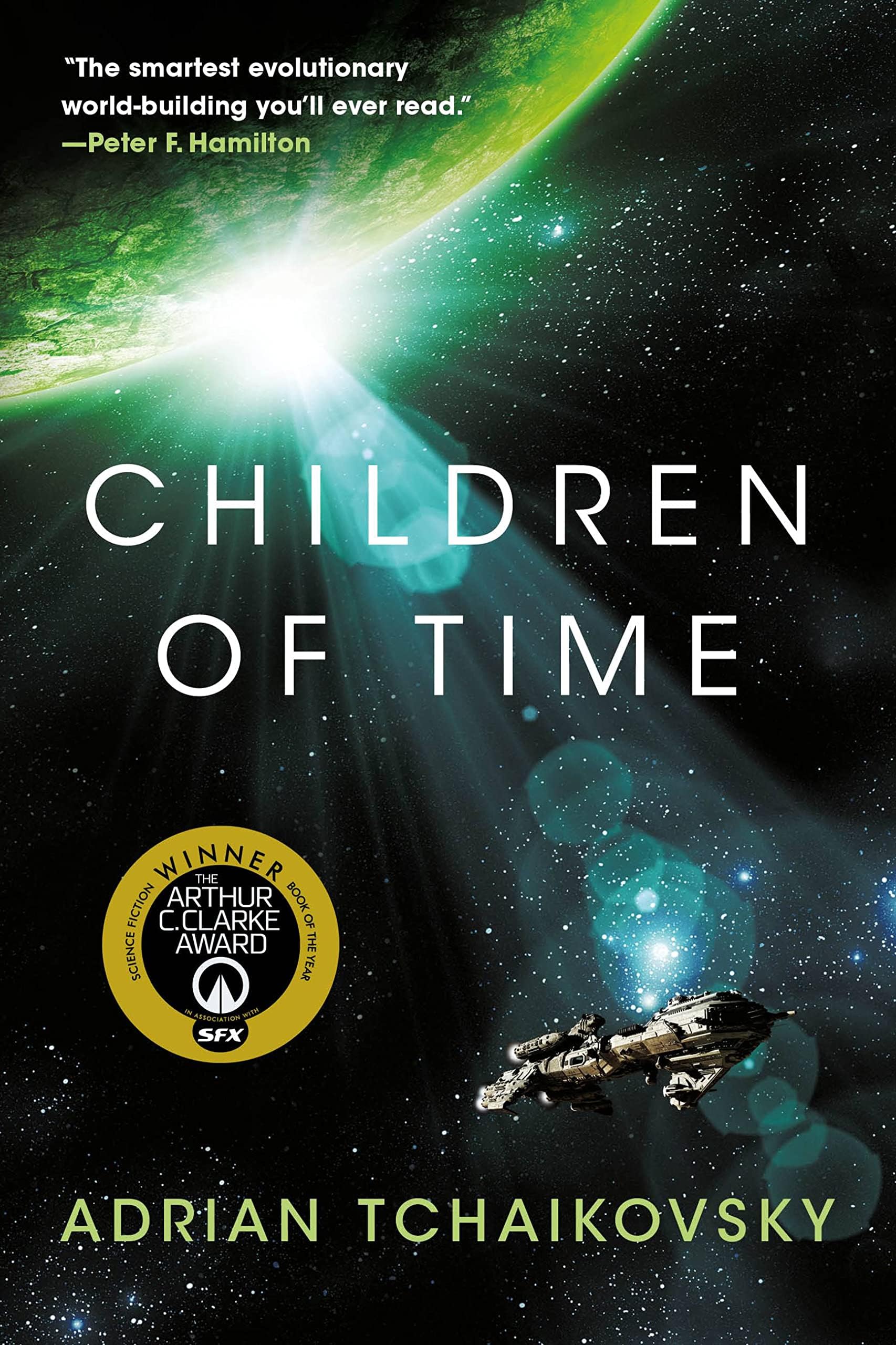

desertcart.com: Children of Time: 9780316452502: Tchaikovsky, Adrian: Books Review: This is a smart story, but it's also got a heart. - This book totally captivated me, and oddly enough, has lessened my dislike of spiders. In that way it's operated somewhat like the nanovirus responsible for uplifting the spiders at the centre of this story, as it had me rooting for these creepy alien, yet pragmatic, creatures throughout the book. They're no cuddly monkeys, but the speculations about how spiders might evolve intelligence and build a society are fascinating. The book is also a nice antidote for anyone, like me, who might sometimes view humanity as just not worth saving as we see global injustices and violence that humans appear so fond of inflicting on each other in the name of power. Also enjoyable for me are the well-developed female characters so often absent in epic science fiction stories. All in all it was a tremendously satisfying read. The exploration of different forms of intelligence: spider, human, ant & AI constitutes the background for this story, and all see changes over the course of the book, which should appeal to folks interested in cognition. There aren't tons of answers here, but a lot of fodder for thought experiments to help those work through various issues in an attempt to arrive a deeper understanding of intelligence. The smart interesting content unfolds within a unique and interesting narrative structure as well, which does much to enrich the story overall. Narratively speaking, there is a satisfying isomorphism between the unfolding of the tale of the spiders' evolution and the humans' journey. We see millennia unfold through the eyes of "key crew" or the same humans, who are awakened at ever widening intervals to help in times of crisis. Alongside this, the story is told from the POV of nearly the same set of spiders, but individual iterations described at different points in time are descendants of earlier spider characters. Obviously members of later generations aren't identical to their ancestors, but there are enough common threads spun across generations to provide a sense of character development. My lessened dislike of spiders is an interesting side-effect (although it's unclear the effect will be a lasting one). In fact, I saw one in the bathroom the other day, and stilled my immediate urge to just kill the little creepy crawly. At least it's not a nasty smart little hunting spider like the Portias Tchaikovsky writes about. While reading the book I looked up Portias and actually became a little obsessed with the wee creatures, who, when viewed from a particular angle, are actually kind of cute with their big giant eyes and furry little bodies. They're relatively harmless to humans, which probably didn't hurt insofar developing a certain fondness for these things. The real Portias are true to Tchaikovsky's descriptions of the ancestors of the beings I found myself rooting for while reading. They are smart, they exhibit object permanence and are stealthy patient hunters. So there's some good base material to work with while imagining how their intelligence might evolve. Review: Planet of No Apes: The Evolutionary Advantages of Remembering History - Forgetting or ignoring the lessons of one’s history brings about the setbacks of repeating it. It’s not a new idea: most have experienced or heard of it one way or another. And yet the failure to gain wisdom from the successes and failures of the past is still one of our species’ greatest follies. “Children of Time” imagines the possibility of total recall of past understandings – the advantages of having it and the ultimate handicap of its absence. The result is an impressive work of science fiction – thoughtful, entertaining, challenging, hopeful, educational, and quite enjoyable, in a way that hearkens back to the standards of Arthur C. Clarke and Isaac Asimov, distinctive in drawing on the background of zoology, rather than the more sci-fi “appropriate” physics, astronomy, mathematics, or chemistry. The plotting is reminiscent of the Foundation trilogy, in that its narratives move from one “crisis” to another, but that is the extent of my drawing parallels.I found the story largely original and well-plotted. The characters are well-drawn, and engaging. While the “lessons of history” appears to be the main overarching idea, there is much more to drive the story and provide plentiful food for thought. The action is entertaining and I thought the ultimate outcome was well-disguised, left unclear until almost the very end, and yet it did not feel contrived or unfounded. I feel pretty confident recommending this to any fan of classic sci-fi or anyone who appreciates entertaining, intelligent, substantive fiction. The only reason I do not give it 5 stars is that its own status as a timeless classic is yet to be confirmed.


| Best Sellers Rank | #3,379 in Books ( See Top 100 in Books ) #2 in First Contact Science Fiction (Books) #14 in Hard Science Fiction (Books) #58 in Space Operas |
| Customer Reviews | 4.5 out of 5 stars 48,571 Reviews |
M**A
This is a smart story, but it's also got a heart.
This book totally captivated me, and oddly enough, has lessened my dislike of spiders. In that way it's operated somewhat like the nanovirus responsible for uplifting the spiders at the centre of this story, as it had me rooting for these creepy alien, yet pragmatic, creatures throughout the book. They're no cuddly monkeys, but the speculations about how spiders might evolve intelligence and build a society are fascinating. The book is also a nice antidote for anyone, like me, who might sometimes view humanity as just not worth saving as we see global injustices and violence that humans appear so fond of inflicting on each other in the name of power. Also enjoyable for me are the well-developed female characters so often absent in epic science fiction stories. All in all it was a tremendously satisfying read. The exploration of different forms of intelligence: spider, human, ant & AI constitutes the background for this story, and all see changes over the course of the book, which should appeal to folks interested in cognition. There aren't tons of answers here, but a lot of fodder for thought experiments to help those work through various issues in an attempt to arrive a deeper understanding of intelligence. The smart interesting content unfolds within a unique and interesting narrative structure as well, which does much to enrich the story overall. Narratively speaking, there is a satisfying isomorphism between the unfolding of the tale of the spiders' evolution and the humans' journey. We see millennia unfold through the eyes of "key crew" or the same humans, who are awakened at ever widening intervals to help in times of crisis. Alongside this, the story is told from the POV of nearly the same set of spiders, but individual iterations described at different points in time are descendants of earlier spider characters. Obviously members of later generations aren't identical to their ancestors, but there are enough common threads spun across generations to provide a sense of character development. My lessened dislike of spiders is an interesting side-effect (although it's unclear the effect will be a lasting one). In fact, I saw one in the bathroom the other day, and stilled my immediate urge to just kill the little creepy crawly. At least it's not a nasty smart little hunting spider like the Portias Tchaikovsky writes about. While reading the book I looked up Portias and actually became a little obsessed with the wee creatures, who, when viewed from a particular angle, are actually kind of cute with their big giant eyes and furry little bodies. They're relatively harmless to humans, which probably didn't hurt insofar developing a certain fondness for these things. The real Portias are true to Tchaikovsky's descriptions of the ancestors of the beings I found myself rooting for while reading. They are smart, they exhibit object permanence and are stealthy patient hunters. So there's some good base material to work with while imagining how their intelligence might evolve.
M**F
Planet of No Apes: The Evolutionary Advantages of Remembering History
Forgetting or ignoring the lessons of one’s history brings about the setbacks of repeating it. It’s not a new idea: most have experienced or heard of it one way or another. And yet the failure to gain wisdom from the successes and failures of the past is still one of our species’ greatest follies. “Children of Time” imagines the possibility of total recall of past understandings – the advantages of having it and the ultimate handicap of its absence. The result is an impressive work of science fiction – thoughtful, entertaining, challenging, hopeful, educational, and quite enjoyable, in a way that hearkens back to the standards of Arthur C. Clarke and Isaac Asimov, distinctive in drawing on the background of zoology, rather than the more sci-fi “appropriate” physics, astronomy, mathematics, or chemistry. The plotting is reminiscent of the Foundation trilogy, in that its narratives move from one “crisis” to another, but that is the extent of my drawing parallels.I found the story largely original and well-plotted. The characters are well-drawn, and engaging. While the “lessons of history” appears to be the main overarching idea, there is much more to drive the story and provide plentiful food for thought. The action is entertaining and I thought the ultimate outcome was well-disguised, left unclear until almost the very end, and yet it did not feel contrived or unfounded. I feel pretty confident recommending this to any fan of classic sci-fi or anyone who appreciates entertaining, intelligent, substantive fiction. The only reason I do not give it 5 stars is that its own status as a timeless classic is yet to be confirmed.
S**E
Terrific start to this series.
*Terrific* first book in a science fiction series, amazingly creative, smart, and exciting. It won the 2016 Arthur C. Clarke Award, and the series as a whole (three books) won a Hugo Award for “Best Series” in 2023. War and environmental destruction have made Earth difficult for humans to live on. A long-term project has been taking place to terraform faraway planets for the survival of the species. One such project is being directed by the monomaniacal Dr. Avrana Kern. The terraforming is complete, including Earth plants, insects, spiders, and small mammals; but Kern does not want it to be for humans. It is her intent to send a shuttle load of monkeys to the planet, where they can evolve to be a better version of humans, with her as a god-figure. The next step will be to seed the planet with a nanovirus that will infect the monkeys and create a rapid evolution of intelligence. But everything goes wrong. A rebellion on the terraforming spaceship causes the destruction of the monkey shuttle, but the nanovirus still arrives, infecting many creatures. The most successful adaptation comes from a comparatively intelligent species of jumping spider. Rapid evolution begins there. Thousands of years later, the last humans leave the Earth in colony ships, with most of the humans stored as “cargo” in suspended animation. One ship, the *Gilgamesh*, investigates Kern’s world and moves on. Eventually they will have to return, and a war between the humans and the spiders seems inevitable. We view the story through many alternating points of view, both human and spider. One fascinating aspect is that, since female spiders are bigger and stronger, with the original Earth adaptation of eating the males after mating, males are considered inferior and mostly good for minor jobs, mating, and a source of food. The males' quest for equality is a clever turnaround for the reader. The book is long and complex, but not highly technical. The cultural and biological details of the spiders’ world are clever and fascinating, based on real world biology. The writing is clear and thoughtful. The last third is especially intense.
G**D
Fantastic Book!
If we encountered intelligent life on another planet, would we even be able to recognize it as such? This question is really the driving force of the book. This book explores a lot of big ideas and concepts, but that question is the one that is at the center of it all. The book follows two story threads that happen over the course of thousands of years; a dying race floating through space, trying to find a new home, and another race rising into intelligence on a planet that was not originally meant for them. It tells this millennia spanning story through a series of connected vignettes that time jump with almost every chapter. If you're looking for a very character driven story, this is not the book for you. The characters are well done, but they are not necessarily what the book is about. This book is about bigger things, things that can only be explored over the course of vast amounts of time. And it is masterfully written. The prose was a little heavy for me at first, but a few chapters in I was hooked, and already beginning to love the prose. This is definitely the kind of book that will leave you severely disappointed if you go in with the wrong expectations as to what kind of book it's going to be. If you're going into it expecting some big space opera full of interesting and very compelling characters, you will be disappointed. Judging this book according to what kind of book it's meant to be, I would say it succeeds on almost every level. SPOILERS: it got me to see a race of spiders as more than "the other" for goodness sake! And society and technological development of the spiders was extremely well executed, as well as very imaginative yet grounded in complete believability -- a hard balance to maintain. It's a bit long, but I believe that length is very necessary for properly telling the story and exploring those concepts that it puts forth. Overall, I would highly recommend this book to anyone who loves great sci-fi that spans huge lengths of time and is very much about exploring certain questions, not necessarily about a group of characters doing stuff.
R**T
Truly epic!
Children of Time is certainly a science fiction epic in the sense of being impressive in size and scope. Originally written as a standalone, it became Tchaikovsky's best-selling novel and so, of course, has spawned sequels. This first book in the series is a chunky 600 pages, and the action of the story covers thousands of years of future history. The novel begins sometime in the far future aboard a space station orbiting a distant planet that has been terraformed and is on the brink of the next stage of development. Under the guidance of Dr. Arvana Kern, primates will be introduced into the ecosystem along with an uplift virus that will speed their evolution. (The station isn't named Brin 2 for nothing.) Being no fan of the directions that humanity has taken, Kern intends to nurture a new intelligent species that may perhaps avoid some of the mistakes her own has made. Things go catastrophically wrong during the setup stage, however, and through a series of events that strain credulity just a bit, the virus is introduced into the planet's atmosphere but the monkeys don't survive. Kern becomes the only surviving human member of the expedition after a coup attempt. Her own consciousness gets mixed up with the ship's AI, and she continues to watch over what she thinks of as Kern's World for thousands of years, not knowing that her primates are long since dead. No worries, however, as certain other species do respond well to the virus, foremost among them perhaps being, oddly enough, jumping spiders. Over the course of millennia the spiders grow rather large (dog-sized, I gathered) and much smarter, as do ants and some types of crustaceans. This is where the novel really shines. Tchaikovsky does a wonderfully entertaining job of projecting out what higher consciousness would be like for these unlikely species given their innate characteristics. At one point the spiders and the ants go to all-out war, and it looks bad for the spiders until they cleverly figure out a way to control the ants by manipulating the way they sense their environment. During this vast amount of time, humanity manages to destroy the Earth and pretty much wipe itself out everywhere in the galaxy except for one desperate starship (not even a ragtag fleet) searching for a habitable world. Ancient records lead them to Kern's World, but the misanthropic Kern-AI-thing wants nothing to do with humanity and warns them away. She is, after all, busy using radio transmissions to nurture the evolving intelligence of what she believes are her beloved primates on the world below. Unfortunately for the last remnants of humanity, the technologies of the old empire were far greater than those they now possess, so even their vast starship is no match for the weaponized countermeasures of the Brin 2 station. They are sent to the location of another terraformed planet, a quest that again takes thousands of years since no faster-than-light travel exists in this universe. But, before they leave, a band of mutineers manages to get past the Brin station and land on the planet for a brief moment in which the spiders unknowingly glimpse their creators and the humans witness a world that they view as a horror beyond words. If things went a little haywire on Kern's World, they went completely off the tracks on the second terraformed planet, which is covered with one vast fungal network. Things are getting desperate for the last hope of humanity by this point but the crew of the Galactica, er, I mean the Gilgamesh, are able to avail themselves of some old-empire technology at this abandoned outpost. Their leader believes that they have no alternative but to return to Kern's World and fight for possession of the planet. I'll skip ahead and assure you that the final battle is a scorcher! What I've described is just the bare skeleton (or perhaps I should say exoskeleton) of the novel. The really good stuff comes in the growing awareness of the spiders over the generations, and in the changing relationships and situations of the humans over the millennia as they go into and out of cryogenic sleep at different times and over varying periods during their ever-more-desperate search for a home. The novel is complete and satisfying in itself and flies by quickly despite its length.
A**E
Intelligent, Bold Science Fiction
I'm not compelled to write book reviews very often, but then it's not often I read a book that I'm so immediately certain will be revered as a classic. And don't worry - no spoilers, here. I've read science fiction for all of my life, though admittedly with long droughts in between trips to the stars or into the speculative world. I picked this one up on account of the positive reviews and its Hugo award, and I've come away so very satisfied that I did. This novel is grand in scope, weaving two major narratives that span eons. What this novel's 600 pages describe is a feat of science fiction, comparable to Asimov's "Foundation" in its sheer scope. The science fiction itself is hard stuff, for the most part, with only limited reason to suspend disbelief. I've not burned through a book this quickly in ages. Not since I was a kid. But the narrative is so gripping that I simply had to keep reading to find out where it was going. I actually began to worry that the payoff wouldn't do the journey justice, but even that was handled with a grace that I should have seen coming (but didn't). My one complaint is that the characterization is a bit one-noteish. There aren't much in the way of character arcs, but then given the nature of the story and its timelines, that does make some sense so it isn't a major beef and it doesn't distract from the story. The characters have their roles to play and they do that well. And in one half of the story, what I just said doesn't matter at all as change is critical to its telling. Overall, as I said - I think this is a classic. I would put this up there with "Dune" as some of the most enjoyable science fiction I've read. I'm not saying it's on-par literature-wise, but as far as compelling, thought-provoking, smart sci-fi goes, this is incredibly original and a joy to read. Can't wait to see what's next from this author.
6**2
A complex, well-crafted and highly original novel
What a wonderful surprise this book is. It's an especially rare beast in the scifi world in that it combines very original ideas with well-crafted and detailed characters and complex storylines woven into a main plot and multiple subplots. Despite all that complexity, the author's clear and entertaining writing makes the storyline easy to follow. Perhaps my deepest appreciation for the book is that it departs from the "wish-fulfillment" motif of so many scifi novels from the 50s through the present. You know what I mean: the Heinlein-like plots where the hero uses his ingenuity and pluck to defeat a resource-rich foe in order to save the planet and win the girl. Those types of plots don't have a story "arc" so much as a straight line from beginning to end. And always told from the perspective of a male with the emotional maturity of a teenager. Not so with Children of Time. At least half the characters are female and those characters are in the "traditional" male roles, like engineering and political leadership. And the male characters are also used in unique and interesting ways. (Warning: slight spoiler ahead) Probably my favorite is a male creature (not human) making the case and risking his life for gender equality among his species. This subplot came out of nowhere in the story, but fits perfectly within the story's fabric. It's also an example of the type of writing and complexity all too often missing from modern scifi. I have never mentioned this before in a review, but the author's vocabulary is also worth noting: three or four times I found a new word that I had never encountered before. ("Hurray!" for the online dictionary function in Kindle.) But Mr. Tchaikovsky does not use his impressive vocabulary or intimidate: he is just a writer with a broad, well-educated mind who has stories to tell. This is my favorite book in years. Well done, Mr. Tchaikovsky.
T**L
Flimsy Webbing
This novel is actually fairly entertaining if you can manage to not think about it too closely while you're reading it. Just shut your brain off and read, and then close the book and don't ponder it anymore when you're finished. Remember the pleasant time you had and move on! In short, don't be like me. If you're like me and pick too hard at the loose threads in the plot, well then the whole web just unravels, weak pun intended. Like the plot holes and inconsistencies. Or the complete lack of romantic or sexual chemistry between the two human main characters who are supposedly in some kind of doomed unspoken relationship. I mean I was seriously convinced that Lain had that "romantic" night with Holsten on the space station because she'd gotten knocked up by Guyen and wanted Holsten to think he was the father. Or all the obnoxious characters who keep spouting complete nonsense while the book acts like they're saying something profound. I mean the Prisoner Dilemma? REALLY? You have one leaky space dinghy while they built an orbital habitat around their entire planet, you idiots. Now's not the time to go on offense. No wonder the human race is almost extinct! Also people keep calling this "hard" science fiction, be aware that it's not. It's got more magical plot devices than a season of Sailor Moon. Anyway the longer I think about this book the more I want to take another star off, and that's not fair. It's not the book's fault I can't follow my own advice and just stop thinking about it. Anyway I purchased this during a sale on Amazon for two dollars and it's certainly worth two bucks. This is the first novel I've read by this author and I may read more if they go on sale. If you're looking for SF novels that you can safely enjoy giving serious thought to, I recommend "To Sleep in a Sea of Stars" by Christopher Paolini or just about anything by Alastair Reynolds. This novel was more like junk food for the intellect, but there's nothing wrong with that. You can't eat steak all the time, sometimes you're feeling the Chicken McNuggets.
Trustpilot
5 days ago
2 months ago