
DOWNLOAD THE APP


Customer Services
Copyright © 2025 Desertcart Holdings Limited
DOWNLOAD THE APP
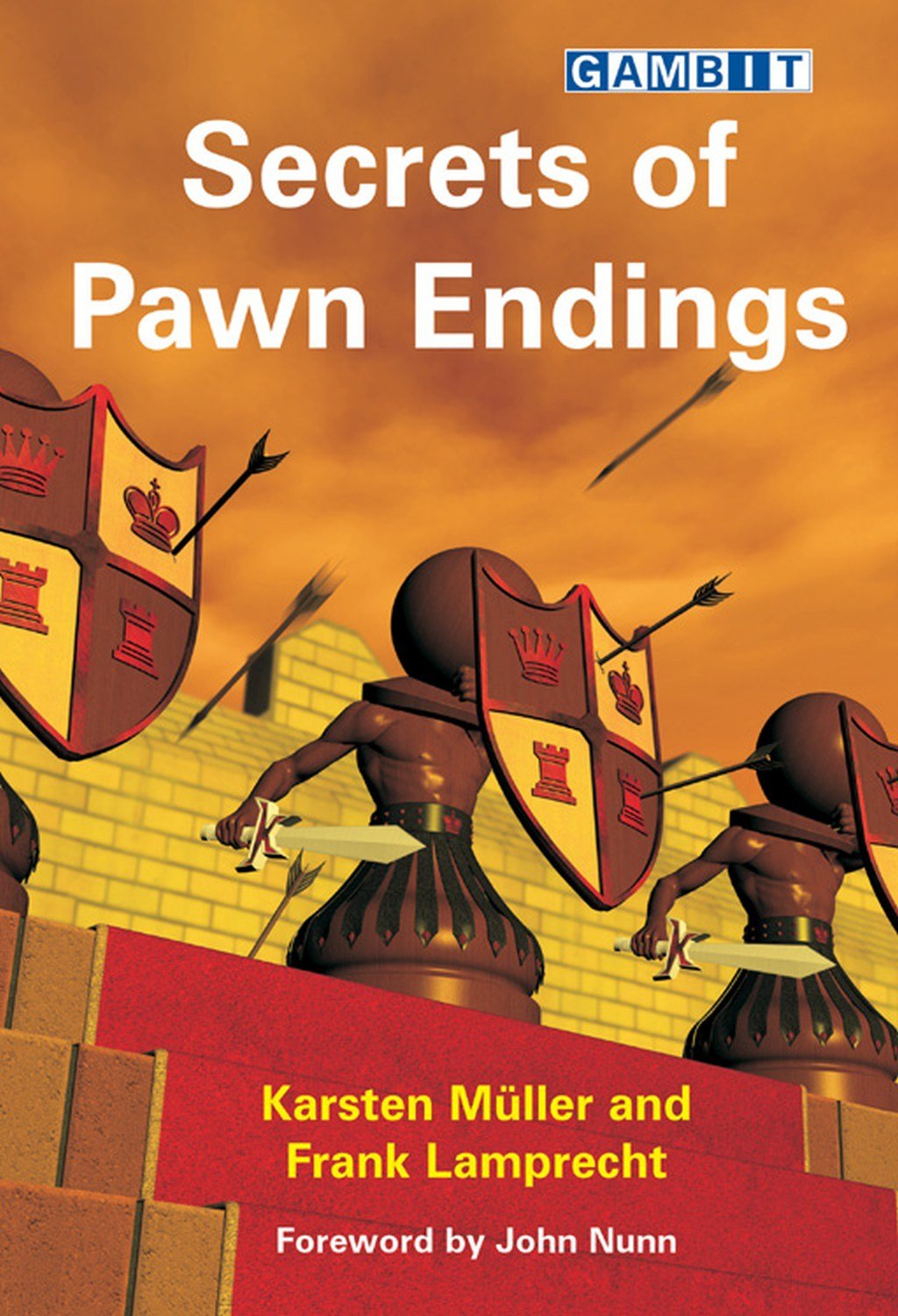
Review: A masterpiece that will greatly improve your endgame play - This book is simply amazing. If you commit the time to study it in depth, you will learn subtleties that would possibly be forever lost to you. One thouroughly awesome example is from the ending of the game S.Ludwig-A.Klauser (Bad Ragaz 1990), where White had an extra pawn (3 vs.2 on the queenside), and it was White to move in the following position: W:Kd3, pawns on a4,b2,c2, B:Ke6, pawns on a7,b7. You would intuitively think that the winning procedure would be to simply blow the pawns up the board a la Capablanca/Nimzovichs' "candidate in front" rule and just win with your extra pawn. However, since there is a deep subtlety (only found through intense study of this book!) of the fact that White's rook pawn has **already moved**, Black will be able to draw in a study-like fashion with a bishop and rook's pawn vs. rook's pawn setup by preventing the opposition and moving his king to the same color as the square of the rook pawn if it be on a4/a5/a6, etc. White wins this position by moving his king up and then advancing his c-pawn, leaving his b-pawn for reserve tempos, losing his c-pawn for Black's b-pawn (likely with check), then using the last reserve tempo from the b-pawn to outflank Black. Not something that is intuitive, and immensely helpful! This book is chock-full of things like the last example, and you will learn the subtleties and exceptions to things like Bahr's rule (concerning fixed rook pawns and a passed pawn), with other many counter-intuitive winning or drawing procedures. The authors have also done an incredible job with back-linking positions in later chapters with material from previous chapters when variations translate into something already learned, all of which is easily referenced for the reader. I can now see why everyone has rated this book 5 stars. Highly, highly recommended. Review: Easy to learn - Excellent book for learning pawn endings!
| Best Sellers Rank | #1,134,156 in Kindle Store ( See Top 100 in Kindle Store ) #564 in Chess (Kindle Store) #764 in Board Games (Books) #937 in Chess (Books) |
D**E
A masterpiece that will greatly improve your endgame play
This book is simply amazing. If you commit the time to study it in depth, you will learn subtleties that would possibly be forever lost to you. One thouroughly awesome example is from the ending of the game S.Ludwig-A.Klauser (Bad Ragaz 1990), where White had an extra pawn (3 vs.2 on the queenside), and it was White to move in the following position: W:Kd3, pawns on a4,b2,c2, B:Ke6, pawns on a7,b7. You would intuitively think that the winning procedure would be to simply blow the pawns up the board a la Capablanca/Nimzovichs' "candidate in front" rule and just win with your extra pawn. However, since there is a deep subtlety (only found through intense study of this book!) of the fact that White's rook pawn has **already moved**, Black will be able to draw in a study-like fashion with a bishop and rook's pawn vs. rook's pawn setup by preventing the opposition and moving his king to the same color as the square of the rook pawn if it be on a4/a5/a6, etc. White wins this position by moving his king up and then advancing his c-pawn, leaving his b-pawn for reserve tempos, losing his c-pawn for Black's b-pawn (likely with check), then using the last reserve tempo from the b-pawn to outflank Black. Not something that is intuitive, and immensely helpful! This book is chock-full of things like the last example, and you will learn the subtleties and exceptions to things like Bahr's rule (concerning fixed rook pawns and a passed pawn), with other many counter-intuitive winning or drawing procedures. The authors have also done an incredible job with back-linking positions in later chapters with material from previous chapters when variations translate into something already learned, all of which is easily referenced for the reader. I can now see why everyone has rated this book 5 stars. Highly, highly recommended.
R**E
Easy to learn
Excellent book for learning pawn endings!
J**S
Secrets of Good Books
Ok, endgame books are mostly raw facts and calculation. Accuracy is more important than writing ability. If you purchased this book, there is no doubt what you expected to take from it. When I found the first typo on the first page of chapter one I thought I made a bad purchase. I don't care about excuses...poor editing, hard to translate from German, or anything else. As I continued to read I found the book to be better than I had expected. Once I got used to the codes and symbols, the book was very enjoyable. The exercises were outstanding. They hammered home the critical ideas without wasting your time on exercises that would never occur in an actual game. And yes the book was very accurate. I learned a few new ways to quickly evaluate complex positions. The order of the exercises was perfect. Each exercise built on the previous exercises as they flowed smoothly through the book. You can not spend too much time with a book like this. After living and playing in Germany for the past two years I am amazed at the strength of German players and their passion for the game. They are absolutely crazy about chess. I find chess everywhere I go in this country. These two authors are a direct reflection of chess in Germany today. I will look for more of their books.
B**V
Don’t judge a book by its cover!
It’s a bit of a shame to see such an ugly and tasteless cover on such an excellent book. But I’m making a weekend project out of painting over it, and I know I’ll be studying this book for years to come!
J**Y
Incredible and thorough
An amazing guide on pawn endings. This is not only one of the most important endgame types, but studying pawn endings also works out your calculation skills. It's much easier to see many moves ahead with pawns and kings only usually (though this book has some positions with thickets of variations that can be tough to chop through) because they're short ranged pieces and pawns only capture diagonally one square and there is very rarely any threat of checkmate. Zwugwzang, Steinitz's Rule, shouldering, widening the beachhead, opposition, triangulation, Bahr's Rule, rule of the square, etc., are all building blocks that make these endings easier. This is by no means an easy book, but it's still nevertheless accessible to club players. It is highly practical so make sure you study this book until the concepts are drilled into your DNA! Dvoretsky's Endgame Manual is a good compliment to it for reinforcing your pawn ending understanding.
L**M
Four Stars
good book
W**E
Your Second Endgame Book
Unfortunately, explanations of pawn endings tend to be more mystifying than helpful to players of average talent (like me). Even single pawn endgames can seem so puzzling. However, with a little work even average players can understand this book. I suspect it would be helpful to unusually talented and experienced players as well. I feel that for most player's purposes this book is a little better than Averbach's book, but it's most fun to have them both and compare their explanations. Averbach's book spends far more time on the theory of corresponding squares, while this book is more practical. In short, don't despair if you can't find Averbach's book; this one is very good. If you've read a basic introduction to the endgame, and want to go deeper, this is the next step. All other endgames constantly threaten to reduce to pawn endgames, so these are fundamental concepts. As it says on the back cover, "Without an understanding of [pawn endings] it is impossible to master more complicated endings." That is absolutely true. Many players will feel that pawn endgames are boring, but in reality they can be very beautiful. If you learn to enjoy them, then your enjoyment of the entire game of chess will increase.
R**9
Muller writes with the rigor of a mathematician
There are few books that, in my view, are just absolutely top-shelf chess books. This is one. Muller writes with the rigor of a mathematician and with a simplicity that makes the information stick. With some hyperbole, I would liken it to a Euclid's "Elements" for pawn endings in that it starts with the absolute essential and basic facts upon which the whole system is built, and then refers back to those building-blocks as axiomatic to whatever the current discussion may be. A beautifully-done book, and one that is a wonderful achievement for Mr. Muller as well as being a genuine contribution to the body of chess literature.
Trustpilot
1 month ago
2 months ago