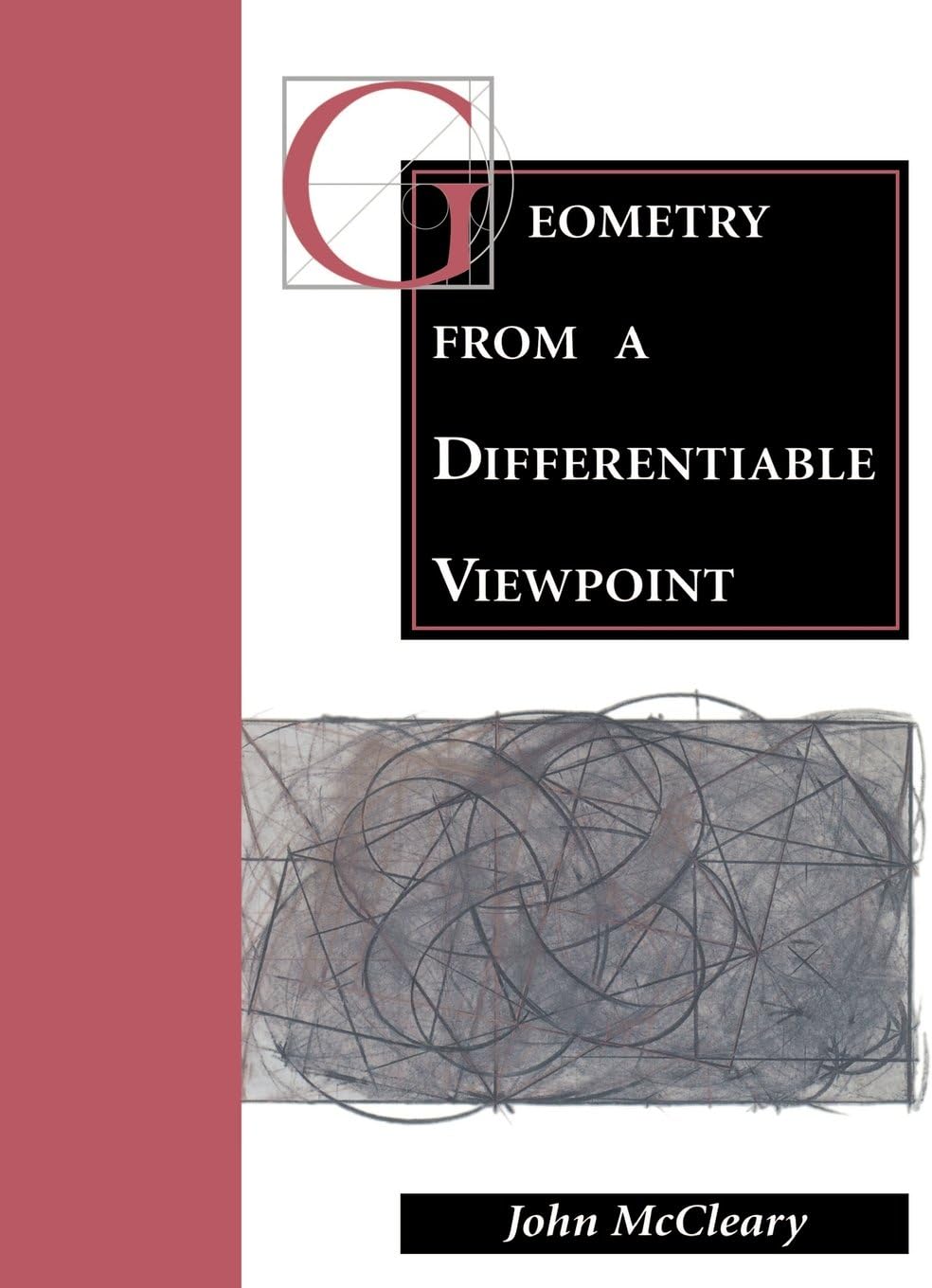
Geometry from a Differentiable Viewpoint
Product ID: 807160011
Buy anything from 5,000+ international stores. One checkout price. No surprise fees. Join 2M+ shoppers on Desertcart.
Desertcart purchases this item on your behalf and handles shipping, customs, and support to France.
Differential geometry has developed in many directions since its beginnings with Euler and Gauss. This often poses a problem for undergraduates: which direction should be followed? What do these ideas have to do with geometry? This book is designed to make differential geometry an approachable subject for advanced undergraduates. The text serves as both an introduction to the classical differential geometry of curves and surfaces and as a history of the non-Euclidean plane. The book begins with the theorems of non-Euclidean geometry, then introduces the methods of differential geometry and develops them towards the goal of constructing models of the hyperbolic plane. Interesting diversions are offered, such as Huygens' pendulum clock and mathematical cartography; however, the focus of the book is on the models of non-Euclidean geometry and the modern ideas of abstract surfaces and manifolds. Although the main use of this text is as an advanced undergraduate course book, the historical aspect of the text should appeal to most mathematicians. Review: a connecting bridge and a foundational stone - I begin with two items of pedagogy: The equations are not numbered. Definitions, propositions and theorems are numbered (first edition). This strategy compels the student to work hard at supplying details in derivations. Also, the diagrams are insufficient for ease of understanding, therefore, I suggest redrawing each diagram for oneself ! Those two items behind us, I concentrate on the positive attributes of this discourse. The author writes that acquaintance with multivariate calculus plus exposure to elementary linear algebra and analysis would be adequate preparation. I suggest study of Angus Taylor: Advanced Calculus. The goal of preparing the reader for work in modern differential geometry is then achieved. Read the Preface: "...offer an exposition, motivated by its history, that prepares the reader for modern, global foundations of the subject." Three Major Parts (A-B-C) comprise the book: (A) foundations and spherical geometry: it helps to be familiar with cartesian to spherical coordinatization. This first part might also serve as review of Euclidean geometry. Recall: congruence, also continuity, scalar product and Taylor series utilized to good effect. That gets you through chapter one. For chapter two, be familiar with cartesian product notation (page 18). Read: "Dedekind cuts may also be used to coordinatize lines." (page 15, although that is mentioned only in passing). The proof regards exponential function (page 43) is interesting, but the student will need to recognize it as solution to a simple differential equation (page 44). Familiarity with hyperbolic functions will be of efficacy (page 52). Quite frankly, part one is the most difficult part of the text. The big picture: Analogy. (B) Curves, Surfaces, Curvature: the second part customarily begins with curves and parametrization. You get practice with "routine" integrals (page 70, what does 'routine' actually mean for integrals ?), orientation,determinants, scalar products again, these your 'bread and butter.'. Chapter eight (surfaces) and nine (curvature) involve a dose of linear algebra and recall a bit of advanced calculus. Intrinsic properties emphasized. Two Proofs of Gauss' Theorema Egregium (initially, page 148) then the student will be walked through another proof in Exercise #10.4 (page 155). Recall matrix multiplication (page 110) and partial differentiation. A reference to Spivak's Calculus on Manifolds (page 113) concludes the discussion of surfaces (study that reference !). Curvature is next. Recall eigenvalues (page 137) and mean-value theorem (page 143). Read: "artful choices of coordinates play a crucial role in certain arguments..." (page 152). You are ready for geodesics (chapter eleven). Recall: triangle inequality (page 166). Analogy invoked again (page 169). Congruence, again (page 191). You see that the earlier material is invoked at later stages of the exposition. The proof of Liebmann's theorem is interesting (page 195). (C) Third Part, a recapitulation and an introduction to abstract surfaces: This part provide a panoramic view of, and introduction to, manifolds. The reader is asked to provide a proof (page 211), this is primarily a computational proof. We read: "The notion of an abstract surface frees us to seek models of Non-euclidean geometry without the restriction of finding a subset of a Euclidean space." (page 217). Disk's of Beltrami (page 220) and Poincare (page 224) as models, an elementary and lucid exposition. Here, too, elementary complex variable will come in handy (Poincare half-plane). Another pass at area and angle-deficit rounds out the discourse (page 238). The book concludes with summary of vector fields and tensors. We read: "Is there a sense in which these equations and covariant differentiations are geometric ? The last stage of the development of Differential Geometry that we will discuss in this book begins with an answer to this question." (page 264). The approach here utilizes coordinates. Read: "the coordinate viewpoint that we have presented gave way to coordinate-free constructions that do the work of tensor calculus globally." (page 267). (D) In conclusion: before attempting this book, consider that firm background in high school geometry and more than mere acquaintance with advanced calculus is necessary. Assimilating the Geometry and Calculus textbooks by Edwin Moise should provide minimum preparation. Assuming that background, this text offers a marvelous choice as an introduction to classical differential geometry with strong disposition for historical antecedents. The exercises are straightforward (although challenging). Solutions to some of the exercises are provided. The excellent Lectures on Classical Differential Geometry (by Struik, 1950), serves as companion to this text. McCleary offers an ambitious undertaking for future study of modern differential geometry. A rather exciting journey.
| Customer Reviews | 4.7 out of 5 stars 4 Reviews |
G**Y
a connecting bridge and a foundational stone
I begin with two items of pedagogy: The equations are not numbered. Definitions, propositions and theorems are numbered (first edition). This strategy compels the student to work hard at supplying details in derivations. Also, the diagrams are insufficient for ease of understanding, therefore, I suggest redrawing each diagram for oneself ! Those two items behind us, I concentrate on the positive attributes of this discourse. The author writes that acquaintance with multivariate calculus plus exposure to elementary linear algebra and analysis would be adequate preparation. I suggest study of Angus Taylor: Advanced Calculus. The goal of preparing the reader for work in modern differential geometry is then achieved. Read the Preface: "...offer an exposition, motivated by its history, that prepares the reader for modern, global foundations of the subject." Three Major Parts (A-B-C) comprise the book: (A) foundations and spherical geometry: it helps to be familiar with cartesian to spherical coordinatization. This first part might also serve as review of Euclidean geometry. Recall: congruence, also continuity, scalar product and Taylor series utilized to good effect. That gets you through chapter one. For chapter two, be familiar with cartesian product notation (page 18). Read: "Dedekind cuts may also be used to coordinatize lines." (page 15, although that is mentioned only in passing). The proof regards exponential function (page 43) is interesting, but the student will need to recognize it as solution to a simple differential equation (page 44). Familiarity with hyperbolic functions will be of efficacy (page 52). Quite frankly, part one is the most difficult part of the text. The big picture: Analogy. (B) Curves, Surfaces, Curvature: the second part customarily begins with curves and parametrization. You get practice with "routine" integrals (page 70, what does 'routine' actually mean for integrals ?), orientation,determinants, scalar products again, these your 'bread and butter.'. Chapter eight (surfaces) and nine (curvature) involve a dose of linear algebra and recall a bit of advanced calculus. Intrinsic properties emphasized. Two Proofs of Gauss' Theorema Egregium (initially, page 148) then the student will be walked through another proof in Exercise #10.4 (page 155). Recall matrix multiplication (page 110) and partial differentiation. A reference to Spivak's Calculus on Manifolds (page 113) concludes the discussion of surfaces (study that reference !). Curvature is next. Recall eigenvalues (page 137) and mean-value theorem (page 143). Read: "artful choices of coordinates play a crucial role in certain arguments..." (page 152). You are ready for geodesics (chapter eleven). Recall: triangle inequality (page 166). Analogy invoked again (page 169). Congruence, again (page 191). You see that the earlier material is invoked at later stages of the exposition. The proof of Liebmann's theorem is interesting (page 195). (C) Third Part, a recapitulation and an introduction to abstract surfaces: This part provide a panoramic view of, and introduction to, manifolds. The reader is asked to provide a proof (page 211), this is primarily a computational proof. We read: "The notion of an abstract surface frees us to seek models of Non-euclidean geometry without the restriction of finding a subset of a Euclidean space." (page 217). Disk's of Beltrami (page 220) and Poincare (page 224) as models, an elementary and lucid exposition. Here, too, elementary complex variable will come in handy (Poincare half-plane). Another pass at area and angle-deficit rounds out the discourse (page 238). The book concludes with summary of vector fields and tensors. We read: "Is there a sense in which these equations and covariant differentiations are geometric ? The last stage of the development of Differential Geometry that we will discuss in this book begins with an answer to this question." (page 264). The approach here utilizes coordinates. Read: "the coordinate viewpoint that we have presented gave way to coordinate-free constructions that do the work of tensor calculus globally." (page 267). (D) In conclusion: before attempting this book, consider that firm background in high school geometry and more than mere acquaintance with advanced calculus is necessary. Assimilating the Geometry and Calculus textbooks by Edwin Moise should provide minimum preparation. Assuming that background, this text offers a marvelous choice as an introduction to classical differential geometry with strong disposition for historical antecedents. The exercises are straightforward (although challenging). Solutions to some of the exercises are provided. The excellent Lectures on Classical Differential Geometry (by Struik, 1950), serves as companion to this text. McCleary offers an ambitious undertaking for future study of modern differential geometry. A rather exciting journey.
Trustpilot
1 week ago
2 months ago