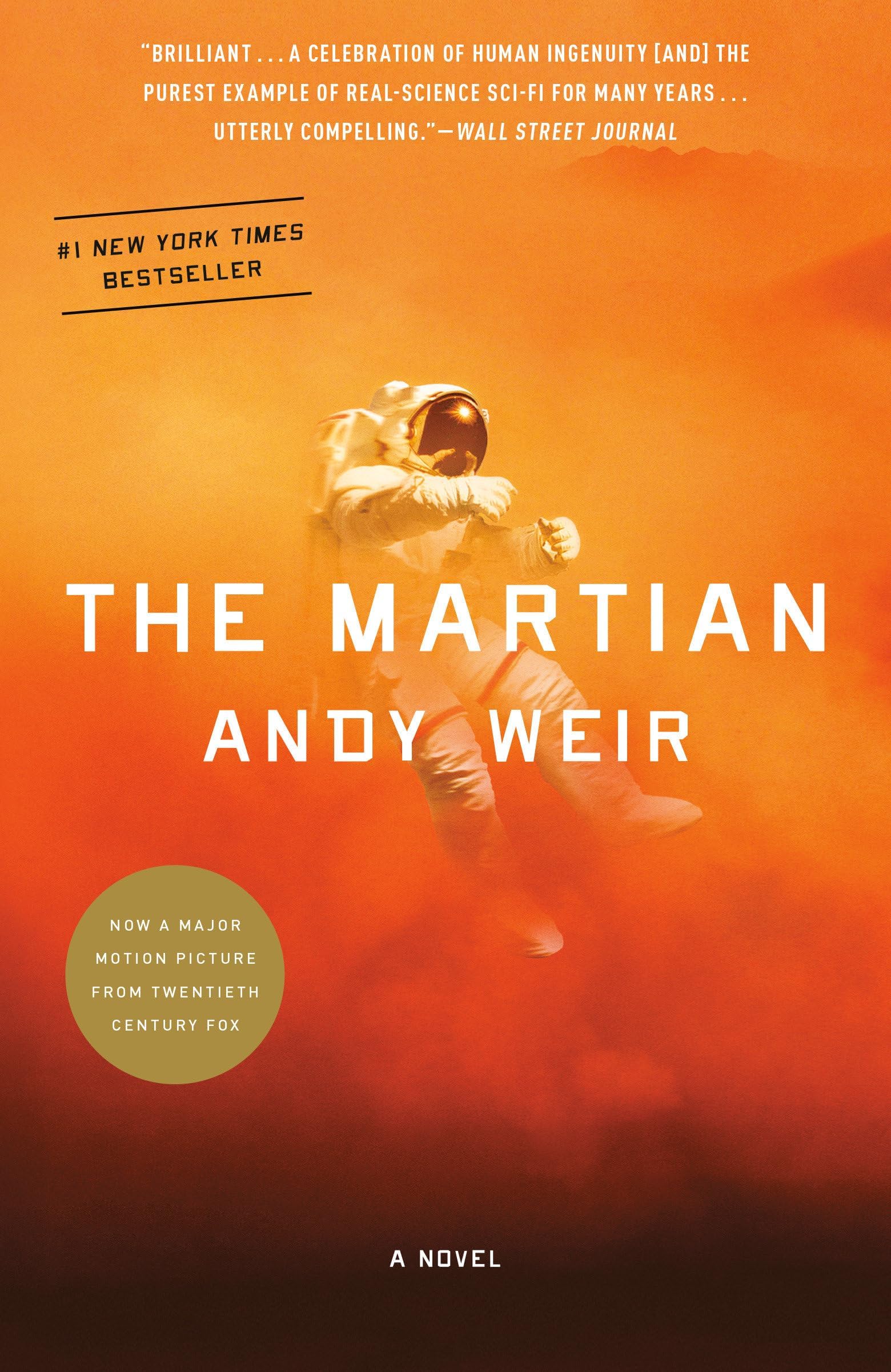
The Martian
Product ID: 7661399
Buy anything from 5,000+ international stores. One checkout price. No surprise fees. Join 2M+ shoppers on Desertcart.
Desertcart purchases this item on your behalf and handles shipping, customs, and support to France.
#1 NEW YORK TIMES BESTSELLER • NOW A MAJOR MOTION PICTURE A mission to Mars. A freak accident. One man’s struggle to survive. From the author of Project Hail Mary comes “a hugely entertaining novel that reads like a rocket ship afire” ( Chicago Tribune ). “Brilliant . . . a celebration of human ingenuity [and] the purest example of real-science sci-fi for many years . . . utterly compelling.”— The Wall Street Journal Six days ago, astronaut Mark Watney became one of the first people to walk on Mars. Now, he’s sure he’ll be the first person to die there. After a dust storm nearly kills him and forces his crew to evacuate while thinking him dead, Mark finds himself stranded and completely alone with no way to even signal Earth that he’s alive—and even if he could get word out, his supplies would be gone long before a rescue could arrive. Chances are, though, he won’t have time to starve to death. The damaged machinery, unforgiving environment, or plain-old “human error” are much more likely to kill him first. But Mark isn’t ready to give up yet. Drawing on his ingenuity, his engineering skills—and a relentless, dogged refusal to quit—he steadfastly confronts one seemingly insurmountable obstacle after the next. Will his resourcefulness be enough to overcome the impossible odds against him? NAMED ONE OF PASTE ’S BEST NOVELS OF THE DECADE “As gripping as they come . . . You’ll be rooting for Watney the whole way, groaning at every setback and laughing at his pitchblack humor. Utterly nail-biting and memorable.” — Financial Times Review: Adventure, Suspense, and Humor wrapped together in a Marvelous Book! - This is a truly marvelous and wonderfully entertaining book. It is also “gripping” in a good way. As some other readers noted, I stayed up way too late some nights because I simply had to find out what was happening as Mark Watney, the Mars-stranded astronaut, struggles not only for survival but hopefully for ultimate rescue. It is not Science Fiction. It is Science. Fiction. Subtle difference. The author, in addition to possessing tremendous knowledge about interstellar details, also put a lot of time into research and his own computer simulations to ensure the details of the story are as accurate as possible. What makes the story work is the situation, an astronaut stranded on an essentially uninhabitable planet far from Earth, and the lead character Mark Watney. He's a veritable “MacGyver” in terms of his ingenuity in figuring out not only how to survive, but also to overcome the inevitable series of mishaps and anomalies that occur throughout his time on Mars. The book starts out with a 'grab you' opening: "I'm stranded on Mars. I have no way to communicate with Hermes or Earth. Everyone thinks I'm dead. I'm in a Hab designed to last 31 days. If the Oxygenator breaks down, I'll suffocate. If the Water Reclaimer breaks down, I'll die of thirst. If the Hab breaches, I'll just kind of explode. If none of those things happen, I'll eventually run out of food and starve to death. So yeah. I'm f----d." The next several opening pages dwell a lot on the scientific aspects of space travel and the Martian environment to the point that I was thinking “geek book.” But the story soon transitions into the rhythm that makes it such a wonderful read. Much of Mark's narrative in the book consists of his Daily Log entries – a writing perspective well-suited to the book, since he has literally no one with which to communicate. What comes through is his strong positive attitude spiked with a wicked sense of humor. You will really come to not only admire Mark, but genuinely like him as well – which means you will be “pulling for him” throughout the book - “C'mon Mark!” Every “up” in the book (e.g. he is finally able to establish communication with Earth) is soon accompanied with a corresponding “down” (e.g. his Martian dwelling – the “Hab” - explodes), etc. Most of us would just give up; I mean it's another four years before there's another Mars mission planned, and he has neither the food, water, or other means to last that long or travel to the planned landing site. But not Mark – he takes each problem in stride, puts his logical (and ingenious) mind into action, and, well, somehow survives another day – and longer, and even does it with a sense of humor. The dialogue beyond Mark's Daily Log is excellent, the plot sublime, and the story would make a wonderful movie. But wait, it IS going to be a movie, starring Matt Damon (great choice!) coming out in November 2015. Can't wait to see it. Read this book!!! Review: The Martian for the High School Math Classroom - Mark Watney has it all together: he’s got the looks, the great sense of humor, and let’s not forget the dream job: an astronaut on the Ares 3 mission to Mars. There’s only one problem: he’s stranded there alone. Sorry ladies. This is the basic plot of Andy Weir’s New York Times bestseller The Martian, an incredibly detailed scientific novel filled with thrill, humor, and passion. Mark Watney becomes stranded following a terrible Martian storm that forced his crew to evacuate without him and landed him punctured with an antennae. Unless by some fat chance he can be rescued, Mark must use his skills as a botanist and engineer to survive alone on a planet known for its inability to sustain human life. Mark must use extensively challenging mathematical and scientific formulas to determine everything from how to ration the food left by his crewmates, how to grow potatoes in bacteria-less Martian soil (spoiler alert: he uses his own crap as a fertilizer), how to increase his water supply by passing hydrazine over a catalyst, to how to communicate with NASA using the computer system from the Pathfinder, an unmanned American spacecraft that landed on Mars in 1997. The Martian’s plotline seems entirely unfeasible and unrelatable. It’s pretty hard for me to believe someone could travel to Mars, let alone coincidentally have the skills of a botanist and an engineer necessary to survive on a desolate planet. However, in many ways, Mark’s experiences are very relatable! From the moment Mark discovers he is stranded, he refuses to go down without a fight. His determination when faced with the seemingly impossible is inspiring, and his wit kept me laughing for hours. Without Mark’s hilarious commentary amidst terrifying events, such as a fatal explosion, a deadly dust storm, and many other failed experiments, the suspenseful and intriguing plot would have been overshadowed by scientific explanations that could easily become boring after a few chapters. Weir’s detailed descriptions of Mark’s emotions, from loneliness to anger to fear, appropriately encompass the emotions that would transpire for anyone stranded far from home with no family, friends, or knowledge of what the future holds. Speaking of the novel’s scientific content, many times, Mark’s calculations were over my head. Despite that, as a future high school math teacher, I would love to incorporate The Martian into my classroom. Why, you ask? Well, Mark is a cool character. He curses, he rejects authority, and he’s super blunt. Basically, he’s your average high school student’s hero. But he also loves math and science, and uses it to save his life. Furthermore, if students can truly connect with Mark, they will want to fight alongside him, which could entail wanting to solve Mark’s scientific problems, that is, if their teacher is enthusiastic enough! I think that The Martian could be incorporated into lessons through word problems within the context of many levels of high school math, from basic algebra to level one calculus. For algebra students, helping Mark find a basic linear equation for how long it will be until he runs out of food would be an interesting problem! For calculus students, helping Mark figure out his water-generating system using related rates and integrals would be more compelling than your average textbook word problem. Weir’s writing style is encapsulating, which makes his novel enjoyable for all readers, even those who aren’t normally fans of science fiction. Weir writes through Mark’s daily logs, allowing the reader to take part in Mark’s mundane tasks and feel his pain when something goes awry. What’s more, the rest of Weir’s characters give every reader someone to relate to. For the feminist, there’s the Ares 3 mission captain, Commander Lewis, whose passion to save her crew member is moving. For the computer geek, there’s Johanssen, the intelligent yet beautiful crew member to whom everyone annoyingly looks for their techy needs. For the guy who wants to do the right thing no matter the cost, there’s Mitch Henderson, the hardheaded flight director. For the lover of rags-to-riches stories, there’s Mindy Park, the dissatisfied NASA employee who moves up on the totem pole to work with NASA big shots after discovering Mark is still alive. For the cautious thinker, there’s Teddy Sanders, who basically leads the mission to rescue Mark, but always considers everyone’s safety first. If you don’t relate to one of those characters, there are plenty more to be discovered if you read! And I would recommend you do!


| Best Sellers Rank | #177 in Books ( See Top 100 in Books ) #3 in Hard Science Fiction (Books) #5 in Science Fiction Adventures #49 in Suspense Thrillers |
| Customer Reviews | 4.6 out of 5 stars 183,210 Reviews |
C**E
Adventure, Suspense, and Humor wrapped together in a Marvelous Book!
This is a truly marvelous and wonderfully entertaining book. It is also “gripping” in a good way. As some other readers noted, I stayed up way too late some nights because I simply had to find out what was happening as Mark Watney, the Mars-stranded astronaut, struggles not only for survival but hopefully for ultimate rescue. It is not Science Fiction. It is Science. Fiction. Subtle difference. The author, in addition to possessing tremendous knowledge about interstellar details, also put a lot of time into research and his own computer simulations to ensure the details of the story are as accurate as possible. What makes the story work is the situation, an astronaut stranded on an essentially uninhabitable planet far from Earth, and the lead character Mark Watney. He's a veritable “MacGyver” in terms of his ingenuity in figuring out not only how to survive, but also to overcome the inevitable series of mishaps and anomalies that occur throughout his time on Mars. The book starts out with a 'grab you' opening: "I'm stranded on Mars. I have no way to communicate with Hermes or Earth. Everyone thinks I'm dead. I'm in a Hab designed to last 31 days. If the Oxygenator breaks down, I'll suffocate. If the Water Reclaimer breaks down, I'll die of thirst. If the Hab breaches, I'll just kind of explode. If none of those things happen, I'll eventually run out of food and starve to death. So yeah. I'm f----d." The next several opening pages dwell a lot on the scientific aspects of space travel and the Martian environment to the point that I was thinking “geek book.” But the story soon transitions into the rhythm that makes it such a wonderful read. Much of Mark's narrative in the book consists of his Daily Log entries – a writing perspective well-suited to the book, since he has literally no one with which to communicate. What comes through is his strong positive attitude spiked with a wicked sense of humor. You will really come to not only admire Mark, but genuinely like him as well – which means you will be “pulling for him” throughout the book - “C'mon Mark!” Every “up” in the book (e.g. he is finally able to establish communication with Earth) is soon accompanied with a corresponding “down” (e.g. his Martian dwelling – the “Hab” - explodes), etc. Most of us would just give up; I mean it's another four years before there's another Mars mission planned, and he has neither the food, water, or other means to last that long or travel to the planned landing site. But not Mark – he takes each problem in stride, puts his logical (and ingenious) mind into action, and, well, somehow survives another day – and longer, and even does it with a sense of humor. The dialogue beyond Mark's Daily Log is excellent, the plot sublime, and the story would make a wonderful movie. But wait, it IS going to be a movie, starring Matt Damon (great choice!) coming out in November 2015. Can't wait to see it. Read this book!!!
A**R
The Martian for the High School Math Classroom
Mark Watney has it all together: he’s got the looks, the great sense of humor, and let’s not forget the dream job: an astronaut on the Ares 3 mission to Mars. There’s only one problem: he’s stranded there alone. Sorry ladies. This is the basic plot of Andy Weir’s New York Times bestseller The Martian, an incredibly detailed scientific novel filled with thrill, humor, and passion. Mark Watney becomes stranded following a terrible Martian storm that forced his crew to evacuate without him and landed him punctured with an antennae. Unless by some fat chance he can be rescued, Mark must use his skills as a botanist and engineer to survive alone on a planet known for its inability to sustain human life. Mark must use extensively challenging mathematical and scientific formulas to determine everything from how to ration the food left by his crewmates, how to grow potatoes in bacteria-less Martian soil (spoiler alert: he uses his own crap as a fertilizer), how to increase his water supply by passing hydrazine over a catalyst, to how to communicate with NASA using the computer system from the Pathfinder, an unmanned American spacecraft that landed on Mars in 1997. The Martian’s plotline seems entirely unfeasible and unrelatable. It’s pretty hard for me to believe someone could travel to Mars, let alone coincidentally have the skills of a botanist and an engineer necessary to survive on a desolate planet. However, in many ways, Mark’s experiences are very relatable! From the moment Mark discovers he is stranded, he refuses to go down without a fight. His determination when faced with the seemingly impossible is inspiring, and his wit kept me laughing for hours. Without Mark’s hilarious commentary amidst terrifying events, such as a fatal explosion, a deadly dust storm, and many other failed experiments, the suspenseful and intriguing plot would have been overshadowed by scientific explanations that could easily become boring after a few chapters. Weir’s detailed descriptions of Mark’s emotions, from loneliness to anger to fear, appropriately encompass the emotions that would transpire for anyone stranded far from home with no family, friends, or knowledge of what the future holds. Speaking of the novel’s scientific content, many times, Mark’s calculations were over my head. Despite that, as a future high school math teacher, I would love to incorporate The Martian into my classroom. Why, you ask? Well, Mark is a cool character. He curses, he rejects authority, and he’s super blunt. Basically, he’s your average high school student’s hero. But he also loves math and science, and uses it to save his life. Furthermore, if students can truly connect with Mark, they will want to fight alongside him, which could entail wanting to solve Mark’s scientific problems, that is, if their teacher is enthusiastic enough! I think that The Martian could be incorporated into lessons through word problems within the context of many levels of high school math, from basic algebra to level one calculus. For algebra students, helping Mark find a basic linear equation for how long it will be until he runs out of food would be an interesting problem! For calculus students, helping Mark figure out his water-generating system using related rates and integrals would be more compelling than your average textbook word problem. Weir’s writing style is encapsulating, which makes his novel enjoyable for all readers, even those who aren’t normally fans of science fiction. Weir writes through Mark’s daily logs, allowing the reader to take part in Mark’s mundane tasks and feel his pain when something goes awry. What’s more, the rest of Weir’s characters give every reader someone to relate to. For the feminist, there’s the Ares 3 mission captain, Commander Lewis, whose passion to save her crew member is moving. For the computer geek, there’s Johanssen, the intelligent yet beautiful crew member to whom everyone annoyingly looks for their techy needs. For the guy who wants to do the right thing no matter the cost, there’s Mitch Henderson, the hardheaded flight director. For the lover of rags-to-riches stories, there’s Mindy Park, the dissatisfied NASA employee who moves up on the totem pole to work with NASA big shots after discovering Mark is still alive. For the cautious thinker, there’s Teddy Sanders, who basically leads the mission to rescue Mark, but always considers everyone’s safety first. If you don’t relate to one of those characters, there are plenty more to be discovered if you read! And I would recommend you do!
K**D
Lost on Mars. A delightful read with great wit and humor. A Must Read!!!!!!
Space, the final frontier. I have been a die-hard fan of flying to the stars for as long as I can remember. My dad took me down to the Capital in Santa Fe, when I was five, so I could see the space capsule and shake the hand of the astronaut who flew into space (around the world a couple of times). He gave me a signed postcard and a little flag. My dad still has them and I still have the vivid memories. I still have the vivid memories of my dad waking us up so we could witness Neil Armstrong landing on the moon and taking those first steps. “One small step for man, one giant leap for mankind”. It was an old black and white TV and the reception wasn’t the best, but we were watching history for mankind, and I felt the import of the event. Sending men to Mars is not too much farther in my mind for us to do. Come on, how far have we gone with Star Trek? Star Wars? But really, even now, we have managed to get a space vehicle to go to Pluto with only a four hour delay in transmission. WOW!!!! That is so far beyond my thinking of the speed of what I thought we were capable of. And then we land a man on Mars and he gets taken out by a sandstorm, not a meteor shower, or a capsule blowing up, but a sandstorm… man, we had sandstorms in Texas that could take out houses… Can you imagine? Stuck on Mars? And no ride home? At least not for three or four years. Boy, time for creative thinking. I have a year’s worth of food and no water…hm. Well, of all the guys to get stranded, the lucky dog would be the farmer. And to make matters even better, he was also the tinker man. I grew up with the expression being bounced around “nothing that bailing wire and duct tape won’t fix.” Between a botanical degree, and the ability to disregard box-style thinking, Mark managed to create a biosphere from Martian soil, his waste, and figuring out how to suck water out of some Hydrogen fuel tanks. He also created enough food to survive utilizing a few fresh food items he discovered on-board and growing them in the created biosphere. What kept the book, Mark, and me rolling, was the rollicking, tongue in cheek journal entries that were a caustic slap schtick. He had the ability to laugh at his perilous situation and mock his tenuous hold on life out in the wilds of Mars --- alone. In its interesting way, the book truly gave us a look at the kind of personality and tenacity that it demanded of an person who commits to a long term program of isolation and stress. The demands needed to think on his feet, to be flexible, to be creative, to work through, around, over, and rework problems and solutions till answers are found. The other storylines of how NASA back on earth, and the astronauts returning home in the spaceship were handing the incident were also quite interesting. While Mark was focused on survival, survival, survival, back at NASA politics and petty hierarchies seemed to take preferences, at times to the actual goal of getting Mark back home. The book was written in a journal format and in the first person. The sections where there were flash-overs to NASA and to the other space craft (rocketing back towards earth), was written in a third person voice, as you observed what was happening, much like a fly on the wall. Back story and depth was skillfully played out through Mark’s reflections in his log. At one point, once he realized that NASA knew he was alive, he made the sarcastic remark that he was going to have to go back and clean-up and delete some entries on the journal, now that he knew it would be read. I cracked-up. Ooops…. I have always been one who says give me the book, maybe I’ll watch the movie, but this time around, Andy did such a wonderful job of building the world that Mark had to survive in, that I am now dying to see how it is visualized on the big screen this fall when the movie comes out. I loved this book. It was a wonderful lite read that left me laughing. The technical jargon was part and parcel and made the book work. I give this book a full FOUR STAR RATING. A great weekend read. And a must read before you see the movie!!!!!
J**Z
like my hip replacement surgery back in 2013
I'd been hearing quite a bit about The Martian, but for some reason was reluctant to dive into it. I'd never heard of Andy Weir, and while I don't mind jumping into works by an author I don't know, this time I hesitated. Then, Amazon was offering the e-book for cheap, and as a bonus they were also offering,through Audible, the audiobook with the Whispersync capability. I took that as a sign, made the purchases, and dug in. And, like my hip replacement surgery back in 2013, wished I'd done so a lot sooner. Mark Watney is an astronaut on the Ares 3 Mars mission. It is Sol 6 - the sixth day the crew was on the planet's surface, when a fierce sandstorm hit. The crew is given the word to scrub the mission and evacuate the planet. If they stayed through the sandstorm, their ascent vehicle would be wrecked and they would be unable to leave. In the process of getting back to the ascent vehicle, Watney is struck by a flying piece of equipment. His spacesuit is pierced and he can't get to the vehicle. An attempt is made to retrieve his body, but the crew has to leave before they can get to him. They leave his corpse on the Martian surface. Except, as you might guess, Watney wasn't dead. His suit was breached in such a way that the hole was plugged just right by the equipment that pierced it. He got back to the hab, and the story takes off from there. Watney is a botanist and an engineer - a convenient combination if you're going to be stranded on the surface of a planet all by yourself and you're trying to figure out how to survive until the next manned mission to Mars more than a year later. As a botanist you have a shot at figuring out how to feed yourself for over a year, and as an engineer you have a shot at figuring out all the rest of the problems that you would encounter along the way. Where is the air going to come from? Where's the water going to come from? How am I going to make do with what I have? How am I going to get to the landing site of the next mission? And just how am I going to survive everything that Mars throws at me? What follows is the story of one man against a planet. One man trying to survive anyway he can to get to go home - even when no one else knows he's alive. It's a fascinating look at what one ingenious person can do when the odds are against him. But lest you think that the entirety of this story follows Watney around on the surface of Mars trying to survive - well, it doesn't. I will have to admit that I thought that was going to be the case, and that it would be pretty boring. Then, when I was least expecting it, Weir does take us to Earth, to follow the exploits of the people who are involved in trying to get Watney back home - once they find out that he's alive. The third leg of the bar stool is the crew of Ares 3 - those folks who left Watney behind. This really is the story of how humanity can work together when it is targeted on a common goal. It's a celebration of how we really can accomplish things if we put away our petty differences and get down to the task at hand. Each leg on the aforementioned barstool has a role to play, and each leg plays it well, although as you might guess not without some difficulty. Watney is the picture of perseverance, tackling anything and everything Mars throws at him. He does so with humor and sarcasm; I frequently found myself laughing out loud when Watney went into humor mode - and it was often. But he was strong, always strong, even when he made a mistake that could have cost him dearly. The ground personnel on Earth worked like the personnel in those Apollo missions - sometimes flying by the seat of their pants, with no clue how things were going to work out. And finally, the Ares 3 crew, voting to spend another year of their lives to go back and get their teammate, fighting their own problems to get there and get the work done. Yes, it does seem like Apollo 13 all over again. This is very much a "hard" science fiction story. There's lots of science here. Weir did his research, and uses it to explain, through the logs entries that Watney makes, just how Watney gets through every situation he finds himself in. Yep, the grand tradition of the info dump is in full swing here, and that may turn some people off. But this is "science" fiction in the original sense of the term. It's problem-solving science fiction, and darn it, even with all that, it's one compelling, gripping story. I found myself caring very deeply about what was happening to Watney, and I looked forward to how he was going to get out of each and every problem he found himself in. I read one quote that used the term "MacGuyver on Mars". Yep, that was it alright. R.C. Bray was probably the best narrator I've heard to date in any audio book I've listened to, with the possible exception of Wil Wheaton narrating a John Scalzi novel. He was emotional, vibrant, and was *never* boring to listen to. He made Watney's jokes come alive. He was simply outstanding. I'm sure some of that was the source material, but the narrator still has to put his/her stamp on the book. Bray did an outstanding job. Whether you listen to or read this book in the traditional manner, I think you'll enjoy it. I know I did. And I think I may just pick up the next Weir novel when it comes out.
J**U
One of the best stories you could read today! Fall in love with space travel again.
UPDATE - Even if you saw the movie, READ THE BOOK! Since reading this book, we have watched the movie at least ten times. It's wonderful of course, but incapable of including all the wonderful bits and pieces, and events, that the book has. Many things have to be left out to produce a movie that isn't four hours long. You will not be bored or disappointed reading this at all if you saw the movie but didn't read the book. It will be even better, and give you all the bonus scenes the movie couldn't. ORIGINAL REVIEW: Absolutely fabulous story. An astronaut that gets stranded on Mars and needs to find a way to stay alive as time passes and supplies & equipment run out or degrade. Instead of giving you any "summary" of the rest of the story line, I'm going to talk about why it's such a great book to read and leave all the cool, funny, suspenseful and dramatic details untouched so you can really enjoy them as you read it yourself. I knew absolutely nothing about the story before reading it, beyond what I've just said in my second sentence above, and I do believe it would make a huge difference. My husband and boys all read this when I did and we were constantly laughing out loud or asking each other, "Where are you at....what's he doing right now?" My oldest is still reading it and I'm finding my self enjoying the revisiting of the story as he passes each chapter. Andy Weir has a very cool writing style. It is different than a lot of other styles I have gotten used to, and I found myself enjoying the change a lot, which means he does it very well. He's really funny and it comes out in his main character in so many ways. After the first few chapters, you find yourself with a page turner that you hate to put down and can't wait to fall back into. I actually paused at the last page of the last chapter thinking there was going to be more, and when I returned to the story the next day with my feet curled under me on the couch I was heartbroken to find the next page was not the start of another chapter but the "Thank you for reading" screen. It was like losing a best friend or a family member to find I had nothing else to read in the book, (well, the interview with Weir at the end of the book was a nice bonus as I was desperate for more...) While others might think it's a negative strike against a book for it to end while the reader thinks there's going to be more, and it is in most other cases, it wasn't in this book. It could have ended at a lot of various different points without leaving the reader to feel like too many loose ends had been left. He chose a good place to end it, but the story was soooo good I would have eaten up 10 more chapters easily, and then some! There's another whole book of real challenges and suspense he could write about after the point he ended this one at. It didn't seem like he did that intentionally, but I would love to read the "next adventure" picking up where he left off. I kept telling my husband after I had finished it, "I miss my martian!!!" I was literally sad for a day or two wanting to hear the details of his next day and not being able to. LOL Now, the science part. Don't click away with a yawn looking for something else. Andy Weir's writing will completely take you by surprise as you find out how much you enjoy understanding the finer scientific reasoning, physics and chemistry behind things this astronaut can or can't do on Mars, and following his logic as he tries to figure out ways to survive. Almost everything the astronaut does is absolutely believable, and his attitude, reactions, and emotions all ring true to the reader as something they themselves probably would think, feel or do. It's so "down to earth" (but on Mars - ha ha) that it makes it engaging. Reading this story doesn't leave you in that fun "what if" wonderment state like some science fiction does with unbelievable circumstances or worlds that are not based in our reality. Weir basis his entire story on our present reality, and writes about the actual probable circumstances if this actually happened. It leaves you thinking, "that's probably just what it's like, or would be like," and you feel incredibly educated about the planet Mars, a fresh wonderment all it's own. You find yourself more motivated to see the real-life discoveries mankind has about Mars in the future; as well as our potential for space travel in general from a realistic point of view. Has Weir found the magic formula to reignite the excitement and imagination of the American public once again for space travel? I think so. As for reading about the physics or chemistry behind his adventures, don't make the mistake of thinking it will be too boring or complex to enjoy. Weir knows how to word things so that you're eyes don't glaze over, and instead you find yourself understanding completely, or quickly Googling something you want to know more about, (and never thought you would!) That's something I found myself doing a LOT!! That's pure inspiration and what makes Weir such a good writer. He also let's the reader off the hook in so many places throughout the story with graceful and/or funny transitions into laymen's terms or explanations, or by having the character admit he really doesn't understand the science behind something, (that's the other astronaut's specialty,) and then he goes about talking plainly while you laugh at how simple to understand it really was. Rather than struggling to understand the science he explains, you find yourself enjoying it with his relaxed writing. This character is a highly intelligent NASA astronaut, and yet the writing, without cutting too many corners, makes you feel like you're on equal footing intellectually. What's really funny is the realization that mankind has created a lot of complicated lingo to communicate within each of the different specialties of knowledge. An efficiency necessity among equally trained individuals for sure, but those who choose to speak their specialized lingo at all times unnecessarily alienate those outside their field. When that same communication is put more simply, it's actually not that hard to understand at all. Kudos to Weir for knowing this and humorously getting around it. Don't pass on this read. Trust me, you will love it and be glad to have read it.
R**S
In space, no one can hear you scream like a little girl
Less than a week after the third manned mission to Mars lands on the planet's surface, a sudden dust storm forces the crew to make an emergency evacuation. When botanist/mechanical engineer Mark Watney is struck violently by flying debris and his suit torn open as he falls back into the storm, his team knows he can't have survived the instant decompression. As their ascent vehicle rises to join the ship in orbit to start the voyage home to Earth, the members of the crew, racked with guilt, mourn a friend and colleague - the first human being to die on Mars. But back down in the dust, Watney opens his eyes. The position of his body and the rapidly drying blood from his wound sealed the breach in the suit just enough for the life-support systems to be able to function. He's still alive, and able to carry himself to the relative safety of the domed habitat that had been the astronauts' home on what was to have been a mission of about a month - but for how much longer? He has no way to communicate with Earth or the ship, and the next mission to Mars won't be for several years. Dare he even hope he can find a way to survive so long, so alone, in such a hostile environment? Fortunately, Watney's years of training and background in sciences and engineering are matched by his ingenuity and sheer determination to survive. And although he doesn't know it, NASA has stumbled across evidence of his survival. Between their efforts and his own, he just *might* have a chance. Andy Weir's "The Martian" is diamond-hard science fiction that reads like tomorrow's headlines. The novel takes place in the very near future (Weir never specifies a date, but it's obviously within the next couple of decades, since scientists who worked on Pathfinder in the mid-1990s are still around), and the author's research is so extensive, his attention to detail so painstaking, that it's almost impossible to imagine that, if and when we do go to Mars, it won't be almost exactly the way Weir describes it. It's not hard to tell that science itself is Weir's first love - in the "log entries" that comprise most of the book, Watney narrates his struggle for survival with an impressive degree of technical detail. Although the narrative voice is, with very few lapses, that of an astronaut pondering things over for his own benefit rather than that of a lecturer educating the less well-informed, Weir's lucid style serves up this hard science with a surprisingly easy touch. Readers who share the author's nerdy proclivities will be hanging on his every word, but any reader who ever took a basic high school science class should be able to get the gist of what's going on even in the most jargon-heavy passages. Nor does Weir ever forget that this is a novel, not a scientific treatise. Watney's wickedly irreverent sense of humor not only helps him maintain morale, it adds a touch of levity to the technical descriptions and keeps the reader emotionally engaged. The occasional paragraph or two that might make for dry reading in isolation can prove breathlessly suspenseful in the context of the life-or-death struggle of a character we care about. Watney's use of humor to cope with stress stems largely from Weir's desire to keep the novel focused on his struggle for survival rather than his depression and loneliness, but what seems a sometimes relentless optimism just makes Watney's occasional melancholy or meditative lapses all the more poignant. Scenes that take place among NASA scientists working back on Earth to find a way to bring Watney home, or among the members of Watney's mission team on their homebound voyage, allow for an occasional change of pace and tone as Weir ventures into the intra-agency conflicts and geopolitical compromises of the space program. This is ultimately a plot-driven novel, with little in the way of dynamic character development, but Weir hasn't cut corners creating a cast of characters worth reading about: though not particularly complex, they are fetchingly sketched individuals, flawed and often funny and very, very likable. I'm a voracious reader of both fiction and nonfiction across a variety of genres. I love to learn, and I love a good story. The best narrative nonfiction (Hillenbrand, Krakauer, Philbrick) satisfies on both counts, as does the rare historical novel (Margaret George, Irving Stone), but I don't believe I've ever read a work of speculative fiction that managed to hit that sweet spot - until now. (Michael Crichton comes close. If you don't believe it's possible to get shivery suspenseful thrills from a lecture on aerodynamics, you obviously haven't read "Airframe.") "The Martian" is, quite simply, one of the rare popular novels to deserve all the praise it's been getting. We just may have Andy Weir to thank for inspiring the next generation of scientists, engineers, and astronauts - as well as a general populace more than happy to keep its feet safely on terra firma, but newly awakened to the thrilling possibilities of space exploration.
N**H
Math! Science! Potatoes!
This must have been a good book because I finished it in 48 hours, and I couldn’t put the book down once I hit the three-quarters mark. Any quibbles I may have with the book were made up for by it’s stress-inducing finale. Good stuff. As the cover would seem to indicate, the novel is all about an astronaut, Watney, who is accidentally stranded on Mars. Then he spends the rest of his time using Science! and Math! (and Potatoes!) to survive. For the first half the narration is told mostly in journal form, but eventually other characters and other perspectives are brought to bear and Weir tells their stories in more traditional forms. The story itself takes a little while to develop, and at times the book reads more like the world’s largest word problem from my freshman math class. I usually understood the basic problem Watney was solving, but after about the third “word problem,” I started glossing over the numbers to see if he had come to a solution or not - he usually does. The mix of writing styles works for the most part, building suspense up to the very last page. The question is, will Science! and Math! get Watney to the end of the book? Or will he end up like Pathfinder, cold and lifeless? You’ll just have to read and find out. I thoroughly enjoyed the premise of the book, and I’m actually surprised that more authors have not written in the very-near-future-space-exploration-thriller niche. The only other book that comes immediately to mind is James Smyth’s The Explorer. (Though to be fair, they are very different books.) While most adults will enjoy reading the book, I think that high school students would really enjoy reading the book, too. There’s lots of cussing in order to make the book edgy, but the characters often come with the sarcasm of a witty adolescent. This will be an easy book to hand to my high school students - they’ll quite like reading it, and they’ll feel smart doing so. For a first book, this is a very strong debut for Mr. Weiss, and I sincerely hope that he continues to find success so that we will have many more of his books to read. On a side note, the book cover, simple though it is, is absolutely beautiful. I spend a lot of time complaining about bad book covers, so let me say again that the cover for The Martian is stunning. The images on your computer don’t do the real-life version justice. My Festivus Review and My Airing of Grievances: Good Lord, no one in the position of Watney, stranded on Mars, would be so calm and collected, let alone cracking the ridiculous amounts of stupid jokes! The normal, serious demeanor of most astronauts in a crisis is no where to be found on Watney. I would be much more forgiving of his personality, if it had started serious and evolved into something more loose and natural, but from the very first page he is nothing but bad jokes. It is so hard to feel for a character who doesn’t go through a normal range of emotions. Being left on Mars should be a soul crushing ride of emotions, but we only get one emotion from Watney: smartass. And not even a very clever smartass at that. You can only type the word “Yay!” a few times before it gets old...and it got really old in this book. I actually felt more for the supporting characters because they went through real emotions. I didn’t get nervous that Watney would be rescued, I got nervous that the supporting cast wouldn’t rescue him. Books aren’t supposed to be that way! While this was a good book, fixing this one issue would have made the book fantastic. However, I still really liked this book. Alright. I guess that’s the end of my review. (Yay!) (Facepalm.)
J**Y
Totally NOT a rant (yep, it's a rant).
I know there are LOTS of reviews already, so maybe mine will just be added to the sea of voices. However, I feel I should point something out, so here is my rant...er..I mean review So, after reading this book, which I read faster than any novel I've ever read...I was intrigued by what others might have thought. I for one chalked up my hysterically enthusiastic love for this book to my marsophile way of looking at the world, and y'know me being an engineering student and a super nerd. Well, I was pleasantly surprised to see so many people did in fact like this book. Wow! People really DO give a sh*t about science! Yay! Ok, so I guess I'm not saying all bad stuff. But I was still frustrated by some of the one-stars. I found a common trend among most (not all) of the one star reviews. The typical complaints I found were these: The book is boring/tedious The book is too technical/"science-y" The writing is sophomoric/bad/etc The characters are juvenile/immature The characters are one-dimensional Go ahead and look at the one star reviews, and nearly EVERY SINGLE ONE of them says one or more of those exact things. Why would I be bothered by this? Well I'll start with the most nebulous or difficult to counter complaint and move to the most exacting, or easiest to refute. "The writing is sophomoric": Okay, so this one is sort of hard to refute. It's true that this is Andy's first novel, however, he isn't exactly new to writing. I will absolutely agree that his writing has a VERY distinct style to it, and if it just isn't your cup o' tea, it just won't improve. His style is polarizing. I think it's pretty obvious that he still has a lot to learn about writing, but I found his attention to detail, and pacing to actually be pretty darn good. Mostly he did the right thing in that his writing got out of the way of itself. I think a lot of this hinges on the other complaints though. If you found the story too technical or tedious, then clearly it'd be difficult to let the writing get out of the way. In fact, it'd be assaulting you right in the eyeballs in a pretty horrific way, and I think that's how it ended up for a lot of the negative reviewers. "Too tedious/boring/technical" This complaint I find to be highly alarming. The technical explanations NEVER exceed anything above high school level. Some of it IS specific, but not that hard to look up. In fact, plenty of "good writing" that is well respected tends to push the reader's vocabulary, they have to look words up, or learn new uses for old words. This is NOT uncommon in the world of great literature. Andy has chosen instead to expand the reader's technical vocabulary. And admittedly, your technical understanding SHOULD be at a level high enough to understand this. If it isn't, I'd recommend reading it, looking up what you don't understand, and reading it again. If this book is too technical for you, then your education has failed you, so do better! This is like complaining that a race car is hard to drive. Well, yeah, of course it is if you don't know how to drive one, driving a passenger car is hardly sufficient enough skill to operate a race car. Same principle here. "one-dimensional/juvenile/immature characters" I find this to be most disturbing of all. If you GENUINELY feel that these people, especially Whatney behaves in a unrealistic way, then I feel VERY sorry for people who interact with you. I was surprised by the depth of the character study done here. I personally resonated with Whatney! My wife went as far as to say that he talks just like me! So of course, I suppose that means many of you one-star reviewers would write me off as juvenile. Yikes. Spoiler: different people have different personalities. Mark Whatney is a CLASSIC "INTP". If you don't know what an INTP is, then google it and read it. You'll notice Mark behaves VERY similarly. In fact, I'd go as far to say that Andy himself might have this personality type, which lends itself well to injecting such passion into the main character, and bleeds through into the writing style itself. Look, this is a FANTASTIC book. If you are really into the space colonization thing, aerospace industry, survival stories, mars stories, and you have a decent enough technical background (or don't mind learning what you don't know) then this is probably a book you will want to read. I think a willingness to be open to both people and details are needed to fully appreciate this novel. Not all the negative reviews are bad, some have pretty valid points about Andy's amateur status. But overall, the majority of the negative reviews should be shunned due to their intolerance of those personalities that fail to match their social standards, and/or general lack of technical competency. I can sum up who should NOT buy this book: The stupid people who can't see the point of math after highschool (how is your retirement account coming along? lots of numbers, right?) The vapid self-centered people who think they're type of personhood and worldview is the only one that matters OR The person who is a rather competent reader who just happens to not be into this kind of story. But for almost anyone else who is interested, you already know you are, so just buy the darn thing already. And if you're offended by anything I said in this review...well, you won't be able to handle Mark Whatney, so you might as well NOT buy it.
E**Y
The kind of Sci-fi book I love to read! Amazing is the word.
Fantastic book. I have watched the movie first, then started reading Project Hail Mary and ordered this book. The quality of the paper and binding is also good. Also arrived in good condition. However it was supposed to be delivered home. For some reason I had to collect it from a service point. I think it was a mistake by the courier. So I would still go with a five star ⭐⭐⭐⭐⭐.
A**N
Źle zapakowana przesyłka
Przesyłka uszkodzona, źle zapakowana. Okładka poniszczona już na starcie.
U**K
Hats-off Andy!!
There are a few rare books that you come across in your life that make you go – oh my gosh, this book is f*****g amazing!! The Martian by Andy Weir is exactly that kinda book. The premise is pretty simple actually. In the not-so-distant future, NASA has a crew of six astronauts on a manned mission to MARS (called Ares 3, so this is not the first). They land and everything’s dandy for 6 sols (Martians days) but right upon which a sandstorm hits. Our protagonist, Mark Watney, gets hits over by the wind and the other crew mates, presuming him dead perform an emergency exit off the planet. Only, he’s not really dead. He wakes up covered in sand to a dead planet. No humans around, no contact with NASA, and no way to get off the planet. Will he survive? And if yes, how?? But more importantly, what does this realization do to the humanity back on Earth? The book reads like a hard science-fiction and that’s not entirely a bad thing. If anything, it only lends more credibility to the narrative and all the wild science-y solutions that Mark Watney pulls out of his hat. But picture this, you’re the only living thing on an entire planet that is thousands of kilometers from Earth. No one knows you’re alive, and even if they do they’re pretty much helpless. What would one do? I thought hard about this, picturing myself in Mark’s situation. Of course he’s a trained astronaut and a botanist and I’m a…well, the point here is that where most people would have succumbed to the hopelessness of the entire thing, he fights and fights and fights some more!! And how! One moment you’re screaming your hearts out ‘NOOOOO! HE’S A DEAD MAN!’ and then Mark comes right up and says he’s gonna be alright. And you heave a big sigh of relief muttering to yourself cheerfully, ‘The bloody bastard’s gonna be fine!‘ That’s pretty much how most of the read went for me. And I have mention here that the author Andy Weir is brilliant! The kind of picture he paints of Mars, down till the smallest detail and the explanation to the various experiments conducted our protagonist – the science is all mostly accurate! And it amazes me for the kind of research and effort he had put into in crafting the entire book. I heard him say that he had to actually write a computer program himself to figure out how many days it would take for a spacecraft to travel from Earth to Mars. Yes, everything’s that calculated. So when Mark throws numbers and formulas at your face, it’s crazy to think that it’s all real. And that’s one more thing about this book, how utterly possible everything feels. This is not fantasy. The events and catastrophes featured in this book can actually happen in real life. That’s one more tangent my mind goes off to often, how would we react if something like this were to happen in reality? Wouldn’t the social media go absolutely crazy!? Wouldn’t there be numerous religious groups praying for his safety! And to say nothing of our protagonist himself. The large reason the book works despite the hard science is Mark’s sense of humor. I would put it somewhere close to Chandler Bing in that aspect. But he is not a brooder, he is a doer! And he cracks some amazing jokes throughout his journey. By the end of the book, you’ll really come to love this fellow. The other supporting cast are all well-etched out too. As an Indian, it was nice to see the character Venkat Kapoor as a high ranking NASA official (The name’s odd though. Kapoor is a North Indian surname while Venkat is definitely a Southie thing). I also loved the entire crew of Hermes. Especially Commander Lewis with her disco addiction. Andy Weir has struck gold with his first feature novel, and deservedly so. Books like this, they’re every bookworm’s kryptonite.
L**.
👽
👽👽👽👽👽👽👽👽👽👽👽
G**V
Best book I have ever read in my life, hands down. PLEASAE BUY, Feel free to ask questions!
FEEL FREE TO ASK ME QUESTIONS ABOUT THE BOOK! I would like to start this review with a note that is both a positive and a negative. I do not read any book, this is because I am never captivated and cant really empathize with the character and I never feel like I am there. But on to the review. "About this version of the product* The book came to me in pristine condition it was truly breath-taking how beautiful the cover is. The book is well sized and honestly this is one of if not the most beautiful and durable books I've bought. There is also a map in the beginning which is awesome since I was cross referencing it so much which made me feel very immersed. *About the book SPOILER FREE PART* The Martian is the most well written, funny, serious, and emotional book I have ever read. This is in part because of the amazing writing. Mark Watney is a charismatic, smart, and resourceful man. In the face of adversity he always manages to crack a witty joke that always made me chuckle or just burst out laughing (No im not psychotic, i don't think). The writing makes you really feel like you know mark which is one reason why you empathize and really feel for him. The Atmosphere is great really selling the barren expanse and devastating loneliness of the Martian lands. *Note: I found that using some noise cancelling headphones and playing some white noise, like the wind, really helped to sell the effect of being on mars*. After only a few pages I had a very clear picture of how it looked at the HAB and I only wish I could take a picture of my thoughts. The story jumps between the perspectives of Mark Watney on mars, Nasa and JPL on earth, and the crew on Hermes the space station the went to and from mars on. *General Consensus* I should have added some photos, including my favourite quotes. This is the best book I've read. I'm so sad its over yet so happy I've experienced it. Andy Weir is my new favourite author and i will be purchasing more of his novels no doubt. Please do yourself a favour and read this book. I cannot recommend it enough. 1000000 / 10 *LIGHT SPOILERS, what happens at the beginning* The book is about the main character Mark Watney's journey surviving mars after being abandoned there by his crew. What happened Watney and his crew consisting of, Lewis the commander, Vogel, Beck, Martinez, and Johanssen were six days into a 52 day mission on mars where they would gather science and conduct experiments when suddenly a large storm hit. The storm was so bad they had to evacuate but on their way to the MAV (Mars Ascent Vehicle) mark is struck by debris and is lost. The crew cannot find him and assuming he is dead abort without him. Mark wakes up and makes it back to the HAB, where he will live for the next (wont spoil how long) number of sols. He has a lot of problems along the way but manages to fix them in amazingly creative ways, I mean I cannot stress enough how glued my eyes were to the pages intrigued and worried about what would happen next. I wont spoil any more of the end because it would ruin how heart-breaking and heart-making (if that's a saying) a lot of the moments were.
Trustpilot
2 weeks ago
1 week ago