![Far From Heaven [DVD]](https://m.media-amazon.com/images/I/B1tFvxQlvpS._AC_SL3840_.jpg)
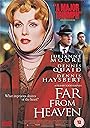

Far From Heaven [DVD]
Product ID: 56732587
Details
- FormatPAL
- ContributorCelia Weston
- LanguageEnglish
- Runtime1 hour and 47
- ColourColour
Buy anything from 5,000+ international stores. One checkout price. No surprise fees. Join 2M+ shoppers on Desertcart.
Desertcart purchases this item on your behalf and handles shipping, customs, and support to France.
Product Description Todd Haynes' tale of 1950s prejudices in America. Housewife Cathy Whitaker (Julianne Moore) thinks she has the perfect set-up; two children, a successful husband (Dennis Quaid) and a house in the suburbs. But this vision is shattered one night when she surprises her husband at work and finds him in the arms of another man. Not able to tell anyone in her social circle, she finds solace with their African-American gardener, Raymond (Dennis Haysbert). However, when they are seen alone together by Cathy's best friend (Celia Weston) - a social taboo in that era - the gossip begins and this threatens to reveal the Whitaker's secret life. .co.uk Review Far from Heaven is a uniquely beautiful film from one of the smartest and most idiosyncratic of contemporary directors, Todd Haynes (Safe and Velvet Goldmine). It takes the lush 1950s visual style of so-called women's pictures (particularly those of Douglas Sirk, director of Imitation of Life and Magnificent Obsession) to tell a story that mixes both sexual and racial prejudice. Julianne Moore, portraying an amazing fusion of vulnerability and will power, plays a housewife whose husband (Dennis Quaid) has a secret gay life. When she finds solace in the company of a black gardener (Dennis Haysbert), rumours and peer pressure destroy any chance she has at happiness. It's astonishing how a movie with such a stylised veneer can be so emotionally compelling; the cast and filmmakers have such an impeccable command of the look and feel of the genre that every moment is simultaneously artificial and deeply felt. Far from Heaven is ingenious and completely engrossing. --Bret Fetzer
R**Y
Heaven
Is this the greatest American film of the "Noughties"? There Will Be Blood might have something to say about that, but Far From Heaven is as damn near to a perfect piece of filmmaking you'll ever see. Todd Haynes would go on to create the solid TV adaptation of Mildred Pierce across five hours. Here, in 100 minutes, he tells a more profound, focused, and affecting story about how so-called civilised society restricts the individual's ability to self-actualise.1950s Connecticut. Julianne Moore plays the committed housewife, Cathy. Her husband is Frank, played by Dennis Quaid. Together they are Mr and Mrs Magnatech. When Kathy stumbles upon Frank kissing a man, their perfect facade begins to crumble. Frank seeks a "cure"; Kathy seeks solace and comfort in her black gardener, Raymond (Dennis Haysbert); while the world around them seeks salacious gossip.The elegance with which these strands play off each other is romantic, poetic, even operatic. Haynes' script and direction, and the performances, mimic the melodramatic style of the films of the period in which this one is set - the socially conscious films of Douglas Sirk and Max Ophuls are obvious stylistic and thematic inspirations. This is not a film without humour, but the humour is never ironic. Never does Haynes mock the past or wink at the audience of the present.It may take time to adjust to the heightened performances - remember this is a style of medium-shot filmmaking from a former time, before these days of close-ups and naturalistic acting. There is detail in the work of Moore, Quaid, and Haysbert (look closely at the almost imperceptible change in Raymond's eyes as Kathy bids him farewell outside the movie theatre) - but there is just as much drama in the film's stunning cinematography, and in its bold use of lighting and colour, including the beautiful costumes. It's a film that could practically function without dialogue. It is also a film that should endure for another 50 years, and beyond.
S**L
Visually pleasing
This film is visually pleasing, beautiful autumnal colours - trees and the clothes...but I would give it 0 for the story lineI wonder if anyone else has noticed certain similarities to All That Heaven Allows? An older but far superior film for me personally...with a much better ending! Does the local gossip have the same name in both films?This film is about a perfect American family living in New England during the 1950s (the type that was depicted by the advertising agencies at the time no doubt) until the 'cracks' start to show, the husband (Dennis Quaid) is living a lie...so that's what they used to do then is it, triedtalking them out of it and if that didn't work, then electric shock treatment?I won't be watching it again...if I want to see New England in the fall I will either visit or watch it on Youtube!
P**I
Four Stars
Great movie. Dreadful times brought to life in Technicolor colours and dramatic acting.
F**F
A luminous gem of a film
Todd Haynes’ sumptuous and completely absorbing 2002 melodrama Far From Heaven is a masterpiece, a film which in my opinion could hardly be improved upon. Its great strength lies in being a multi-layered film with a glorious main text riding over rich layers of meaning. Most obviously the film is a simple homage to Douglas Sirk, the great German-American director who produced for Universal Studios in the 1950s a series of melodramas, ‘women’s weepies’ like Magnificent Obsession, All That Heaven Allows, There’s Always Tomorrow, Written on the Wind, The Tarnished Angels and Imitation of Life. These films painted an idealized picture of 50s America where family values ruled supreme with great stress placed on the pursuit of material wealth and social position. On the other hand, while laying out the allure of fast cars, palatial residences, high fashion and social recognition, Sirk subtly critiqued the values 50s America held so dear showing how social exclusivity leads to snobbery and xenophobia and how materialism leads to empty heartache, jealousy and contempt. His films are at once both a celebration and an excoriation of 50s America. What follows is a thematic review in which there are spoilers. If you haven't watched, don't read.Haynes takes both sides of the Sirkian equation and honors his source with a full blown melodrama set in 1957 about the Whitakers, a family living in Hartford, Connecticut. Frank (Dennis Quaid) is the highly successful boss of Magnatech, an advertising company while his wife Cathy (Julianne Moore) is his perfect wife looking after their perfect house and perfect kids (a boy and a girl naturally). Frank is the breadwinner absent from home most of the time while Cathy does the social rounds centered round her best friend Eleanor (Patricia Clarkson). Pictured for a magazine article as the perfect ‘Mr & Mrs Magnatech’ (re: ‘Mr & Mrs 50s America Values’) at the film’s outset, the idyllic situation is proven a lie. Frank leads a double life as a homosexual giving in to his urges after hours while Cathy is felt naturally drawn to her black gardener Raymond (Dennis Haysbert). Of course homosexuality and miscegenation are themes Sirk wasn’t allowed to touch, at least not directly. We sense he wanted to go there in his portrayal of male weakness (the Robert Stack character in Written on the Wind) and of racial discrimination (the black mother-daughter relationship in Imitation of Life) but was prevented from really doing so. By forefronting these themes in his film Haynes is able to make explicit what Sirk was only allowed to hint at. He is also able to show the ‘perfect’ American family splinter apart and end on a downer. This was a real no-no back in the 50s, but we should remember that until the Studio weighed in Sirk had wanted to end All That Heaven Allows with the Rock Hudson character dying. Knowing Haynes is effectively removing the handcuffs from 50s melodramas we can say Far from Heaven is a film Sirk would probably have made today.In every department Haynes asked that Sirk be replicated. Leaving aside for a moment the immaculate screenplay with its multiple references to Sirk and to other films, the first thing we notice is Elmer Bernstein’s stunning soundtrack which turns the clock back to the kind of lush 50s string sonorities that “nobody wants to hear any more” (Bernstein in an interview on this DVD). Then there is Ed Lachman’s extraordinary camerawork which superbly captures the timeframe of the film, the deep autumnal golds and reds of trees moving through dark cold blue winter to the final burst of spring cherry blossoms in the closing shot. Camera setups echo many of Sirk’s own. The opening aerial camera-shot of the town deliberately quotes the opening aerial shot of the town in All That Heaven Allows, a film which also moves from autumn through winter to spring. Lachman’s camera oscillates around the exterior of the Whitaker residence in a way that’s very reminiscent of the way the house is shot in Written on the Wind. Latticed windows imprison those living inside and the inner décor is chosen with extraordinary attention to detail. As are the costumes, Sandy Powell turning out a series of stunning dresses especially for Julianne Moore which amazingly had to take into account the actress’ pregnancy during the shoot. For a car sequence which was shot deploying 50s-style back projection Haynes has said he used the same back drop that Sirk actually used for one of his films. The film looks and sounds totally Sirkian and that goes with an acute sense of heightened artificiality. Everyone dresses in an impossibly immaculate way with careful use of color, reds and golds for Cathy and her circle of lady friends and blues and greens for Frank’s off-limits activities. The house is quite obviously a huge set which is much larger than the exterior shots suggest while the street shots have the same ‘studio back lot’ feel we get with Sirk.One problem with the artificiality in Sirk is that his characters often seem to exist in 2D. The people Rock Hudson, Jane Wyman, Robert Stack, Dorothy Malone, etc all play represent set types who behave in set ways predictable in the manner of all good melodramas of the time. The goal of any melodramatist is to satisfy the audience, feed them what they want, when they want. Sirk’s films are so predictable that for years they went without recognition, unpraised, unwatched and laughed at, the object of scorn and ridicule. Directors like Rainer Werner Fassbinder and then later Martin Scorsese and Quentin Tarantino brought him back into fashion and here Haynes adds a third ‘D’ by combining fresh modern ingredients in his script with extraordinary acting across the board. All of the characters are fully rounded and more real than melodrama usually allows. This enables Haynes to really drive home some harsh realities about homophobia and racism which prevailed in the 50s and (by implication) still prevail today. So in total this film is a fascinating amalgam of acutely realistic point-making and extraordinarily ‘real’ acting rendered with a highly artificial aural-visual presentation.The main point about the heightening of homosexuality and miscegenation is that Haynes presents them as erupting out of the extreme pressures put on characters to conform to their roles in 50s America. Taking homosexuality first, Frank is clearly a highly pressured sales exec who has had to repressive his sexuality for so long in a country where homosexuality is a crime. His responsibilities to his company and his family necessitate that he maintain the image of respectability at all costs. The film starts just as he is about to be pushed over the edge. He has to be picked up from the local police station for loitering (about which he lies to Cathy) and follows his grand ‘I’m in control’ entrance to his office with a despairing dash of whisky to his morning coffee. Haynes hints at his after-hours activities, visits to cinemas and gay bars which today would be perfectly kosher, but which back then was criminal activity. The scene where Cathy catches him in his office kissing another man is followed by a wonderful scene between husband and wife where they both profess lack of understanding. What makes the scene so startling is that in this ‘Sirkian melodrama’ it’s exactly the kind of scene we don’t expect to see, and it’s quite expertly played – shame on Quaid’s part and shock on Moore’s. The doctor’s scene is really the defining moment for the trajectory of this sad marriage. The doctor has to invite Cathy in with Frank to discuss the problem, but he doesn’t. He insists Frank sees him alone and from that point Frank just cannot share with Cathy what happens in his weekly meetings. The meeting shows a genuinely mortified Frank who is convinced homosexuality is a disease which he is determined to beat. He calls himself “despicable” and not sharing his pain with Cathy results in a series of despicable actions. He rudely tells her to mind her own business on the steps just after the interview, he gets drunk at the big party Cathy has been preparing for, and then he slaps Cathy after he fails to ‘rise to the occasion’ when he tries to make love. After that there is no turning back. Cathy bends over backwards to show concern and love, but it doesn’t stop Frank from going off with another man, this time for good. In this family melodrama there is no question that Frank is the villain of the piece and Haynes loads the dice against him by retaining his ‘women’s weepie’ remit and staying focused mainly on Cathy who suffers exquisitely as played by Moore. To an extent the melodrama reveals Frank to be a victim of social conditioning. He thinks homosexuality is a disease because society tells him so and he keeps things from Cathy because the doctor hasn’t stressed enough the importance of talking to her. A combination of self-disgust and masculine pride combine with the prevailing social homophobia to really shut himself away from the one person who he should really be talking to if he wants to save his marriage. The final phone call coming at a moment when Cathy is in such despair where Frank wants to confirm their divorce, is noticeable for the man not even asking how Cathy is. This combined with his swift romance with the young man in Miami convinces us that he probably didn’t want to save his marriage anyway and all our sympathy swings toward Cathy.Cathy is pressured just as much as Frank to keep up the image of her perfect life, and the stress leads her to seek out almost subconsciously a soul-mate, a person she can relate to. Cathy is portrayed as an advanced liberal, sympathetic to black people, modern art and admirably equipped to accept Frank’s homosexuality. Her thinking stands in stark contrast with the conservative thinking of the other members of her social circle as shown when she meets Raymond in her garden and then again at the art gallery where her friendliness with a Negro causes everyone to react with icy shock. Her friendship with Raymond really takes off the morning after Frank hits her. She can’t tell her ‘best friend’ about it, but she needs little prompting to be totally open with Raymond when he takes her for a drive into the woods. The restaurant scene where Raymond demonstrates how “being the only one” feels is possibly the starting point for her love, but she’s not intending to do anything about it despite what a vicious social gossip aptly named Mona (Celia Weston) says. Portraying this white/black relationship allows Haynes to put on screen certain racist everyday 50s realities which melodrama (even Imitation of Life) usually avoids. The ostracizing of Cathy’s daughter at the ballet show because ‘her mum likes black men’ is painfully observed as is the stoning of Raymond’s daughter, the exodus from the Miami swimming pool because a black boy put his toe in the water, the racist yelling across the street at Raymond touching Cathy’s arm, the café where blacks and whites are not supposed to sit together, and the stones thrown through Raymond’s window demonstrating that blacks dislike blacks going with whites just as much as whites do. Cathy and Raymond’s relationship stirs up a hornets’ nest of xenophobia which recalls Fassbinder’s Fear Eats the Soul equally as much as the film that inspired it – All That Heaven Allows of course. The point about the relationship though is that their love is so touching through existing because of all the hostility rather than in spite of it. On this point the film is perhaps closest of all to Sirk’s A Time To Love and a Time To Die which is also a love story that would never happen if not for circumstances pushing two souls in need together. Haynes is outstandingly successful here in stressing the poignancy of the relationship. Starting with Cathy’s scarf being blown from her shoulders to be returned by Raymond and finishing with the same scarf tied around her head as she silently waves her love goodbye, the characters are beautifully acted and observed by Haynes. The scarf is colored blue, the color of danger in this film which suggests Cathy’s liberal-minded differences from her social circle has always been set to ignite an explosion of some kind given the right set of circumstances. I don’t think anyone can come away from this film without thinking first of Julianne Moore’s stunning central performance. She brilliantly captures a woman struggling to be perfect, but sucked under by circumstances which overwhelm her. She could hardly be more loving to her husband and we ache for her plight as she is embarrassed in scene after scene. Also, her relationship with Raymond emerges naturally and with complete purity. Look at their scenes together and we see they don’t actually say that much, but the way they regard each other, move and empathize together is all so tangibly realized and deeply moving.Far From Heaven is an outstanding melodrama and this text alone is greater than the vast majority of films that are out there. But what stuns me even more is the film’s sophisticated postmodern intertextual undertow. With Poison, Velvet Goldmine and I’m Not There Haynes demonstrates his ability to construct films out of a series of interlocking ‘texts’ which comment on one another in fascinating ways. Far From Heaven is no different. The main text of melodrama is so lush and intoxicating that it is very easy simply to go with the film’s emotional flow. That was certainly my first reaction when I saw it years ago, but repeated viewings show that on a deeper level Haynes’ film is deeply artificial in the sense that the subject of the film isn’t only human emotions and the themes of homosexuality and miscegenation, it is the art-form – melodrama itself – which is his central subject. Look at the screenplay and we realize how thoroughly it is made out of other films to the extent that it is in effect a film about other films. I can identify three subtexts, the first consisting of a group of Sirk melodramas, Written on the Wind, A Time to Live and a Time To Die and Imitation of Life especially, but All That Heaven Allows most of all to the extent that Haynes’ film can almost be regarded as a remake; second consisting of Fassbinder’s Fear Eats the Soul, another ‘remake’ of All That Heaven Allows; and the third consisting of a dichotomy between how 50s America was perceived at the time by Sirk and his contemporary audience, and how 50s America is perceived looking back from 2002 by Haynes and us. Cathy and Raymond are 2002 characters living in a time with which they are out of synch. Their perspective is closely aligned with ours to the extent that they act as pairs of glasses (as Haynes’ camera lens if you like) through which we observe first 50s America, and second how 50s America was observed by Sirk and contemporary audiences.It is only a slight simplification to say that Haynes’ screenplay can be encapsulated in the equation, All That Heaven Allows + Fear Eats the Soul = Far From Heaven. I have already mentioned a variety of ways Sirks’ films inflect Far From Heaven. In addition, Miami is chosen as the holiday destination for the Whitaker’s New Year break because it deliberately quotes Written on the Wind. In that film the Robert Stack character takes Lauren Bacall to Miami on a whirlwind courtship which results in their decision to marry within 24 hours. Here Frank goes to Miami with Cathy, but meets there the man who he will leave her for within a month. A vacation designed to rescue a marriage ends up destroying it. Then there is the relationship between Cathy and her kind and generous housemaid Sybil (Viola Davis) which clearly refers to the relationship between the Lana Turner character and her black maid in Imitation of Life. As in the Sirk, the maid is a member of the local church and offers a moral underpinning which points up the ‘honor’ of the black community played against the materialistic xenophobia of the WASP community.All That Heaven Allows provides Haynes with his central story and his narrative structure. I have mentioned the aerial camera shot that opens both films. Then the scene continues onto an introduction of the heroine (Cary/Cathy, the names are similar) and her meeting with her best friend Eleanor/Sara. Then there’s the scene where the gardeners Raymond/Ron offer to take Cary/Cathy for a ride to look at nature which they both refuse at first before changing their minds. There are three social party scenes in each film showing each character to be in place and out of place and then together with catastrophic results. We see Cary ‘in place’ in her WASP country club environment, ‘out of place’ in the Transcendentalist enclave where Ron is ‘in place’ and then caught in the middle when she and Ron go to the country club together. We see Cathy ‘in place’ where she gives the central party at her home, ‘out of place’ when Raymond takes her to a restaurant where only blacks frequent, and then caught in the middle at the art gallery where she and Raymond create a scene. Haynes follows Sirk very closely, the two big differences being Cary’s husband is kept alive in the shape of Frank whose homosexuality is a new ingredient and the gardener instead of being much younger than the heroine is black. This is where Fassbinder’s Fear Eats the Soul enters the equation. That film was about an older woman Emmi (even older than Cary) marrying a young black Arab Ali who is about Raymond’s age. The reaction of the community (relocated to downtown Munich) is the same – adamant refusal to accept either miscegenation or the age gap. The icy thousand yard stares we see in the Haynes film come straight from Fassbinder as do the numerous times the shot is held on characters just a little longer than usual. We are forced to stare along with the characters. There’s also a direct quote to Fassbinder in the street scene where Cathy is telling Raymond they can’t be friends. “You’re beautiful,” she says, the very words Emmi uses to describe Ali as he’s taking a shower. Haynes is clearly in love with Sirk and Fassbinder and the whole ‘women’s weepie’ melodramatic style and it’s clear that his film is speaking especially to those who are familiar with the films. If you are familiar with all three then you know that Haynes’ film is essentially a film made out of other films to such an extent that ‘homage’ doesn’t quite capture the true complexity of what is going on. Clearly Haynes is analyzing the form to try and understand it and he makes a dazzling entertainment. When directors indulge in this kind of self-reflexivity it can often be as dry as dust (as so often with Godard), but the melodrama is so delicious that this layer doesn’t intrude. Indeed one doesn’t have to take it into account to enjoy the film. It is ‘there’, but perhaps we can take it or leave it, in both cases we will still be bowled over by the final result.We can’t help but buy the final ‘text’ that I want to look at, even if we do so subconsciously. It is feasible that there were enlightened individuals in 50s suburban Connecticut who were as progressive and open-minded as Cathy and Raymond are, but it must have been very unusual. The point is that when we see these characters we understand them and react to them as if they are characters in the here and now. We don’t see too much of Raymond, but the fact that he is university educated with a business degree, clearly knows something about modern art and thinks nothing of essaying friendship with a white woman without even thinking through the consequences, until that is he is forced to, all make him a highly sympathetic character who we emphasize with totally, in a way that audiences of Sirk’s time just wouldn’t have done. Cathy dominates the film and is also extremely modern-minded as I have already described. White women of her social position usually wouldn’t act the way she does in the film. There are several scenes where she acts as if she were Julianne Moore herself out of role and behaving as she would do in real life. The conversation in the garden in front of the society journalists, the deep conversation with Raymond in the art gallery, agreeing to go with him to a restaurant where clearly whites are not welcome – this is all very un-50s behavior, to say nothing of her kind and extraordinarily understanding acceptance of her husband’s homosexuality. I think even today many women would baulk if they found their partner was gay. Fortunately today’s climate is a lot more liberated than it was and films like this can be made, and the point is Cathy represents how any free-minded, liberated pro-choice person would now be.Haynes uses his two characters with their modern perceptions deliciously especially when he seems to slip out of the 50s altogether. In the art gallery Cathy and Raymond have a beautiful conversation as social equals. If anything Cathy knows a little less than he does about modern art (she asks how to pronounce ‘Miro’), but they engage with a freedom which we all recognize today, but then Haynes quietly pans away and shows the other people there all staring, giving them the evil eye. Suddenly we are brought back into the 50s and realize for a second the difference between Haynes and us looking back at the 50s and Sirk and his audiences looking in the 50s. Haynes does it again near the end of the film when Cathy has just told Eleanor about Frank’s homosexuality. Eleanor espouses sympathy and encouragement to her best friend. But Cathy keeps on talking as if to herself about Raymond as being the only rock she could cling to through her troubles. Again, in the present day we watch feeling sympathy because we have been wanting her to go off with her love regardless of his colour. But again Haynes pans away. There’s a long silence and then we see Eleanor’s face staring at her ‘friend’ with total disgust. Again we are brought back to the 50s and are made very aware of the gap between past and present. Most lyrical of all of course are the scenes where Cathy and Raymond are alone, in her garden, in the country and then sadly outside his house. In these scene the 50s are totally forgotten, especially the country scene where Raymond gently asks about Cathy’s head and they talk about seeing across the divide into different worlds. We are made aware of being freed from the social constraints as Cathy is able to tell him things she hasn’t been able to tell Eleanor, and we feel the tragedy of the situation outside his home where its obvious Raymond has to think about his daughter first and quietly dismisses any idea of Cathy ever coming to Baltimore as the social stigma would just pick up again there. The melodramatic pull of the film is so strong that we just want Cathy and Raymond to go off together at the end and find a piece of paradise for themselves, but paradise didn’t exist for miscegenation in the 50s and we are kept oscillating between our present day desires for these characters and the 50s social expectations that were expected to be upheld.Finally, looked at from this contemporary/modern viewpoint changes our view of other characters, especially Frank who perhaps isn’t the villain of the piece after all. On the level of melodrama he is extremely unsympathetic (the villain of the piece), but looking at him trapped in history we appreciate that he is simply trapped by society, a figure of pity who has run out of options. Even though he acts despicably towards Cathy, it is something which is justified in a way if we look back from our liberated modern perspective. We wonder why homosexuality was then thought to be a disease and the act judged illegal by the government. We wonder why the doctor didn’t involve Cathy in the consultation from the start. She had risen from her chair anticipating going with Frank, but the doctor tells her to stay out. We actually feel sorry for Frank in that he can’t be and act as nature made him. Frank’s behavior is hardly nice, but eventually he does get the guts to split away from living against his grain. We’d like to think that in a few years’ time in the more liberated 60s he will come around and recognize how lucky he was with Cathy. The children mean he will have to keep on seeing her and there is the chance that time will heal. But the film stresses most of all that it is the times, not Frank that are cruelly repressive. Cathy and Raymond provide the modern viewpoint from which we can see this with admirable clarity.I have no hesitation in pronouncing Far From Heaven one of the very best films made in the 21st century. A wonderful intensely moving experience, Haynes is truly one of the greatest directors working today. This DVD is top quality and comes with extensive extras, a making of doc with interviews with the cast and staff. Highly recommended.
G**R
Picture quality a little too dark for me.
I found the picture quality a little dark. Great storyline but, the picture quality spoilt my enjoyment.
E**O
Fine. If you don't want to watch it in English.
Beware. You can watch this in Spanish with no subtitles, but if you want to watch it in English then you will have Spanish subtitles splashed across the bottom of the screen. And there is no option to switch them off. Deeply disappointing. Other than that, it's great.
N**E
Fantastic 50's movie with modern subject matters.
The way this movie handles homosexuality and race relations really bring home how far things have come regarding these subject matters in the last 50 years or so. Julianne Moore is fantastic as a wealthy 50's housewife in conneticut and you cannot help but feel her pain as the film progresses. Brilliant plot and characters (Dennis Quaid is fantastic) and there's no doubt in my mind that Ms Moore should have won an oscar for her performance in this film. If in doubt buy it, you'll see what I mean.
Trustpilot
3 weeks ago
1 month ago