
Buy anything from 5,000+ international stores. One checkout price. No surprise fees. Join 2M+ shoppers on Desertcart.
Desertcart purchases this item on your behalf and handles shipping, customs, and support to France.
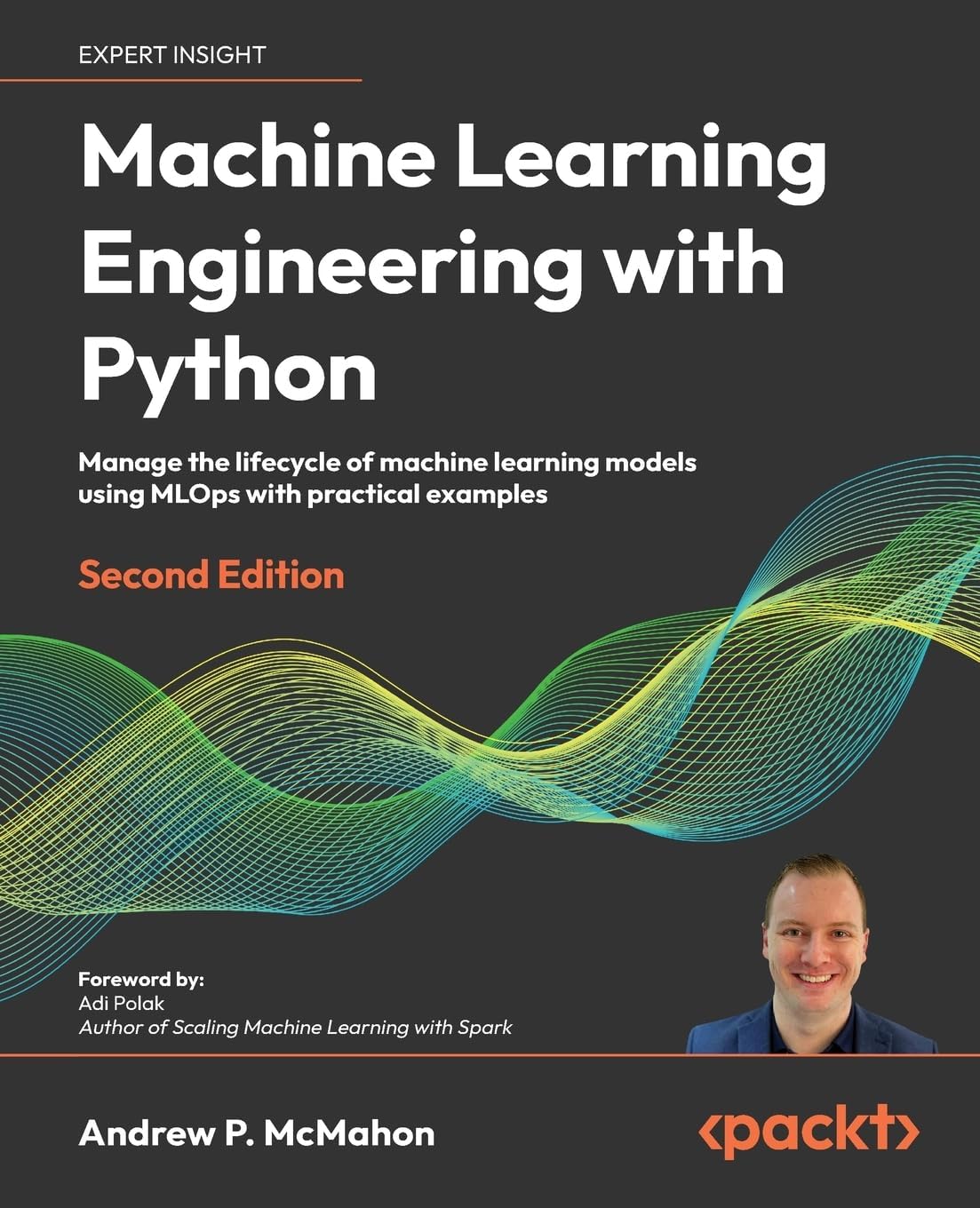
Buy Machine Learning Engineering with Python: Manage the lifecycle of machine learning models using MLOps with practical examples 2 by Andrew McMahon (ISBN: 9781837631964) from desertcart's Book Store. Everyday low prices and free delivery on eligible orders. Review: Machine Learning Engineering with Python, Andrew P. McMahon - Excellent service! Product arrived on time and was well presented. Highly recommended purchase. Review: If you want to learn about MLOps and machine learning... you need this book!!! - This book is so very helpful both as a reference that can be used for seasoned MLOps veterans in developing , distributing and curating models and also in instructing newcomers in the basics of MLOps (providing examples and explaining the basics behind transformers, neural network models and LLMs). It even provided some background in Python to fill in the gaps in my knowledge where my university courses fell short! As someone who plans to enter the ML/LLM/AI field after graduation, this will be my go-to guide!


| Best Sellers Rank | 608,270 in Books ( See Top 100 in Books ) 3,687 in Computing & Internet Programming 12,627 in Engineering & Technology |
| Customer reviews | 4.5 4.5 out of 5 stars (44) |
| Dimensions | 19.05 x 2.67 x 23.5 cm |
| Edition | 2nd |
| ISBN-10 | 1837631964 |
| ISBN-13 | 978-1837631964 |
| Item weight | 789 g |
| Language | English |
| Print length | 416 pages |
| Publication date | 31 Aug. 2023 |
| Publisher | Packt Publishing |
A**S
Machine Learning Engineering with Python, Andrew P. McMahon
Excellent service! Product arrived on time and was well presented. Highly recommended purchase.
S**T
If you want to learn about MLOps and machine learning... you need this book!!!
This book is so very helpful both as a reference that can be used for seasoned MLOps veterans in developing , distributing and curating models and also in instructing newcomers in the basics of MLOps (providing examples and explaining the basics behind transformers, neural network models and LLMs). It even provided some background in Python to fill in the gaps in my knowledge where my university courses fell short! As someone who plans to enter the ML/LLM/AI field after graduation, this will be my go-to guide!
R**E
Let down by the hands-on
I was (am) really looking forward to sinking my teeth into this book and the numerous topics covered - however my progress has been scuppered by many errors trying to get the python libraries working correctly. So I haven't even got the chance yet to get the ball rolling! I've tried across Mac (issues with Apple silicon) and Windows (Intel) - and just have too many issues out the gate to bother continuing. pity.
H**O
Incredibly valuable for hands-on ML engineers and anyone interested in the topic
Andy McMahon invited me to review the second edition of his book "Machine Learning Engineering with Python", which was published earlier this week. I have to say I REALLY enjoyed this read! 😃 Not only does it dive deep into the crucial role of ML engineers, who serves an acute need to translate the world of data science modelling and exploration into the world of software products and systems engineering. It also uses real world examples on how this role is shaped and how AI/ML applications actually go from Proof-of-Concept (PoC) all the way into production (which is so much harder than most of us woyld think). This is not a theoritical book, it is fully hands-on with code samples and fully fledged applications, which makes it somuch more valuable. And it has an entire chapter covering Deep Learning, Generative AI, and LLMOps (which I believe will be the most important topic of the coming months and years). I highly recommend this book to anyone who wants to actually leverage the power of AI & Machine Learning in production. Well done, Andy
A**Z
A Comprehensive Guide to Modern ML Practices!
For anyone passionate about MLOps, I wholeheartedly recommend this book. Key Insights: - Simplifies the multifaceted roles in ML, providing clarity in a dense field. - Through hands-on examples, tools like ZenML and Kubeflow are demystified. - Provides insights into designing scalable ML systems using tools like Ray. - The book's detailed approach to MLOps for LLMs, with a clear focus on validation and achieving peak performance, is notably distinctive and comprehensive. The book doesn't just dwell on theory; instead, it's deeply practical with tangible code examples, all available on GitHub. Look out for the chapters on ML Development Process and how to automate it, ML System Deployment Patterns, Deep Learning, GenAI and LLMOps.
D**V
I enjoyed reading this book. Andrew wrote a very helpful source for ML practitioners. Python tips, tooling advice, and a great use-case (ETML) all make up a great bundle
K**R
I just finished reading through this Machine Learning Engineering book and was impressed. Overall, it has great organization and a well-designed table of contents. The preface was as complete as it needed to be and is very accurate in who this book was written for. As boring as these details are to most people, attention to them shows that the author writes well and gives me more peace of mind for the rest of the book. This book can be seen as having three acts. The first act is the introduction, which explains the basics of why certain tools and languages are used in MLE and the common terms you'll find throughout the book. It also gives an overview of the entire process, which is important to keep in mind as you learn the details. The second act gives those very details in a well-structured layout. The details that matter are here and simple examples are given. This allows the reader to really get a handle on the content. The final act brings it all back together again and shows a full example. Unlike the first overall example, this includes the details that the reader has been learning. This is a great way to cement the knowledge that the reader should know, even if the details don't exactly match what they will actually work with. Overall, a well-written book. If you're interested in MLE, this is a great place to start. I highly recommend knowing some Python and ML techniques before starting, though, to get the most out of it.
H**T
I have experience as a statistician, data scientist, software engineer, programmer, and I would say a little bit as an ML engineer. In Chapter 1, the author talks about the different roles, so I look forward to reading that to compare against my experience! haha. I don't have any experience using tools to build pipelines, so I am looking forward to reading about that. I like the content and structure of the book, and with only 9 chapters it's not overwhelming. I feel like I could get up to speed really quickly. I have familiarity with many parts, but not everything. I am interested in reading the section about "Choosing a style" - OOP or FP. I am also interested in exploring the "standard ML patterns" - data lakes, microservices, event-based designs and batching. I am interested in learning more about using AWS, so it's great that that's covered. The chapter on scaling is definitely interesting, as is the chapter on LLMs. I have watched interviews with the OpenAI and MSFT folks on the GPT models and I have interacted with ChatGPT. The LLMs look fun to try and the python code in the book looks very easy to read. I like this book a lot. It concisely convers all the points in moving from concept to solution, including what tools can be used. I think it will be a great starting point for me. I can't wait to try it out!
A**V
I had high hopes for Machine Learning Engineering with Python, but unfortunately, this book turned out to be a major letdown. The content is extremely shallow—most chapters feel like little more than glorified "Hello World" examples. Rather than digging into the real challenges of machine learning engineering, the book presents a superficial overview of each topic with minimal depth. Many chapters follow a repetitive and uninspiring structure: screenshot of code -> screenshot of output, with little to no explanation in between. One of the most frustrating aspects is the confused target audience. Early chapters waste time explaining extremely basic Python concepts (like what a function is), yet later chapters dive into more advanced topics like async/await, decorators without a proper introduction or context. This inconsistency makes it hard to recommend the book to either beginners or experienced practitioners—it's too shallow for the latter, and too erratic for the former. The book is also riddled with code snapshots instead of actual walkthroughs. Important design decisions, architectural trade-offs, or best practices are barely discussed. It often feels like the author is showing you what they did, without teaching you why they did it that way. The final disappointment came in the last two chapters. I was particularly excited for these, as they promised to tie everything together in a real-world deployment. But instead of deploying to cloud or production-grade environments (as any serious ML engineer would expect), the author simply deploys the projects locally, which completely defeats the purpose of demonstrating end-to-end ML engineering. In summary, this book feels more like a rushed set of notes or tutorials than a serious guide to machine learning engineering. If you're looking to build real-world ML systems or understand the lifecycle of production ML, this book will not get you there. Look elsewhere.
C**A
The book covers all types of ML engineering tasks and tools. Very usefull specially if following the code examples. If you are a AI enthusiast and want to learn the tools that would help you to build your ML solutions this is your book. It releases the focus on the algorithms to go deep into the deployment and maintenance of solutions.
Trustpilot
3 days ago
2 weeks ago