Desertcart purchases this item on your behalf and handles shipping, customs, and support to France.
🔆 Charge smarter, live greener — power your future with Victron Energy!
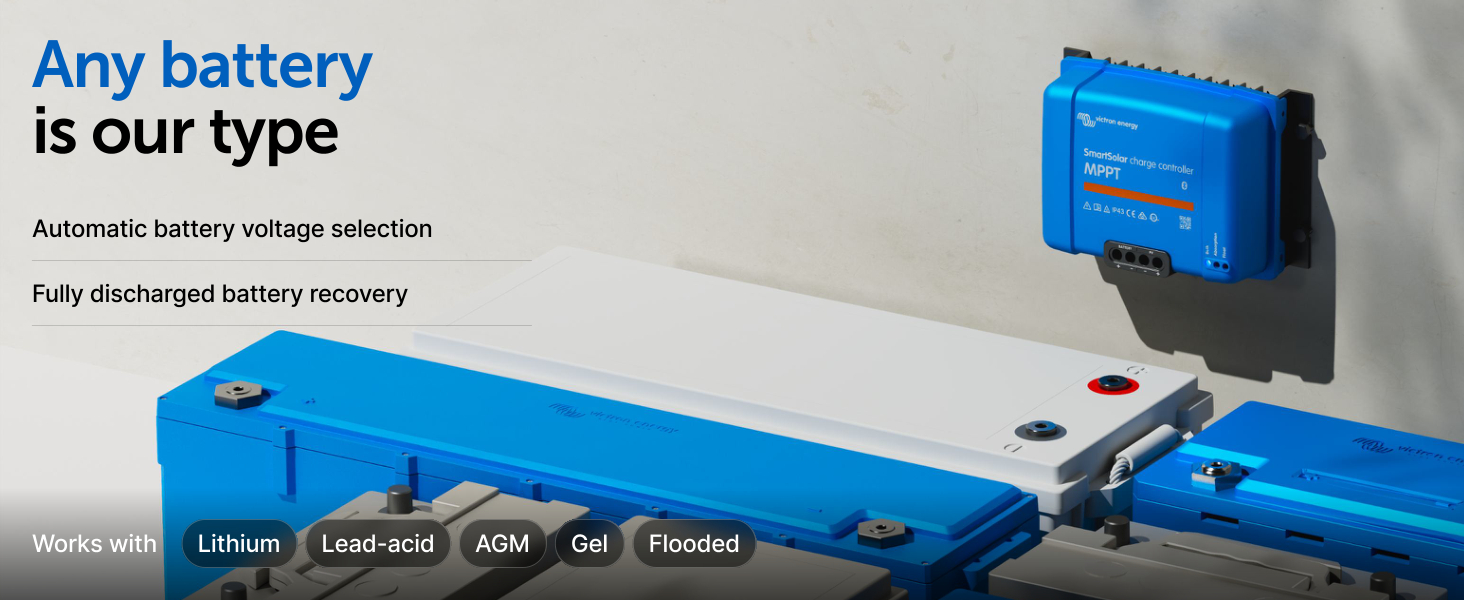
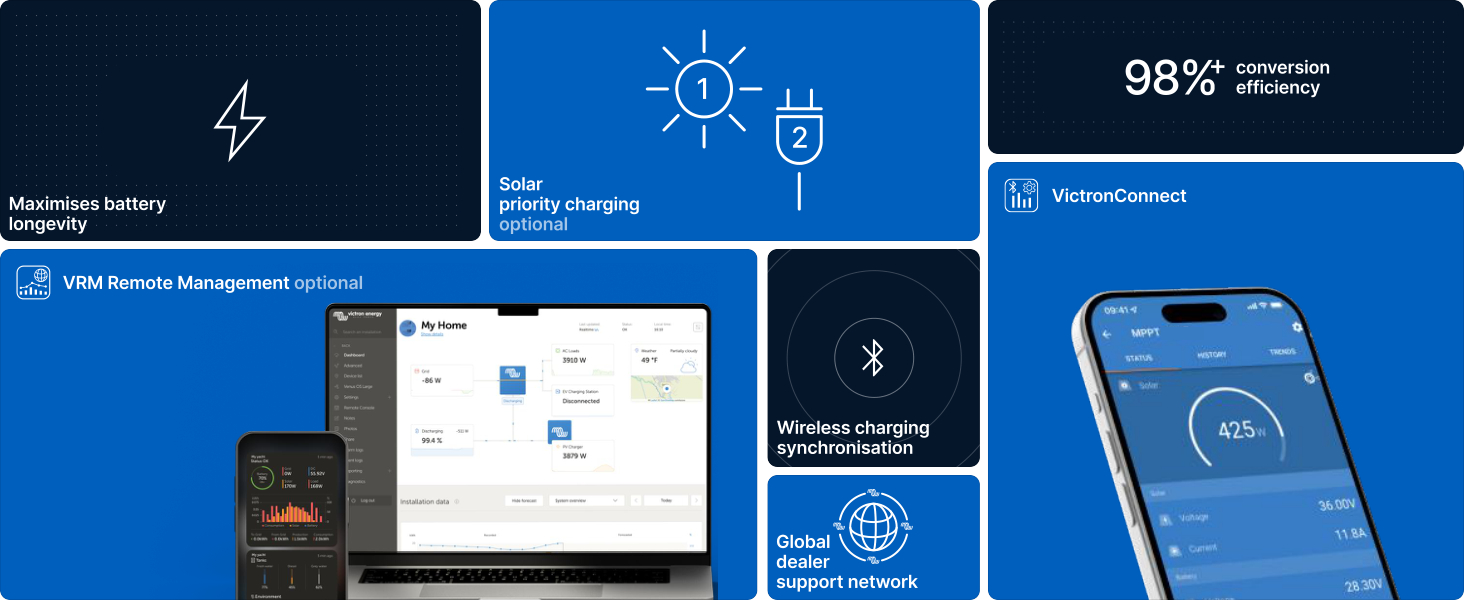
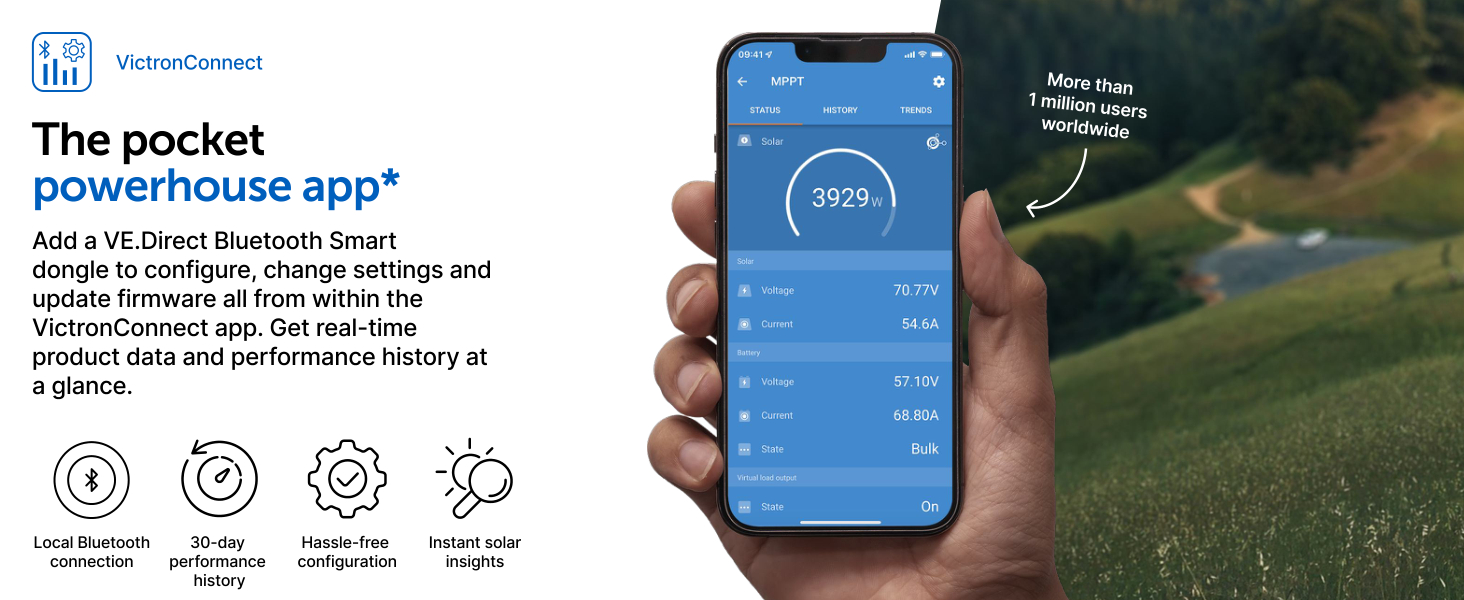
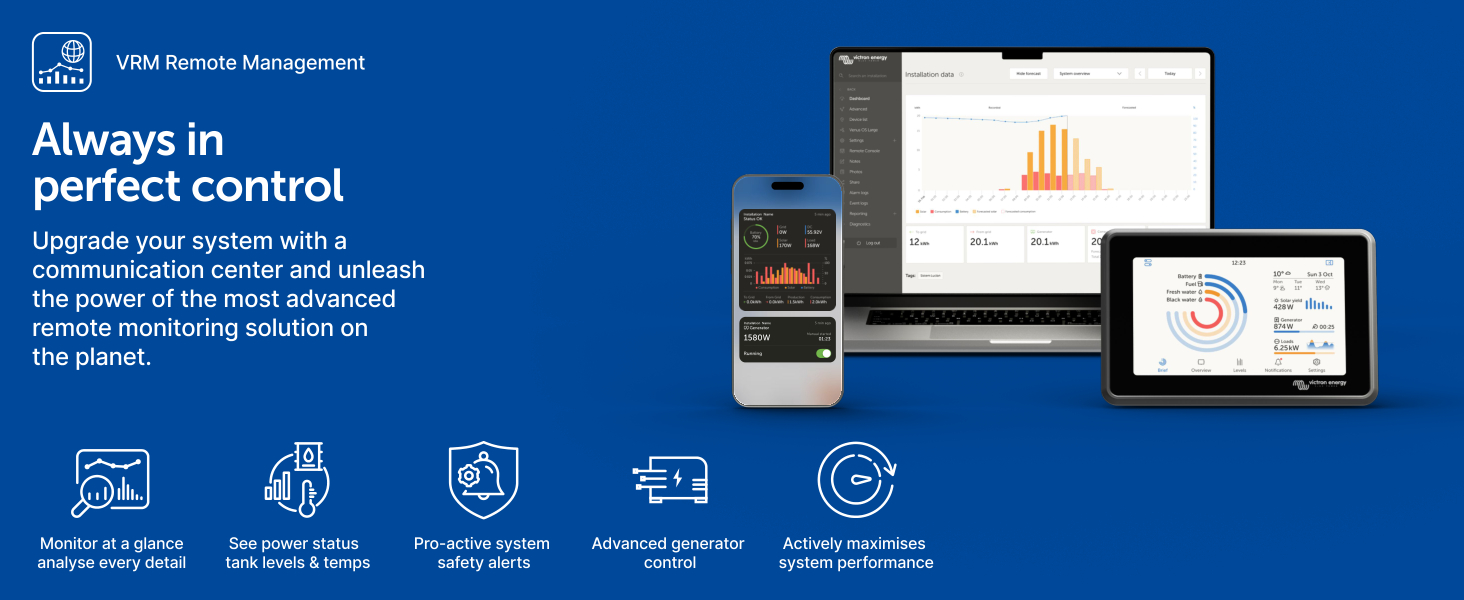
The Victron Energy SmartSolar MPPT Solar Charge Controller (75V, 15A, 12/24V) is a robust, Bluetooth-enabled solar charge controller designed for professional off-grid and hybrid solar setups. It features advanced MPPT technology for maximum power extraction, supports multiple battery types including LiFePo4, and offers real-time system monitoring and configuration via the VictronConnect app. Its synchronized multi-controller capability and intelligent load management ensure optimized energy use and extended battery life, making it a top-tier choice for efficient, smart solar energy management.


| Brand | Victron Energy |
| Color | Blue |
| Display Type | LED or minimal display |
| Item Dimensions L x W x H | 4.7"L x 2.1"W x 1.8"H |
| Item Weight | 0.58 kg |
| Material | Plastic |
| Material Type | Plastic |
| Operating Temperature | 60 °C |
| Product Dimensions | 4.7"L x 2.1"W x 1.8"H |
| Voltage | 24 volts |
P**.
Excellent MPPT controller for a small, off-grid solar system.
I have a small, off-grid solar system for my shed to run lighting and a ventilation fan. It has two 50W panels connected in series, two 10 amp-hour 12V LiFePo4 batteries, and this charge controller. I had previously used a competitor's simple PWM controller but wanted to upgrade to MPPT for greater efficiency and to take advantage of having installed two panels rather than the single 50W panel I had earlier. This controller had ~50% higher voltage and current handling capability than the PWM controller. Pros: - MPPT allows for greater efficiency and using panels in series for higher voltage (~40V nominal in my case). - Very simple setup. - Supports LiFePo4 batteries. - Terminals are large and easy to connect wires to. (Tip: crimp ferrules onto stranded wires rather than trying to insert bare stranded wire. Ferrules help the wires stay together and make a better connection than bare wires.) - Built-in Bluetooth support that connects to Victron's excellent app that makes setup and configuration a breeze. - The Bluetooth data module will log data for at least several weeks and you can view it using the app. - Built in charging profiles for a variety of common batteries, such as flooded, AGM, and gel lead-acid batteries, and LiFePo4 batteries. - Lots of little additional options, like being able to enter custom profiles for batteries, limiting the boost voltage to 14.4V rather than 14.6V, setting a "tail current" to switch from absorption to float modes based on charging current rather than time, customizable float voltage, etc. gives the user a high degree of flexibility. One can also limit the charging current to below the maximum rated value if desired. - It's trivial to connect to a Cerbo GX or a Raspberry Pi running Victron's Venus OS to send data to Victron's free VRM service for remote monitoring, graphing, and allow for remote monitoring. - The user can set a PIN code to prevent unauthorized users from connecting via Bluetooth. - With the latest firmware update, certain settings can be locked and prevent even authorized users from making changes that might cause damage or be otherwise problematic without additional authorization. (This owner retains full control, and can unlock those settings so they can be changed if desired.) - Replaceable standard automotive ATM fuse offers overload and short circuit protection. - Extremely well-written, comprehensive manual and online resources are available. English-speaking staff can answer questions if asked. Active user forum for support from and discussion with other users. - Robustly made, feels hefty to the hand. - Easily mounted with screws. - No discernible RF noise from the controller. I'm a ham radio operator and my radios are sensitive to RF noise in the area, but the controller produced no noticeable noise. Cons: - No on-device display or buttons. It has colored LEDs that are either on steady or blink to indicate its charging mode (these are described on the face of the controller and in the manual), but has no LCD screen to show solar/battery voltages, currents, or other information. All configuration must be done via the app. - No built-in shunt to monitor state of charge for the battery. An external SmartShunt can be purchased at additional cost (more than the cost of the controller, in fact) to provide state-of-charge data for the battery and send that information to the app via Bluetooth or to the VRM service. The controller monitors voltage and current, but not state of charge. - The on-device data logging takes place in the Bluetooth module, not the controller itself. When you connect the controller to VRM via a Cerbo GX or Raspberry Pi running Venus, logging data is sent to the VRM service and can be plotted there or downloaded for offline analysis, but the smallest time interval on VRM is 1 minute. The Bluetooth module logs data at 1 second intervals. You can use the app to connect, via VRM, to the device and view the 1-second-interval data trends, but you can only see that short-interval data starting when you connect (you can't see historic 1-second-interval data if you're not connected by Bluetooth). In short, this is an excellent controller. Having built-in Bluetooth is very help and does not require any external module. It is easily connected to a monitoring device (not included) that can send data to Victron's VRM service and allow for remote monitoring and control via WiFi or cellular connections using that device (for clarity, the controller itself only supports Bluetooth and has a port for a data cable, but does not have built-in WiFi or cellular capabilities). It offers a huge amount of value for money, and I strongly recommend it.
P**E
an outstanding controller at a stellar price!
This controller is amazing. it's changed so much on what have done with my solar setup. First, it's extremely versatile handing both 12V and 24V panels. it handles lead-acid, gel, and LiFePo batteries efficiently. The bluetooth gives me direct insights into what's going on with the controller.. what it's taking in, what it's sending out. I get clear insights into the charging phase and allows me to know where my battery is at in the charging process. the street light process (and load circuits) has allowed me to put in LED lights that shine on my gate after dark and shut off during the day (based on the solar input thresholds you set). The only slight negative is that you have to be within about 10' of the unit to get bluetooth to connect. it's a little weak, but that's a small price to pay for such an overall amazing unit. Overall, the unit is very well designed, super easy instructions, and mostly intuitive setup. Strong improvement from any other 'dumb' controllers you may have.
A**X
One of the best solar charge controllers I have installed, configured and used.
I have to say some kind words so far for this charge controller, in short, this is an amazing product. Early in its use, I have a small outdoor solar array using batteries to power a sprinkler system, sound system, lighting and an outlet using a separate inverter. We live on top of a hill, no trees, no wind blocks and get the worst of the weather constantly. I have been through many MANY MPPT Solar Charge Controllers and was a bit scared to go with a Bluetooth only controlled device. I was quickly impressed with the VictronConnect software, giving a demo device so I could test drive the settings and see exactly what I would get and control. Next up, how hard is it to connect and reconnect once I got physical hardware.... It was literally as easy as the demo equipment. I was able to power on the controller using Solar power OR battery, meaning as long as you have 1 power source it just works. Bluetooth connected instantly, one tap on my Android phone and the PIN on side of the controller and I was done. I did notice that the default for me was 24v when I had a 12v battery connected but that wasn't a big deal, went through set to 12 and was all set. Because I do a lot of work with solar controllers, I wanted to see how accurate and fast this little beast was on the phone app, ran a constant 25w load and the app was within a half second reporting accurately. Variable loads also gave good information, up to this point I was already sold that this was a solid device. The app is just about perfect, gives you Amp and Watt usage which is nice for quick math and efficiency conversion. I also really like that the battery stats show when your load is pulling from solar only or from battery, very clever and easy to read. Pros: Super easy to install, Plug and Play Easy to configure easy AND expert settings Complete customization of battery settings and a good number of presets Was able to configure exact settings for my 12.8v LiFePO4 battery! Feels solid and I have no doubt that it will last in harsh environments Easy to mount, Good size fits just about anywhere Easily control load on/off depending on solar input Cons: Cant find any yet but here are some things to note Mine defaulted to 24v, easy change to 12, maybe sensitive batteries and large systems might have connection issues Would be nice to have a day timer for on/off functions as well as solar input but this is being super picky If you are looking for a good MPPT Solar Charge Controller, feature rich and don't mind using your phone and Bluetooth to configure, this is the one you want. Can't comment on longevity thus far but I have no doubts this will last! Will update if anything changes...
D**.
Excellent charge controller
This is an excellent charge controller, loaded with features, very compact, very reliable. The ability to use an app to track the solar metrics extends beyond just that capability. In my case (as a software developer and electronics tinkerer type person), I'm using an ESP32 module (about $6) to capture the Bluetooth broadcast data from the charge controller and upload it to my website, where I can easily monitor the solar performance of my camper remotely. I'm using the VictronBLE ESP32 library with additional code to upload the data to my web server. This charge controller supports around 200 Watts of solar if your battery(s) are 12 V, and around 400 Watts if your battery(s) are 24 V (15 A x 12 V = 180W, 15 A x 24 V = 360 W, however since the charge voltage is a little higher than your battery voltage, it is right around 200 W and 400 W). I'm running 400 Watts of solar (2 x 200 W) with a 12 V battery, so the charge controller can really only make use of about half of my maximum solar power. However, the upside is that on a cloudy day when the panels cannot produce their full power, having double the solar results in double the wattage (IE if one panel can only produce 30 watts on a very overcast day, then I get 60 watts with double the panels). The charge controller handles this just fine - it only allows up to the 15A to flow even if the panels can produce more. I highly recommend this controller. If you don't understand the relationship between the amperage of the controller, the battery voltage, and the wattage, then use AI or research it yourself a little. It isn't too complex. Essentially for this controller, the 75V is the maximum solar voltage it can handle (and that is determined by the properties of your solar panels, and whether you have then in serial or parallel combinations), 15A is the maximum amperage it can send to a battery or load, and 12/24 means it works with both 12V and 24V battery setups.
D**S
Know what you need before you buy! This worked for me.
Solar energy is a great way to have back-up power for your home or for your RV. Solar isn't super complicated, but there are a lot of things you need to know to make the best purchases. Solar charges (like the Victron) come in both PWM and MPPT. PWM are significantly less expensive, but may fit your needs. MPPT is a better option, and this very affordable Victron unit is a fantastic entry-level charge controller. It's 75/15 name refers to the maximum volts it will accept/use from your solar array, and the 15 amps it can accept/use. The Victron Smart Solar 75/15 can handle up to 300 watts of solar panels wired in series or parallel. In series, that's about 68 volts max, well within tolerances, or 16.5 amps max which will be capped at 15 amps. Truth is, except for perfect sun and panel angle, you're not likely to hit the 16.5 amps. Still, that's not bad! A great part of the Victron 75/15 design is that it has bluetooth built in, so don't need to shell out extra for a dongle. Note: if you want this, look for the "Smart Solar," if it doesn't say this, you'll need a dongle. The size of this unit is just excellent; I bought it for my DIY powerstation. It works great, giving me nearly the full 100 watts from my Renogy solar panels under ideal conditions. For the money (about $65 at the time of purchase) it's simple enough for the beginners, or strong enough to manage a modest RV. Cons: It uses small, flat-head screws, so you'll need a small "pocket" screwdriver to make the connections. The input for the wires is pretty small. I had a ferrule kit, so I was able to insert 12 AWG with no trouble. I don't know how you'd easily get 10 AWG (somewhat standard for solar) but what I had worked and I'm happy.
C**L
Great charge controller but read the tech specs before purchase
I bought and installed this on a small camp trailer. What sold me was the Victron reputation, integrated Bluetooth connectivity, and programmability. Installation was easy. I used marine grade 10AWG wiring and it was a very tight fit. Anything less finely stranded than marine grade, larger AWG or with crimped-on ferrules won't fit. I'll note that I initially got the polarity of the solar inputs backwards and it didn't damage the device (just made it hot like the manual says it will and the panel voltage in the app looked wonky). The phone app that you can use to adjust controller settings is logical and fairly intuitive. It connected to my phone seamlessly. There is also a means to jumper the controller for some fairly limited battery charge settings without the app. You need to remove the jumper if you plan to utilize programming via the app. My one issue is a fairly large one, but it's really my fault for not reading the specs real closely. The controller won't start charging until the panel voltage is 5V higher than the battery voltage. After the initial 5V offset it will continue to charge until the offset drops to 1V. For me this is a dealbreaker because I have a single 210W panel (generally running around 17.5V in direct sunlight) and a LiFePo4 battery (nominally 13.6V) so the panel voltage will only ever be 5V higher than the battery when the battery is near fully depleted. This means the controller will not normally enter charging mode. Bummer! So I had to swap out this Victron unit with a charge controller with less features I really liked in this Victron. But I do like the Victron controller and plan to use it in another upcoming project where the panel voltages will be much higher.
L**Z
This charge controller replaces my 75/10
I purchased a pair of 100 watt panels and the Victron 75/10 charge controller. They are installed on my work truck to charge a 100AH battery that is connected to a 3KW sine inverter. I got the new upgrades installed on Feb 20th and within a week I had already reached the 10 amp peak output from the controller and still had more output available from my panels. I didn't even know about the 75/15 at the time and especially that it was only about $10 more. If I had known I would have just gotten the 75/15 from the start. It was easy to swap out and setup since I had just done the same thing a week ago. The Bluetooth output has about the same range, limited to about 30 feet and my system is in a metal box which limits it even more. Sure would be nice if it had a longer range. My Victron Energy Smart Battery Sense bluetooth range is much better. The 75/15 charge controller so far has worked nearly flawlessly. Minor idiosyncrasies have been noticed but nothing to really complain about. The controller reassess the power point about every 10 minutes. You can notice it in a steady sunshine condition when it all of a sudden searches the power point. It shows up in the Trend graph also as a small downward spike in the power output of the panels. I haven't maxed out the controller with my 200 watts of panels yet. But I've gotten a peak of 189 watts from them in March with the sun still lower in the sky with summer still far away when the sun will be high in the sky and be much more in orientation of the panels that are basically laid flat and parallel to the ground on the top of my work truck boxes. The recorded information is very nice. You can go back a couple days or up to a month to look at what the system was doing. I do however notice that the Power Graph of the panel watts does short you of peaks. Today I had the 189 watt peak which did show up when I looked at the Trend charge within minutes of it happening. But after the day was over I went back and the peak output was only 157 watts which is a little disappointing and one of the quirks I had spoken of. The History for the day shows that the peak was 186 watts which is much closer to the 189 watts I observed on the screen. Really wanted to see 190 watts but just after that peak the clouds came in and the output was about 50 watts the rest of the day. All in all it is a fine charge controller and I would likely stay within the system if I was to put something more permanent elsewhere than my truck.
A**R
Well Made, Works Well, Good App
I use this charge controller between a solar panel and a battery. The panel is a single 120-Watt 12/24-Volt unit with a maximum (open circuit) voltage of 33.7 V. The battery is a pair of 12-Volt lead-acid batteries wired in series to make 24V. It appears to be working well. It charges and maintains the batteries at about 25.8 Volts. The controller is easy to wire and set up. The iPhone app took some fiddling around to get going - a couple extra minutes that may have been my fault. Once up and running the app connects the phone to the controller via Bluetooth over a modest distance, maybe 10 yards. The app shows charge current, panel voltage, charge power, and battery voltage. The controller is compact and appears to be solidly made. I would buy another if I have the need.
S**M
un prodotto eccellente
Provato quasi tutte le funzioni del Victron e devo dire che funziona tutto alla perfezione. Il collegamento wifi e l'app sono semplicissime da utilizzare e abbastanza complete anche in termini di statistiche. Il prodotto sembra robusto fatto di buoni materiali. La morsettiera e' vermente fatta bene e ben dimensionata per il mio 15A. Le impostazioni del caricatore, tutte impostabili con app in wifi, sono veramete elementari, il voltaggio della batteria la riconosce automaticamente e per ciascuna tipologia e' tutto preimpostato ma se si vuole si possono cambiare i parametri. E' un MPPT al 100%, infatti aggiusta la potenza assorbita in funziona di quella massima disponibile. La corrente erogata a carico da servire (load + batteria) e' maggiore di quella in ingresso da FV ed a tensione inferiore (12 o 24v) come deve essere per un Buck converter. La gestione del carico funziona bene sia in termini di programmazione sia in termini di gestione della potenza. Provato varie situazioni (ad esempio Potenza FV > e < di quella richiesta da carico e dal caricabatteria etc). Funziona veramente bene, come un orologio, un prodotto semplice ma professionale che non crea sorprese. Ho letto di molti MPPT che si comportano in modo strano nella gestione del carico. Ad esempio ho letto di caricatori che non gestiscono correttamente attivazione/disattivazione carico a seguito transizione giorno notte, notte giorno e giorno notte (hai detto niente!!! da buttare) o altre situazioni strane. Non ha ventola e quindi e' silenziosissimo ed io non sono riuscito a farlo scaldare fino a 80W assorbiti. Il prodotto e' eccellente ma ha un lato negativo, il costo che non e' proprio economico soprattutto per correnti da 20a in su. Comunque se non volete problemi e non volete andare a caccia di problemi ve lo consiglio vivamente, io non mi addentrerei in caricatori MPPT da 100A che costano pochissimo, anzi, ve li regalano addirittura, il perche' lo scoprereste certamente in seguito.
M**N
Best item but price to high
Best mppt & communication for raspberry Pi
İ**M
Mppt
Bu işin en iyisi yıllardır kullanılanıyorum
J**Y
value
does the job buy again.
F**A
Great solar mppt
Great solar mppt
Trustpilot
2 weeks ago
2 weeks ago