
Buy anything from 5,000+ international stores. One checkout price. No surprise fees. Join 2M+ shoppers on Desertcart.
Desertcart purchases this item on your behalf and handles shipping, customs, and support to France.
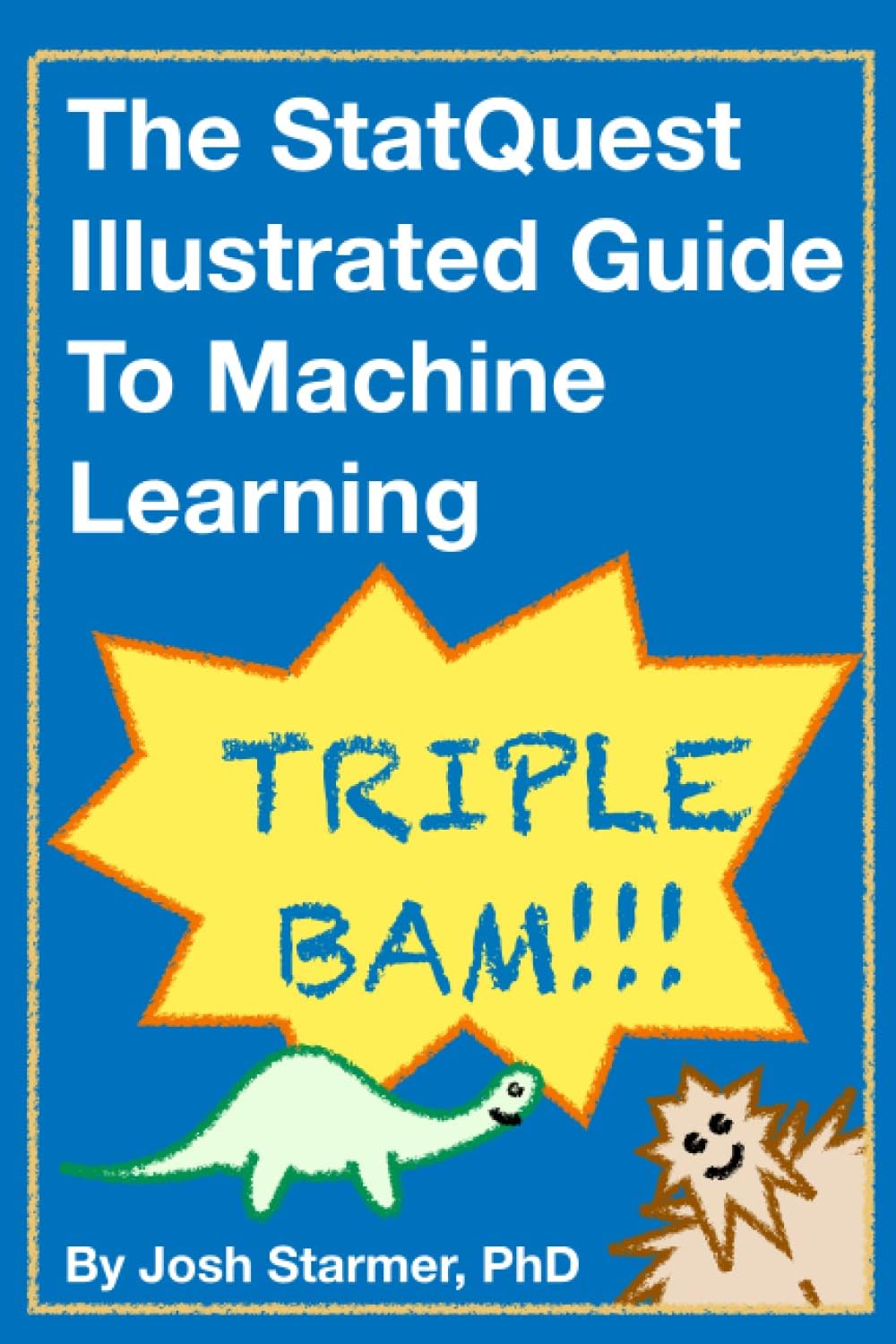
Machine Learning is awesome and powerful, but it can also appear incredibly complicated. That’s where The StatQuest Illustrated Guide to Machine Learning comes in. This book takes the machine learning algorithms, no matter how complicated, and breaks them down into small, bite-sized pieces that are easy to understand. Each concept is clearly illustrated to provide you, the reader, with an intuition about how the methods work that goes beyond the equations alone. The StatQuest Illustrated Guide does not dumb down the concepts. Instead, it builds you up so that you are smarter and have a deeper understanding of Machine Learning. The StatQuest Illustrated Guide to Machine Learning starts with the basics, showing you what machine learning is and what are its goals, and builds on those, one picture at a time, until you have mastered the concepts behind self driving cars and facial recognition. Review: Great machine learning intro or review! - This is a great book! I loved StatQuest and this book is written with the same approach. Lots of pictures. It's easy to understand, and while I'm only half way through it, it has helped my ML understanding tremendously. I had taken a Machine Learning course, but this book explains things so much better than my course text did. Highly recommend. Review: Connecting the Dots Across ML Algorithms - I've read a few books and taken a few different courses on ML. One thing, among many, that this book does well is to connect together concepts that are used among a variety of different algorithms. Where there are differences in say, how a model is optimized, it fully explains the how and the why of the differences and how they end up with the same result, optimization. The result for me is that now when I am reading different material about ML, I understand why the authors chose a specific algorithm or cost function to solve a problem.
| Best Sellers Rank | #30,247 in Books ( See Top 100 in Books ) #19 in Computer Neural Networks #97 in Artificial Intelligence & Semantics |
| Customer Reviews | 4.8 out of 5 stars 976 Reviews |
P**A
Great machine learning intro or review!
This is a great book! I loved StatQuest and this book is written with the same approach. Lots of pictures. It's easy to understand, and while I'm only half way through it, it has helped my ML understanding tremendously. I had taken a Machine Learning course, but this book explains things so much better than my course text did. Highly recommend.
T**S
Connecting the Dots Across ML Algorithms
I've read a few books and taken a few different courses on ML. One thing, among many, that this book does well is to connect together concepts that are used among a variety of different algorithms. Where there are differences in say, how a model is optimized, it fully explains the how and the why of the differences and how they end up with the same result, optimization. The result for me is that now when I am reading different material about ML, I understand why the authors chose a specific algorithm or cost function to solve a problem.
A**P
Words can't do it justice!! Wonderful resource
Easy to read and entertaining resource on statistics and machine learning. Where most other resources I've come across sound confusing, Josh gets out of his way to simply and clearly explain complex topics. Wonderful book! Can't recommend highly enough!
M**.
The ultimate Machine Learning book, perfect for learners of all levels.
For anyone seeking a intermediate\beginner-friendly and visually engaging introduction to machine learning, Josh Starmer's book is an excellent option. It effectively simplifies complex concepts, presenting them in an easily digestible format, often enhanced by clear illustrations. By minimizing the use of heavy mathematical jargon, the book creates a welcoming environment for readers who may feel intimidated by the subject matter. This approachable style makes it a valuable resource for newcomers to the field.
G**Z
The Most Accessible Book on ML that I've Encountered
I recently picked up a copy of Joshua's new book "The StatQuest Illustrated Guide to Machine Learning" (SIGML). And I must say, I'm very impressed 🤯! By a large margin, it is the most accessible book on ML that I've encountered...the anthesis of a typical dry, esoteric, & unintuitive ML book. Many technical and academic books alienate a large portion of their readers, self-sabotaging their educational value to those would-be learners by employing an esoteric vocabulary that's only accessible to people who possess specific academic backgrounds. By contrast, rather than making assumptions, Joshua takes pains to equip readers with a working knowledge of the language required for the concepts that he introduces - an approach that the entire technical and academic publishing sphere could learn a great deal from (i.e., focus less on sounding smart and more on helping people of all backgrounds to learn effectively)! Along this vein, I was surprised to learn something new in the very first chapter 😊! Many years ago, when first learning spreadsheets, I was introduced to data in rows and columns. Then, I moved on to structured databases with "tabular" data where the rows were referred to as "records" and the columns were referred to as "attributes". Later, in the ML space, I once again encountered tabular data...and this time the rows were called "observations" and the columns were called "variables" (which can be "independent" if they're informing the prediction or "dependent" if they're what's being predicted). By the time that I got into learning Stats/ML, I was mostly just amused to find yet another set of nomenclature for tabular data. I don't recall ever reading or being told why the fields of Stats & ML refer to the columns as variables (the discussion always focused on the independent vs. dependent part). So, without thinking about it much, I just accepted that in the ML context columns are called variables. Yet, here Joshua thoughtfully takes time to explain that columns of data are referred to as variables because the data "varies" from one observation to the next 💡. While completely logical, I have to admit being ignorant about this rationale for the nomenclature until yesterday when skimming through Chapter 1 of SIGML. This is a great book for those who're looking for a gentle, fully accessible introduction to ML that doesn't cut corners...it's also a good resource for seasoned ML practitioners who might want to go back and inspect their knowledge base for unrealized blind spots from a new, more illustrated perspective 😉.
C**K
Excellent explanation
I am extremely satisfied with the book. As someone new to the field of machine learning, I found the illustrations and explanations in this book to be incredibly helpful in understanding the concepts. Josh Starmer's approach to teaching is engaging and easy to follow, and I appreciate the way he breaks down complex ideas into simple, understandable pieces. The book is well-organized and covers a wide range of topics in machine learning, making it a valuable resource for anyone looking to learn more about this exciting field. Overall, I highly recommend "The StatQuest Illustrated Guide to Machine Learning" to anyone interested in getting started with machine learning or looking to deepen their understanding of the subject. It's a fantastic resource that I will definitely be referring back to in the future.
C**C
Cool machine learning book for visual learners
*Note – The digital version/eBook, is forced into portrait mode (vertical), instead of landscape mode (horizontal); and does not auto-rotate like most eBooks. This is unfortunate, because the wide, illustrated pages are now crammed into a smaller vertical window, and it makes it much harder to read (see pictures). Even on my 10 inch tablet it is not easy for me read everything. I would suggest going with the paperback version instead for this reason. * This book uses images and text to explain machine learning concepts in a very visual, almost comic-book style. The author Josh Starmer has a popular Youtube channel which has many videos that explain these same concepts; and some of the images/diagrams in the book seem to be the same as the ones from those videos. The book is divided into 12 chapters, with about 270 pages, followed by Appendices A through F. The book covers many different specific concepts, including: Cross validation, statistics, regression, decision trees, and even neural networks. The format is great for visual learners, as each page has several images and visual representations of the topics being explained. Overall I thought that this was a great idea for a book that can help to explain some complex ideas in an easier-to-digest format. This method of presentation might allow for a wider audience to get interested in these concepts. Again though I would have to suggest the paperback version, as it is probably much easier to read. You could also head to the author's channel to watch some of these videos if you are interested in the subject.
V**E
One of the best books I've ever read
Josh has mastered one of the hardest skills in writing (and teaching): Explaining advanced concepts in an easy-to-understand way without leaving out important technical details. He does not dumb the algorithms and concepts down, but rather explains them in a more visual and down to earth manner, all while keeping the book fun and interesting to read. Squatch and Norm are great additions to the book as well, making it feel like you're on a learning journey together with them. Overall an amazing book. Josh is a far better teacher than my professors, and so not only has the book been good entertainment, but also a great help in machine learning courses at my university.
D**O
Great Informational Book
This book is not "the only teaching material you need," but it works excellent as a supplementary for an overview of fundamentals and a recap of the material. This way, it works both for the beginners and advanced programmers with passion.
J**E
Wondefully written content that is easy to understand
I normally avoid writing any reviews, but I could not resist myself from holding back, so I'm writing down my experience of reading this book. The content is written in such a way that you do not want to put the book down. Page after page, it is pure knowledge condensed in a way that it is very extremely easy to grasp. Adding to the way it is printed in color is only pleasing to the eye and to the mind to recognize the intuition behind a concept. While I'm not new to ML or DL, this book is definitely a must read if you want to enter into the ML or DL scene. Kudos to this author. This nicely supplements his Youtube channel. Nicely done!
J**Z
De los mejores libros sobre ML
Buenísimo ! Todo explicado de modo gráfico, visual, intuitivo.
T**Z
Prosto, ciekawie i zabawnie o ML
Czekam na kolejne, rozszerzone edycje.
C**A
The book is extraordinary!!
Josh makes machine Learning easy and fun with his practical and powerful techniques. He shows how machine learning works, and explains the ideas by drawing the pictures behind the equations. He's a genius! Triple Bam!!!🦕
Trustpilot
1 week ago
2 weeks ago