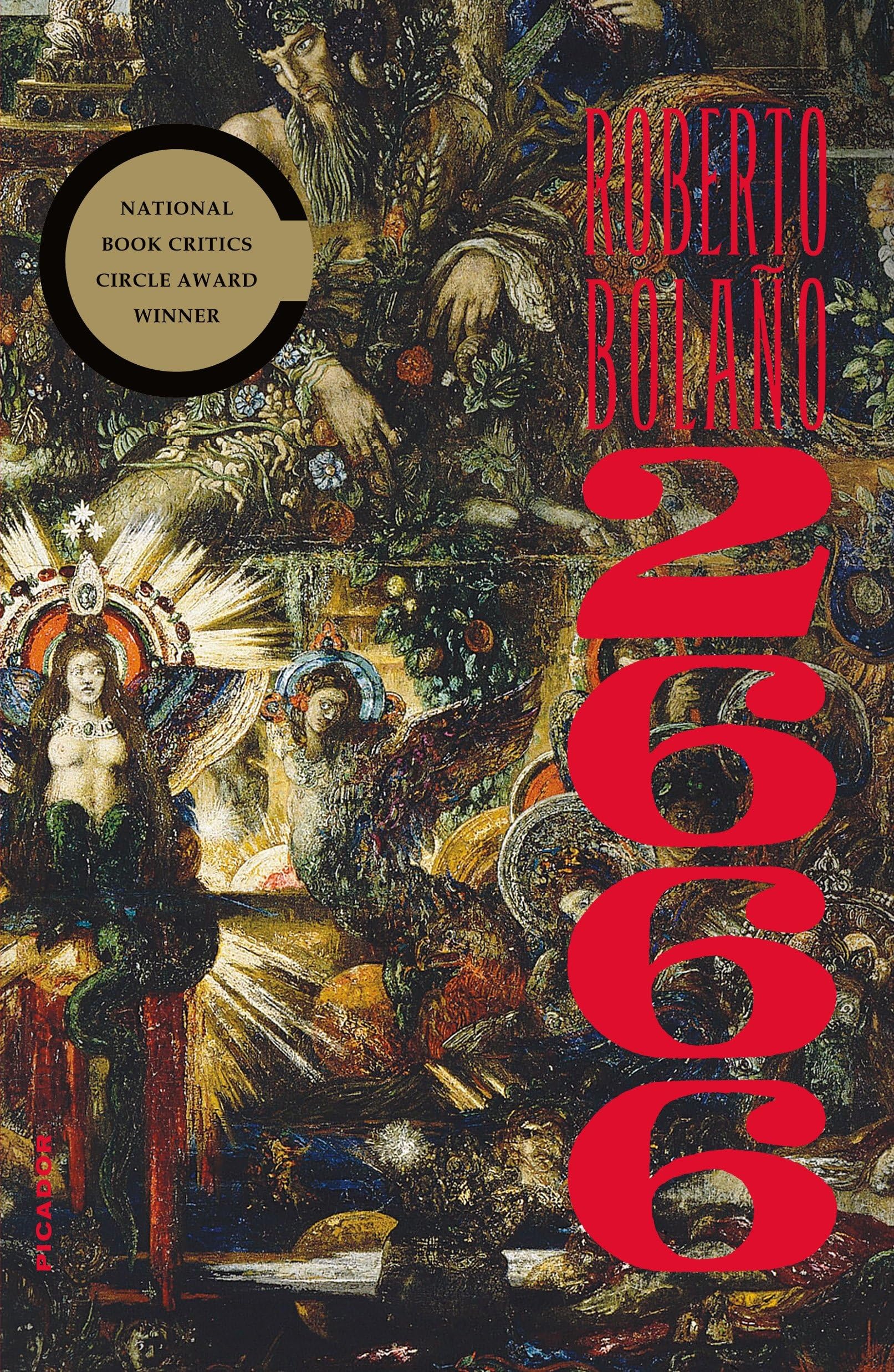
2666: A Novel
Product ID: 4582939
Desertcart purchases this item on your behalf and handles shipping, customs, and support to France.
A NATIONAL BOOK CRITICS CIRCLE AWARD WINNER A NEW YORK TIMES BEST BOOK OF THE TWENTY-FIRST CENTURY: TOP TEN THE POSTHUMOUS MASTERWORK FROM "ONE OF THE GREATEST AND MOST INFLUENTIAL MODERN WRITERS" (JAMES WOOD, THE NEW YORK TIMES BOOK REVIEW ) Composed in the last years of Roberto Bolaño's life, 2666 was greeted across Europe and Latin America as his highest achievement, surpassing even his previous work in its strangeness, beauty, and scope. Its throng of unforgettable characters includes academics and convicts, an American sportswriter, an elusive German novelist, and a teenage student and her widowed, mentally unstable father. Their lives intersect in the urban sprawl of SantaTeresa―a fictional Juárez―on the U.S.-Mexico border, where hundreds of young factory workers, in the novel as in life, have disappeared. Review: Epic! - I would guess that one of the most complimentary things you could say about a book just read is that you can’t wait to read it again. Perhaps even more so when that book is a dense 893-page epic, in that reading it even one time takes extreme devotion and time. Well, that’s the way I felt after turning that final page of 2666 by Roberto Bolaño, partly because I simply enjoyed the journey, overwhelmed by his hypnotic prose, and partly because of the structure of the novel itself, and the nagging thought I have that I’m missing something beyond the obvious that ties together the five parts of the book, some hidden nexus that even now lies just outside my grasp. 2666 is a difficult book to explain, and therefore to review. I'm sure I've not yet understood everything there is to know within its pages. The novel is really five individual books or novelettes, loosely connected by some similar characters, locations, and interwoven thematic material. They are, however, somewhat stylistically different. The first, THE PART ABOUT THE CRITICS, follows a disparate group of European literary scholars as they try to track down the mysterious and reclusive German author Benno van Archimboldi. Ultimately, in their quest to find their literary hero, they are led to the northern Mexican border town of Santa Teresa, where they meet a Chilean professor, Amalfitano, who in 1974 translated one of Archimboldi's novels. But was Archimboldi really in Santa Teresa? If so, what on earth would have brought him there? Part two, THE PART ABOUT AMALFITANO, tells the story of philosophy professor Amalfitano, his wife Lola, and his daughter, Rosa, about how they came to Santa Teresa, and what happened there. In part three, THE PART ABOUT FATE, we're introduced to a new character, Oscar Fate, an art reporter for a New York newspaper who is sent to cover a boxing match in Santa Teresa, Mexico. Part four, and longest of the five, THE PART ABOUT THE CRIMES, is brutal and relentless. For nearly 300 pages, Bolaño dispassionately catalogs dozens upon dozens of rapes and murders of women in Santa Teresa through the eyes of local law enforcement who believe they have one or more serial killers in their midst. This was the most difficult of the sections to finish. As the crimes and clinical descriptions pile up, one after another after another, you become numb, and the horror turns to mere tedium. I'm sure it's the exact effect the author had in mind. Finally, part five, THE PART ABOUT ARCHIMBOLDI, and the novel turns finally to the mysterious German author, the focus of the search from part one, and the reason for being in Santa Teresa in the first place. While it is easy to summarize the sections, it is not so easy to dig deeper and capture the real spirit of the novel in a review like this. I'm not exactly sure how Bolaño does it, but he writes in a way that mesmerizes the reader. While his prose is beautiful, it treats everything, even the horrific, in a prosaic, deadening manner. It has a strange dulling of the senses effect, but keeps you reading, turning the pages. Bolaño often goes on extended digressions, sometimes many pages long to the point that you forget the original point. He peppers the novel with strange and sometimes humorous non sequiturs. It had been very long since Lotte thought about her brother and Klaus's question came as something of a surprise. Around this time Lotte and Werner had gotten involved in real estate, which neither of them knew anything about, and they were afraid of losing money. So Lotte's answer was vague: she told him that his uncle was ten years older than she was, more or less, and that the way he made a living wasn't exactly a model for young people, more or less, and that it had been a long time since the family had news of him, because he had disappeared from the face of the earth, more or less. [873] Throughout the novel, Bolaño tosses in seemingly extraneous details, bits of information, which, in the end, really do turn out to be extraneous. Characters come and go, never to be seen again. 2666 is a slice of life – it's messy, many mysteries are left unexplained. There is no tidy bow. And, more than anything, the deaths in Santa Teresa haunt everything in the book. If there is anything that ties the five sections together, it's the mystery of the killings of Santa Teresa, and the constant threat of death. And I know I say this a lot, but: the book will not be to everyone's liking. Definitely not a summer beach book. And, no, the title is never explained. Review: No Doubt in My Mind This Is a Contemporary Masterpiece - Roberto Bolaño died in 2003, completely unknown to me, and left behind a semi-finished work entitled 2666. What drew me to 2666 was initially the number in the title which belies much of the book. What caused me to follow through with reading it was the extremely diverse culture the Chilean born son of a truck driver/boxer that emigrated to Mexico. Also note that this isn't a book for nerds but rather a book for book nerds who may be seeking a very distinct departure from their normal reading. Like reading James Joyce, Cormac McCarthy or Philip Roth for the first time, Bolaño's 2666 gave me the impersonation that there was something much much more to the subtext of what I was reading than I could ever hope to grasp. 2666 dragged me violently across present day literary criticisms to the entire European theater of World War II to Santa Teresa, Mexico. It was embarrassingly unknown to me that this place of convergence (Santa Teresa) in the story is in real life a place where hundreds of women and girls have actually been brutally raped and murdered since 1993 with many indications of a serial killer present. To save many of you the time of reading this entire review in my novice hand, I will first reveal that I recommend this book to no one despite my rating of five stars. One of the reasons is that this took me several months to read and at times felt like a burden or chore--a terminal weight upon my shoulders. The other reason is that this book, which is broken into five parts, is rumored to have a sixth and final part yet to be published that may tie these parts together in a more satisfactory manner. The book's title is a year in which all of these stories were supposed to converge according to all supplementary reading I've done and yet there is no evidence of this other than it being an "imaginary center" upon which everything converges. With that in mind, proceed with caution before reading this book. The plot follows an arc in time with the pacing often resembling a sine wave plotted against another (out of phase) sine wave of relevance to the story. The first part of this book revolves around four critics. They are all from different countries and they all become friends upon discovering their severe desire for a very mysterious German writer named Benno Von Archimboldi. If the name sounds absolutely absurd to you, it is a pen of a very mysterious individual of which little is known. The four critics are known for being absolutely brilliant in their literary endeavor to dissect and analyze Archimboldi's works. Norton, the English female of the four, starts a love affair with one of the three men. At times Bolaño sounds like lyrical poet describing their emotions for each other and how much they are brought together by their youth and criticism of Archimboldi. And at other times, he callously reveals a detail in one sentence--a detail that might have taken him five pages to reveal it in the same chapter. Push/Pop stacks litter this story like several stories within the story or several pages relaying a notebook found in a fireplace about a painter. The critic in the wheelchair, Morini, takes the story on a quest also to find an artist, Edwin Johns, who for his epic masterpiece he "cut off his right hand, the one he painted with, and attached it to a kind of multiple self-portrait." When Morini finds the artist, he asks him "Why did you mutilate yourself?" He answers Morini by leaning toward and whispering something in his ear. Morini seems to have caught a touch of the insanity that binds Johns to his institution where they visit him but Morini reveals later what "he thinks" was Johns' motivation for mutilation: money. Bolaño's experiences with literature and love of authors is well revealed in this section. It was at this point that I speculated Bolaño wrote this book to relay to me the sorry state of the world where friends have sex, transmit diseases and betray each other. I would soon find myself sorely mistaken and learn new horrors. As the story slowly moves from Europe to Mexico in search of the mysterious Archimboldi, the four employ the help of Amalfitano who is slightly tied to them in the plot line. Amalfitano is an interesting character--and also the second part of the book--who hangs a book entitled Testamento Geometrico because he felt at ease when he knew "that the wind could go through the book, choosing its own problems, turning and tearing out the pages." Amalfitano, like many of the characters of this book are not all there and have vivid dreams relayed by Bolaño to the reader. And Bolaño reveals yet more about himself, a respected short story author, for example: "What a sad paradox, thought Amalfitano. Now even bookish pharmacists are afraid to take on the great, imperfect, torrential works, books that blaze paths into the unknown. They choose the perfect exercises of the great masters. Or what amounts to the same thing: they want to watch the great masters spar, but they have no interest in real combat, when the great masters struggle against that something, that something that terrifies us all, that something that cows us and spurs us on, amid blood and mortal wounds and stench." And as this text--which is wonderfully translated--weaves sentences that last sometimes as long as five pages and sometimes fewer than five words, you realize this is the work of a great master of Latin America. The third section is about Fate. Not fate as in destiny but Oscar Fate, a reporter from Chicago sent down to cover a boxing match near Santa Teresa. With the fight that Fate is covering, the book transitions from mostly non-violent story telling to almost the extreme opposite. In this description of events leading up to the fight and the fight itself, one can see the dualism in Bolaño's writing where the setup lasts well over 50 pages and the fight itself is several short sentences occupying three inches of a page. The strangest descriptions are flayed out in front of the reader only to have (what would be the juiciest part to just about any other author) last a heart beat to the reader. Maybe that's how boxing matches feel, I've never been to one. But I'll never forget the description of the Mexican arena between the opening fight (which got more of Bolaño's attention than the main event) and the match Fate was covering, a description that stuck in my head for several days: "Three thousand Mexicans up in the gallery of the arena singing the same song in unison. Fate tried to get a look at them, but the lights, focused on the ring, left the upper part of the hall in darkness. The tone, he though, was solemn and defiant, the battle hymn of a lost war sung in the dark. In the solemnity there was only desperation and death, but in the defiance there was a hint of corrosive humor, a humor that existed only in relation to itself and in dreams, no matter whether the dreams were long or short." Following the fight, Fate gets mixed up in some unpleasantness. Fate discovers the crimes the book centers around and wants to cover them but cannot get his boss to agree to it. This transitions the reader to the fourth, most violent and tiresome section of the book: The Part About the Crimes. The crimes are 200+ clips written sometimes very police-report-style and an occasional detail of savagely raped and murdered girls and women surrounding Santa Teresa. Laced between them are a few character developments and a gringo law enforcement officer bent on finding out who is behind them that meets his untimely demise. The strange part about these crimes is that some are perfectly plain cut and they have a confession from someone who committed the homicide. This section delves into many things including a love relationship between a psychologist and police officer that cannot amount to anything, an individual who suffers from sacrophobia by urinating in a string of churches and even a seer who can view the crimes and appears on TV while channeling them. But one of my favorite characters arises in this section of the book--Lalo Cura. Lalo enters as a hired guard to the wife of a narco (drug runner) and earns his respect by being one of the few people in the middle of everything who actually cares and can see what is going on and what is about to happen. The fifth part of the book succeeds in tying together many of the above sections as the author constantly picks up characters and discards them. We see many characters from the book resurface and tie into the story in a brilliant and satisfying way. While at times the plot of this book seemed weak or not at all present, the delivery and descriptions of this author should be noted by people across the globe. Oftentimes I reflected on the sheer task the translation of this work must have been and I praise Natasha Wimmer for her work on this epic piece of modern literature. The last thing I would like to mention about this book is that it is packed with references to classic works and culture the world over. Borrowing from The Bible, Greek & Roman Mythology, other authors and modern legends, Bolaño rises up as someone well versed in a very large realm of world culture. In the end, I felt awestruck to have read something dripping with such allusions. I also was blindingly aware that the cultural differences that separated me from this author added more to my enjoyment of this novel than I thought possible. This book left such imagery and concentrated essence of itself in a residue on my mind that I found myself thinking and rethinking about it and often stuck on a passage I had read over a few times while performing inane tasks like driving to work. This was an escape into horror so realistic about real events in history and modern life that I feel it transcends Stephen King while at the same time the two authors may share some aspects of borderline obsessive compulsive attention to detail. I sincerely regret (as with most works in foreign tongues) not being able to enjoy this in its original language. If you asked me to summarize this book into a single sentence I would first pilfer the words of a reviewer of Archimboldi from the fifth and final chapter, "I don't know, I don't know." But I am certain I would, in the end, most likely settle on the book's epigraph attributed to Charles Baudelaire: "An oasis of horror in a desert of boredom."


| Best Sellers Rank | #6,759 in Books ( See Top 100 in Books ) #154 in International Mystery & Crime (Books) #451 in Serial Killer Thrillers #684 in Literary Fiction (Books) |
| Customer Reviews | 4.3 out of 5 stars 2,174 Reviews |
M**N
Epic!
I would guess that one of the most complimentary things you could say about a book just read is that you can’t wait to read it again. Perhaps even more so when that book is a dense 893-page epic, in that reading it even one time takes extreme devotion and time. Well, that’s the way I felt after turning that final page of 2666 by Roberto Bolaño, partly because I simply enjoyed the journey, overwhelmed by his hypnotic prose, and partly because of the structure of the novel itself, and the nagging thought I have that I’m missing something beyond the obvious that ties together the five parts of the book, some hidden nexus that even now lies just outside my grasp. 2666 is a difficult book to explain, and therefore to review. I'm sure I've not yet understood everything there is to know within its pages. The novel is really five individual books or novelettes, loosely connected by some similar characters, locations, and interwoven thematic material. They are, however, somewhat stylistically different. The first, THE PART ABOUT THE CRITICS, follows a disparate group of European literary scholars as they try to track down the mysterious and reclusive German author Benno van Archimboldi. Ultimately, in their quest to find their literary hero, they are led to the northern Mexican border town of Santa Teresa, where they meet a Chilean professor, Amalfitano, who in 1974 translated one of Archimboldi's novels. But was Archimboldi really in Santa Teresa? If so, what on earth would have brought him there? Part two, THE PART ABOUT AMALFITANO, tells the story of philosophy professor Amalfitano, his wife Lola, and his daughter, Rosa, about how they came to Santa Teresa, and what happened there. In part three, THE PART ABOUT FATE, we're introduced to a new character, Oscar Fate, an art reporter for a New York newspaper who is sent to cover a boxing match in Santa Teresa, Mexico. Part four, and longest of the five, THE PART ABOUT THE CRIMES, is brutal and relentless. For nearly 300 pages, Bolaño dispassionately catalogs dozens upon dozens of rapes and murders of women in Santa Teresa through the eyes of local law enforcement who believe they have one or more serial killers in their midst. This was the most difficult of the sections to finish. As the crimes and clinical descriptions pile up, one after another after another, you become numb, and the horror turns to mere tedium. I'm sure it's the exact effect the author had in mind. Finally, part five, THE PART ABOUT ARCHIMBOLDI, and the novel turns finally to the mysterious German author, the focus of the search from part one, and the reason for being in Santa Teresa in the first place. While it is easy to summarize the sections, it is not so easy to dig deeper and capture the real spirit of the novel in a review like this. I'm not exactly sure how Bolaño does it, but he writes in a way that mesmerizes the reader. While his prose is beautiful, it treats everything, even the horrific, in a prosaic, deadening manner. It has a strange dulling of the senses effect, but keeps you reading, turning the pages. Bolaño often goes on extended digressions, sometimes many pages long to the point that you forget the original point. He peppers the novel with strange and sometimes humorous non sequiturs. It had been very long since Lotte thought about her brother and Klaus's question came as something of a surprise. Around this time Lotte and Werner had gotten involved in real estate, which neither of them knew anything about, and they were afraid of losing money. So Lotte's answer was vague: she told him that his uncle was ten years older than she was, more or less, and that the way he made a living wasn't exactly a model for young people, more or less, and that it had been a long time since the family had news of him, because he had disappeared from the face of the earth, more or less. [873] Throughout the novel, Bolaño tosses in seemingly extraneous details, bits of information, which, in the end, really do turn out to be extraneous. Characters come and go, never to be seen again. 2666 is a slice of life – it's messy, many mysteries are left unexplained. There is no tidy bow. And, more than anything, the deaths in Santa Teresa haunt everything in the book. If there is anything that ties the five sections together, it's the mystery of the killings of Santa Teresa, and the constant threat of death. And I know I say this a lot, but: the book will not be to everyone's liking. Definitely not a summer beach book. And, no, the title is never explained.
E**N
No Doubt in My Mind This Is a Contemporary Masterpiece
Roberto Bolaño died in 2003, completely unknown to me, and left behind a semi-finished work entitled 2666. What drew me to 2666 was initially the number in the title which belies much of the book. What caused me to follow through with reading it was the extremely diverse culture the Chilean born son of a truck driver/boxer that emigrated to Mexico. Also note that this isn't a book for nerds but rather a book for book nerds who may be seeking a very distinct departure from their normal reading. Like reading James Joyce, Cormac McCarthy or Philip Roth for the first time, Bolaño's 2666 gave me the impersonation that there was something much much more to the subtext of what I was reading than I could ever hope to grasp. 2666 dragged me violently across present day literary criticisms to the entire European theater of World War II to Santa Teresa, Mexico. It was embarrassingly unknown to me that this place of convergence (Santa Teresa) in the story is in real life a place where hundreds of women and girls have actually been brutally raped and murdered since 1993 with many indications of a serial killer present. To save many of you the time of reading this entire review in my novice hand, I will first reveal that I recommend this book to no one despite my rating of five stars. One of the reasons is that this took me several months to read and at times felt like a burden or chore--a terminal weight upon my shoulders. The other reason is that this book, which is broken into five parts, is rumored to have a sixth and final part yet to be published that may tie these parts together in a more satisfactory manner. The book's title is a year in which all of these stories were supposed to converge according to all supplementary reading I've done and yet there is no evidence of this other than it being an "imaginary center" upon which everything converges. With that in mind, proceed with caution before reading this book. The plot follows an arc in time with the pacing often resembling a sine wave plotted against another (out of phase) sine wave of relevance to the story. The first part of this book revolves around four critics. They are all from different countries and they all become friends upon discovering their severe desire for a very mysterious German writer named Benno Von Archimboldi. If the name sounds absolutely absurd to you, it is a pen of a very mysterious individual of which little is known. The four critics are known for being absolutely brilliant in their literary endeavor to dissect and analyze Archimboldi's works. Norton, the English female of the four, starts a love affair with one of the three men. At times Bolaño sounds like lyrical poet describing their emotions for each other and how much they are brought together by their youth and criticism of Archimboldi. And at other times, he callously reveals a detail in one sentence--a detail that might have taken him five pages to reveal it in the same chapter. Push/Pop stacks litter this story like several stories within the story or several pages relaying a notebook found in a fireplace about a painter. The critic in the wheelchair, Morini, takes the story on a quest also to find an artist, Edwin Johns, who for his epic masterpiece he "cut off his right hand, the one he painted with, and attached it to a kind of multiple self-portrait." When Morini finds the artist, he asks him "Why did you mutilate yourself?" He answers Morini by leaning toward and whispering something in his ear. Morini seems to have caught a touch of the insanity that binds Johns to his institution where they visit him but Morini reveals later what "he thinks" was Johns' motivation for mutilation: money. Bolaño's experiences with literature and love of authors is well revealed in this section. It was at this point that I speculated Bolaño wrote this book to relay to me the sorry state of the world where friends have sex, transmit diseases and betray each other. I would soon find myself sorely mistaken and learn new horrors. As the story slowly moves from Europe to Mexico in search of the mysterious Archimboldi, the four employ the help of Amalfitano who is slightly tied to them in the plot line. Amalfitano is an interesting character--and also the second part of the book--who hangs a book entitled Testamento Geometrico because he felt at ease when he knew "that the wind could go through the book, choosing its own problems, turning and tearing out the pages." Amalfitano, like many of the characters of this book are not all there and have vivid dreams relayed by Bolaño to the reader. And Bolaño reveals yet more about himself, a respected short story author, for example: "What a sad paradox, thought Amalfitano. Now even bookish pharmacists are afraid to take on the great, imperfect, torrential works, books that blaze paths into the unknown. They choose the perfect exercises of the great masters. Or what amounts to the same thing: they want to watch the great masters spar, but they have no interest in real combat, when the great masters struggle against that something, that something that terrifies us all, that something that cows us and spurs us on, amid blood and mortal wounds and stench." And as this text--which is wonderfully translated--weaves sentences that last sometimes as long as five pages and sometimes fewer than five words, you realize this is the work of a great master of Latin America. The third section is about Fate. Not fate as in destiny but Oscar Fate, a reporter from Chicago sent down to cover a boxing match near Santa Teresa. With the fight that Fate is covering, the book transitions from mostly non-violent story telling to almost the extreme opposite. In this description of events leading up to the fight and the fight itself, one can see the dualism in Bolaño's writing where the setup lasts well over 50 pages and the fight itself is several short sentences occupying three inches of a page. The strangest descriptions are flayed out in front of the reader only to have (what would be the juiciest part to just about any other author) last a heart beat to the reader. Maybe that's how boxing matches feel, I've never been to one. But I'll never forget the description of the Mexican arena between the opening fight (which got more of Bolaño's attention than the main event) and the match Fate was covering, a description that stuck in my head for several days: "Three thousand Mexicans up in the gallery of the arena singing the same song in unison. Fate tried to get a look at them, but the lights, focused on the ring, left the upper part of the hall in darkness. The tone, he though, was solemn and defiant, the battle hymn of a lost war sung in the dark. In the solemnity there was only desperation and death, but in the defiance there was a hint of corrosive humor, a humor that existed only in relation to itself and in dreams, no matter whether the dreams were long or short." Following the fight, Fate gets mixed up in some unpleasantness. Fate discovers the crimes the book centers around and wants to cover them but cannot get his boss to agree to it. This transitions the reader to the fourth, most violent and tiresome section of the book: The Part About the Crimes. The crimes are 200+ clips written sometimes very police-report-style and an occasional detail of savagely raped and murdered girls and women surrounding Santa Teresa. Laced between them are a few character developments and a gringo law enforcement officer bent on finding out who is behind them that meets his untimely demise. The strange part about these crimes is that some are perfectly plain cut and they have a confession from someone who committed the homicide. This section delves into many things including a love relationship between a psychologist and police officer that cannot amount to anything, an individual who suffers from sacrophobia by urinating in a string of churches and even a seer who can view the crimes and appears on TV while channeling them. But one of my favorite characters arises in this section of the book--Lalo Cura. Lalo enters as a hired guard to the wife of a narco (drug runner) and earns his respect by being one of the few people in the middle of everything who actually cares and can see what is going on and what is about to happen. The fifth part of the book succeeds in tying together many of the above sections as the author constantly picks up characters and discards them. We see many characters from the book resurface and tie into the story in a brilliant and satisfying way. While at times the plot of this book seemed weak or not at all present, the delivery and descriptions of this author should be noted by people across the globe. Oftentimes I reflected on the sheer task the translation of this work must have been and I praise Natasha Wimmer for her work on this epic piece of modern literature. The last thing I would like to mention about this book is that it is packed with references to classic works and culture the world over. Borrowing from The Bible, Greek & Roman Mythology, other authors and modern legends, Bolaño rises up as someone well versed in a very large realm of world culture. In the end, I felt awestruck to have read something dripping with such allusions. I also was blindingly aware that the cultural differences that separated me from this author added more to my enjoyment of this novel than I thought possible. This book left such imagery and concentrated essence of itself in a residue on my mind that I found myself thinking and rethinking about it and often stuck on a passage I had read over a few times while performing inane tasks like driving to work. This was an escape into horror so realistic about real events in history and modern life that I feel it transcends Stephen King while at the same time the two authors may share some aspects of borderline obsessive compulsive attention to detail. I sincerely regret (as with most works in foreign tongues) not being able to enjoy this in its original language. If you asked me to summarize this book into a single sentence I would first pilfer the words of a reviewer of Archimboldi from the fifth and final chapter, "I don't know, I don't know." But I am certain I would, in the end, most likely settle on the book's epigraph attributed to Charles Baudelaire: "An oasis of horror in a desert of boredom."
S**N
In search of the meaninglessness of it all
This is a must-read for people who like to take on the challenge of doorstop-sized fiction. But it's not like Tolstoy or Dickens or Mann, or Tokarczuk, whose works have a narrative cohesiveness and thematic clarity. It is said that Bolaño wanted this to be several novels, not one, but that his estate published it as one work. In any event, its thematic backbone has to do with the search for a relatively obscure German author with an awkward Italian name over a period of 80 years or so. The prose can be stunningly good, and the social criticism embedded in the story is spot on. For example, late in the book, said author is invited to stay at a lodging for vanished authors, mostly French, mostly male. The lodging turns out to be a mental asylum, though a pretty benign one. More malefic vignettes have to do with the blind mediocrities who committed mass murder on behalf of the Nazi regime in WWII, or the willful disdain of the Mexican bureaucracy in the face of the ongoing (real life) femicides in Northern Mexico. The grinding horror of those murders seems endless, reported as matters of fact rather than human loss, and important -- if at all -- only to the victims' friends and family. Bolaño was a citizen of the world, native of Chile, resident of Spain and Mexico at different times. He gets the landscape of the northern Mexican frontier just right, or at least the upland Sonora part. His knowledge of the classics, of poetry, mythology, and geography are impressive, and somehow not showy. His send-up of academic comparative literature is priceless, concentrating as it does on its own self-absorption and conviction that one interpretation of an author's work is "right" above all others. To me, the book is a stroll through the 20th century and the first part of the present century. But it's a stroll in the spirit of Oskar in The Tin Drum, walking along the road to hell as an interested observer. In the end, most of the protagonists seem to live unstuck lives, with personal plans swept away by war, murder, insanity, death and abandonment. Sound familiar? At the same time, many of the characters have real moments of happiness or at least moments free of fear and worry, during which they gaze at the stars, make love, remember their friends and enjoy an ice cream confection (yes, that's in there, too). In that regard, 2666 is like War and Peace without the historic figures - no czars, no Napoleon. The reader could use a complete list of dramatis personae, especially since there's no czar and no Napoleon, and one loses track of characters' entries and exits in the course of 900 pages. Another reviewer said that 2666 met the test of a long book that made one want to immediately start over for a second read. It didn't meet that test for me, but I'm glad I read it anyway.
R**X
The first great novel of the global age
This book is astonishing. There is more life - with all of its blood, hope, love, stench, tenderness, confusion, morality, fear, violence, sex, mystery, loneliness, and death - pulsing through these pages than any other book I can think of save, perhaps, War & Peace. It presents compelling and absolutely convincing portraits of multiple male and female characters from diverse cultures, ethnicities and generations. It covers almost an entire century in time, right up to the present, and takes place on at least three continents. The novel contains stories inside of stories inside of stories, and the result is that it seems as if half the world's population walks between the covers of this book. And Bolano illuminates many dark chambers of their individual and collective souls. Many, many passages left me staring into space in stunned silence for the quality of the language and the quality of the Truth with a "T." Characters might appear for just a few pages and then vanish from the text, but while they are present they appear as fully formed people with wants, fears and desires that seem profoundly real. I have read nothing like it. Critics will complain about the lack of plot unity (although it, like history, all does come loosely together) and story progression (as in life, the random people talking about things both frivolous and essential juxtaposed with the mindnumbing number of horrific and inexplicable homicides are all part of his point), but I suspect their criticism results from the book not meeting their preconceptions of what a book is or should be. I suspect they don't know what to make of all of these characters coming and going in a manner that, at least on the surface, doesn't seem to advance the story. To those readers who have initial difficulty with the book, I would advise to stop waiting for "things to happen," stop waiting for one plot point to lead inevitably to the next. Instead, concentrate on the characters you meet along the way. Try to recognize their individual passions, fears and concerns and notice how these may or may not be like your own passions and fears and concerns, and rejoyce in our oddities. Bolano shows us we are all a riddle inside a paradox. While there are big and important themes in this book, initial pleasure is found by recognizing the awe in and of the individual characters in small and even disconnected realizations. As my mother often reminds me, the real joy of life is found in the small moments. If you only care about the big moments, life will be a disappointment. The same is true with 2666. But, as I said, there is much more beyond the small moments of this book. There are big themes and multiple layers. One (and only one) important layer to the book, and perhaps the reason some people have claimed Bolano is a writer for writers, is that the whole thing is a metaphor for an artist's relationship with his work in light of mortality, specifically Bolano's concerns about his own literary legacy in light of his impending death. I don't want to say too much about the ending of the book, which I found, like the rest of the book, to be glorious for its presentation of life's silmultaneous profundity and meaninglessness. But the ending is a perfect example of a random character, who literally enters the book on the second to last page, talking, with a distinct and convincing voice, about something (and someone else who is not in the book) that is interesting but mundane and seemingly totally irrelevant. Yet behind the voice of the character we recognize that the real speaker is Bolano wondering about his own literary legacy. As we all do, he is asking himself if he will be remembered, and if so, for what? Will it be for his masterpiece, or for some small thing in his life that he does not even recognize? After all, what will you be remembered for, and by whom? Can you say? Probably not. When the book is read with this understanding, it is never, to borrow a word from 2666, "cloying." This book comes out of the tradition of masterly works, and like the works of all the masters before, it charts an entirely new course in literature. It is silly and pointless to hold up masterpieces against one another - I treasure many books that have been written in my lifetime - but if there is a better or more important book written in the last forty years, I have not read it. Yes, 2666 has imperfections, but somehow those imperfections are like beauty marks and only add to its colossal grandeur. If ever there was a book that was meant to be unfinished (and it doesn't read like it was unfinished), this is the book, for it is a representation of the world with its unending cycles of births and deaths and all that happens between. Like the other very, very great books, this book doesn't just change what is possible in fiction; it changes our understanding of our world and of our places in it. This is less a book than a symphonic mirror held up to our humanity and our history, to what we are and what we have wrought. God help us, and God bless Roberto Bolano.
C**R
The Great World Novel!
As any reader would tell you, in America, every reader of literature is in search of the Great American Novel, every reviewer tries to proclaim one work, or another to be almost there, but it always seems to fall short. Post-Modernist of late have been holding the praise, I say this do to the recent death of David Foster Wallace, whose major, nearly unreadable tome Infinite Jest played more like the Emperor's New Clothes to reviewers, than an actual work that examined anything of life and meaning and the world (At least not in the clear and lucid prose that you find here). Roberto Bolano was a great writer because, unlike the writers in America who take on large scopes, Jonathan Franzen etc., Roberto Bolano believed in the power of the written word. While American writers cried they didn't have an audience and people weren't reading, Roberto Bolano's books delcared the eternal importance of literature, and writing, while at the same time, showing it in both its gritty realism (poverty) and its heaped of forgotteness (writers of importance who may one day become relevant). This book is brilliant because, even though the paragraphs are long and sometimes laborous, but never are they tedious, never do you feel a word was misused or overused, never, as you do with a lot of books that write in the style that Roberto Bolano seemed to perfect, do you feel that he was ever trying to write in the way he was wriitng. Reading 2666, reading any of his works, you feel as if he sat down and what came out came out, as if you're reading a work right from his mind. A writer once said, "Writing's easy, all you have to do is sit down and open a vein," and that's what Roberto Bolano did. The Critic Section is entertaining, a high praise to literature. Though many critics have pointed out that its second feels disjointed and a bit awkward, I'd be hard press to find such a book that created an interesting beginning about what potentially could've been an uninteresting subject (this seems to be Roberto Bolano's greatest ability, Nazi Literature in the America's, a fictional encyclopedia of far right authors). The Part about Amalfitano had a beautiful allure and moved quickly. I don't want to give blurbs for each part, it trivializes this great work, there is no doubt if I were talk freely about each part in this review it would be a second book. When I first found Bolano, I came to him, not without urging, but not wanting to commit myself to a six hundred page brick of a book about Spanish Poets called the Savage Detectives right off the bat, so I decided to get Amulet, only because it was cheap and I had a thirty percent off coupon. I read the book in six hours and thought there couldn't be anything more special. I read his book of short stories Last Evenings On Earth and thought the urgency and brilliance of his words shows an aptitude that I haven't seen in a long time in literature. His works renewed a zeal, that feeling one gets when they're reading something they hadn't known existed. I went to the Savage Detectives quickly, and if there wasn't a great Novel of the 21st century, this was certainly it--Not American, not Latin American, Not French or Asian--but a novel, a brilliant work of fiction, from Bolano's mind to the page. A novel which broke rules that seemed so impossible to break and did it in such a way it was too beautiful to ignore. Now this book, 2666, a behemouth, a dying man's last work, a work he fought hard to get done, and left partially unfinished (though you really can't tell). This work, we can all hope, is the beginning of something, and not the final statement of a dead man, but the awakening statement to a world of writers to stop chasing the Great French or American or Mexican or Canadian or Chinese novel, and start writing the Great World Novel. This is what 2666 is, the first and maybe only great world novel. It eclipses his former works and unites them in a way that no other novel has probably ever done for an authors body of work. It came in the 21st century. It's either a start of something great to come, or the remnants of the end of the 20th century. I hope for the former, fear the latter. Buy this book, devour it, and enjoy. It deserves to be read by anyone who has ever read a book of literature and found themselves tired with the latest strand of same old same old literary fodder. This book steps out, its a blood letting for the masses, its a speedball ride into the lurid and entertaining, into the frightening and the joyful, into the horrors of this world and into its beauties. It's a portrait and serial, pulp and high form, horrorific journalism and perfected prose, lucid and direct, a work that will have you finish and turn to the front page to start over again.
J**N
Wonderfully written, dense and lyrical prose - but not really a novel
It took me a very long time to get through this book. Usually I read one or two books a week, depending on the length. A 900 pager like this one, usually a solid week, unless I have a lot of free time, which I never have these days. If it's a very dense nonfiction or biography work, maybe two weeks. But it took me three months of on-and-off attention to get through 2666. Normally, if I don't get into a book, I'll just put it aside and move on. Even if it's an author I really enjoy. 2666, however, was not like that. I'd read it for a day, put it aside for several weeks, and then get curious again and pick it back up. Slogging through the interminable Part Four, I almost gave up... but the prose was so strong, and I kept getting hints that it would all add up to something... so I kept going. And now I have finally finished it. Looking back, I realize now that I read the first three parts of the book in about two weeks. Then Part Four took me two and half months. And the final Part Five I read over just the past week. My main reason for reading 2666 is that it received awards out the ying yang (that's a technical, literary term, I'm told). It topped the National Book Critics Circle in 2008. Time Magazine gave it Best Book of 2008. It's been lauded by readers all over the world. And, just to add some icing to the cake, it was the final book by author Roberto Bolaño before his death. He apparently handed over the manuscript to his publisher while he lay dying in the hospital. According to the introduction, Bolaño had intended the five parts of 2666 to be published as five separate novels, each a year apart. But after his death, his heirs decided to publish all five parts as one massive work, which they believed was more fitting to the manuscript. So, I bought 2666 and dove in. The first thing I'll say is that I sure wish there was a Kindle version of this! 900 pages in hardcover is very heavy. Weighs almost four pounds. Not an easy book to read in bed, that's for sure. Just picking it up, I immediately understood why the author had intended it as five separate books. Ok, all well and good. But what's the story about? Well... it's kind of hard to say. If judged by the amount of words and pages dedicated to plot, then it's the story of a series of murders in the Mexican border town of Santa Teresa (a thinly-veiled fictional version of Ciudad Juárez, near the Arizona border). Hundreds of young women are brutally raped and murdered there, in a decade-long series of unsolved crimes. Every part of the book briefly touches upon this storyline, and three of the book's five parts are set almost completely in Santa Teresa. We follow a local University professor, as he moves in his own world, nearly oblivious to what is going on around him - included the danger than his teenage daughter puts herself in on a nightly basis (Part Two: The Part About Amalfitano). Why does the distracted instructor hang an out-of-print geometry book outside to sway on a clothesline, refusing to take it down for months? We follow an African-American reporter, send to Santa Teresa to cover a boxing match, as he gets drawn into the circle of that city's underworld, and to people who may (or may not) share responsibility for many of the murders (Part Three: The Part About Fate). And, for nearly three hundred pages, we follow the discovery of every single body over nearly ten years. In an episodic, non-narrative form, one after the other, date by date. Some of the victims are identified. Many aren't. Several people are arrested for some of the murders, including an odd German man who's a naturalized American citizen - but living in exile in Mexico (Part Four: The Part About The Crimes). But if judged by what is at the heart of the book, what (at least to me) the real story is, then it's about a German novelist named Benno von Archimbaldi. In the opening pages, we meet four European academic literary critics, all of whom specialize in studying and critiquing the works of Archimbaldi, and each of them from a different country (Part One: The Part About The Critics). And in the climatic last section, the book concludes with the life story of Archimbaldi, and we loop around to where we began (Part Five: The Part About Archimbaldi). The story of Archimbaldi and the people who study him is what got me hooked, and what kept me reading through the rest of the book. It was Part Four that nearly lost me. This is the most difficult part of the book, mainly because there is no plot thread for this entire section. It really is just a narrated crime docket. A body is found, its condition is described, and various connections are followed up. We meet the many different police officers and detectives trying to solve the crimes. We meet many of the criminals. We follow one of the possible murderers into prison, and bear witness to an incredibly brutal torture-murder session as justice is served by prisoners on their own behind bars. The only thing that kept me going was that I could see the table of contents promised that we'd finally get back to Archimbaldi after this horrific tour of Santa Teresa was over. I wish I could say that at the book's end, it all ties together - but not really. Yes, it's not surprising to find out there is a connection between Archimbaldi and the angry young German man who's the prime suspect in the murders - but I'm going to warn you right now that this is not the kind of book that ties things up. By the end of the book, you do not know who's responsible for the murders. You don't know if the mysterious German man with the connection to Archimbaldi had anything to do with the murders or not. You will not get a conclusion to Archimbaldi's story. Nor will you ever see or hear from any of the critics again after Part One. Nor will you find out what happens to Fate or Amalfitano or any of the other characters. Part Five loops back to Part One, and I suppose you could just go right back to Part One and keep on reading the book forever if you wanted to. You still won't get any answers. As a novel, 2666 is pretty unsatisfying. It's not a true novel, ignoring most storytelling conventions. Characters weave in and out, speaking and thinking in long, unbroken pseudo-paragraphs that go on for pages and pages. A lead character may stop in to rent a typewriter... and for the next ten pages, we jump into the point of the view of the storeowner, and hear his life story. He never appears again, and has no bearing on any part of the story. And we don't even get to the end of the scene that brought us there in the first place! There are a great number of dreams in 2666. Everyone is always waking up and recounting a dream that is vivid and surrealistic... and yet not a single one, to my mind anyway, had anything to do with what was going on either in that character's life or anyone else's in the book. Another running theme is insanity - particularly any variety of insanity that involves making some sort of sacrifice for the sake of art. So. Why read 2666 at all? Because what this book adds up to, when all is said and done, is a testament to the craft of writing. It's the prose that kept me turning the page. Despite the fact that this book is translated from the author's original Spanish, the words are beautifully crafted, even (and maybe even especially) when used to describe brutal or violent deaths. I would not have awarded it such high honors as those listed up at the beginning of this review. To my mind, the novel as an art form and as entertainment has certain expectations, certain loose rules, and 2666 is simply too unstructured and rambling to fit even those loose rules. It's a collection of hundreds of incredibly well-written scenes, but just putting a bunch of scenes between two covers does not make something a novel. To me, that is the true art and craft of the novel: combining fantastic prose with well-conceived characters who act within a compelling story. In the end, I can't overtly recommend 2666. It's a dense work. I suppose if you really truly enjoyed Ulysses or Gravity's Rainbow, this will be right up your alley. For me, it was an interesting glimpse into another writer's mind, and I'm glad I made the trip - even if it was a trip which I have no desire to repeat. Your mileage, however, may vary. And by the way - I don't have the slightest idea what the title means.
T**O
Bolaño's 2666, simultaneously electrifying and infuriating
2666, the marvelously maddening, posthumously published novel by the late Chilean novelist Roberto Bolaño totals close to 900 pages in its American edition and is separated into five parts. In a brief forward by Ignacio Echevarría, Bolaño's literary executor, Echevarría writes that Bolaño intended for each of the novel's five parts to be published as individual works. The first section, titled "The Part About the Critics," follows four European academics (three men and one woman) who share an obsession with an obscure, reclusive German novelist, Benno von Archimboldi. Rumors surface at a conference in France regarding his whereabouts and the critics travel to northern Mexico, to the border city of Santa Teresa (standing in for Ciudad Juarez) in search of Archimboldi. The section concludes shortly thereafter, with the critics coming up short in their investigation. From here on, Santa Teresa serves as the novel's central setting, with an ensemble of countless characters shifting in and out of focus. The second section, titled "The Part About Amalfitano," follows a professor of philosophy at the University of Santa Teresa who begins to hear voices and gradually loses his mind. Amalfitano appeared very briefly in the first section, serving as a tour guide to one of the European academics in Santa Teresa. The third section, titled "The Part About Fate," follows an American journalist named Oscar Fate, on assignment in Santa Teresa to write about a boxing match, only to cross paths with Amalfitano's daughter Rose. The novel grows increasingly grim during the second and third sections, with occasional mentions being made of the serial murders occurring in Santa Teresa, culminating in the novel's forth (and longest) section, titled "The Part About the Crimes." This section sequentially chronicles a series of unsolved murders numbering in excess of 300. Bolaño describes each of the murders in the cold, clinical language of a forensic pathologist. The section features an enormous cast of characters, including innumerable policemen, private detectives and reporters, all attempting to solve the spree of murders. The strange, potent power of Bolaño's prose lies in its complete and utter detachment, the numbing banality of its relentless cataloging of atrocity: "A few days after the murder of Paula Sanchez Garces, the body of a girl of about seventeen, five foot seven, long hair, and slight build, appeared by the Casas Negras highway. She had been stabbed three times, and there were abrasions on her wrists and ankles and marks on her neck. The cause of death, according to the medical examiner, was one of the stab wounds. She was dressed in a red T-shirt, white bra, black panties, and red high heels. She wasn't wearing pants or a skirt. After vaginal and anal swabs were taken, it was concluded that the victim had been raped. Later, one of the medical examiner's assistants discovered that the shoes the victim was wearing were at least two sizes too big for her. No identification of any kind was found, and the case was closed." For nearly 300 pages, Bolaño recounts such murders, the cumulative effect of which is equal parts tedious and agonizing, the polar opposite of popular entertainment's generally sensationalized depiction of crime and murder. In the novel's fifth and final section, titled "The Part About Archimboldi," the elusive German writer Benno von Archimboldi takes center stage, during which Bolaño recounts nearly the entire span of his fanciful life, from childhood to World War II, before finally depositing him in the desolate Santa Teresa desert. As a whole, 2666 is compulsively readable, though individual sections don't quite hold up when weighted against the novel's horrifyingly hypnotic centerpiece. "The Part About Fate," stands out as the weakest section, perhaps because it feels most unrelated to the novel's principal narrative. Nonetheless, the section features one of Bolaño's most memorable and vibrant passages: a bizarre rant delivered by a former Black Panther turned motivational speaker that totals roughly ten pages: "[The] sun has its uses, as any fool knows, said Seaman. From up close its hell, but from far away you'd have to be a vampire not to see how useful it is, how beautiful. Then he began to talk about things that were useful back in the day, things once generally appreciated but now distrusted instead, like smiles. In the fifties, for example, he said, a smile opened doors for you. I don't know if it could get you places, but it could definitely open doors. Now nobody trusts a smile." In "The Part About the Crimes," one of the hundreds of women whose senseless deaths fill Bolaño's catalog of inexplicable human evil somehow manages to survive, crawling to the front steps of a hospital, only to die before being afforded the opportunity to reveal the identity of her attacker. The passage is simultaneously electrifying and infuriating, much like the whole of Bolaño's one of a kind magnum opus.
B**.
A mystical vision in reverse...
It would be hard to imagine a more apt epigraph for Roberto Bolano's ambitious novel, 2666, than the one Bolano himself chose: "An oasis of horror in a desert of boredom". The line is from Charles Baudelaire and it manages to sum up the novel in a single sentence. The poet T.S. Eliot believed that Charles Baudelaire's depictions of ennui, and the horrors of modern life, were like the photographic negatives of a more positive, mystical, and beatific vision. In his essay on Baudelaire Eliot writes "the sense of Evil implies the sense of good" and "such suffering as Baudelaire's implies the possibility of a positive state of beatitude". In past ages the beatific vision was presented directly and in positive terms. Writers celebrated the signs of God's Providence in nature and history. The whole world seemed to sing the praises of God and provide evidence of His Glory. T.S. Eliot was as aware as anyone that the time for such positive visions was over. The modern world that Eliot himself depicts in his poems is a wasteland and the negative vision is all we have left of the mystical after the "death of God". We no longer see the providence of God in the indifference and violence of nature, and even if there is progress in history, something that is doubtful to say the least, the progress comes at the price of a great deal of waste and human suffering. Countless innocent lives are sacrificed to the march of history, some of them are sacrificed nobly on behalf of great causes, but many are simply the victims of the mundane realities of city life and mental illness. There are a number of modern writers who seem to me to present the reader with a negative vision of a God-forsaken world, a kind of modern day mystical vision, or substitute for the old visions of God's grandeur. What the writers I am thinking of have in common is not simply the unflinching portrayal of the darker side of life but the belief that an honest look at the darker side of life is capable of providing some metaphysical insight into the nature of reality. Blood Meridian: Or the Evening Redness in the West , by Cormac McCarthy, is a novel that presents such a vision and, it seems to me, 2666 is another. 2666 does not have a unified narrative structure, but the novel is centered around a series of rapes and murders that take place in the Mexican border town of Santa Teresa and, the narrator claims, even though "no one pays attention to these killings...the secret of the world is hidden in them". The brutal and senseless murders that are the focal point of Bolano's novel are the aperture through which the metaphysical nature of reality is revealed, just as, in previous ages, writer's believed they could read the secrets of God's Providence from the interlocking purposes of nature. The novel itself is long, at times frustrating, and composed of five separate, but interrelated, movements. 'The Part About the Critics' tells the story of four literary critics devoted to the work of an obscure German author named Benno von Archimboldi. After hearing a rumor that Archimboldi has been spotted in the Mexican border town of Santa Teresa three of the critics set off in pursuit. 'The Part About Amalfitano' follows the story of a philosophy professor, who lives in Santa Teresa with his daughter Rosa, and is slowly losing his mind. 'The Part About Fate' is about a newspaper reporter who is in Santa Teresa to cover a boxing match but winds up becoming interested in the murders taking place in the city. 'The Part About the Murders' interweaves the stories of a number of Santa Teresa detectives with endless newspaper like reports of the murders. 'The Part About Archimboldi' moves back in time to tell the life story of the German author Benno von Archimboldi, whose real name is Hans Reiter, including his experiences in World War II as a soldier for the German army. The five parts of the novel are related through what the philosopher Ludwig Wittgenstein would have called "family resemblances". Just as the facial resemblances between family members pass from a similar nose here, to a similar chin there, without there being a single facial feature that is common to all members of the same family, so too, the parts of this novel are related through a recurring character here, and a different recurring character or setting there, without there being a single unifying story to tie them all together into a whole. There is no Ur-story or meta-narrative operating in Bolano's world, perhaps another sign of our Godless post-modern condition. The first section is related to the second through the character of Amalfitano, who appears in both, and to the fifth through the character of Archimboldi. The second is related to the third through Rosa, and the fourth section is related to all of the others through the town of Santa Teresa. The fifth is connected to the first through Archimboldi, and the third and fourth through Klaus Haas. If beauty is the perception of form, or integral wholeness, then there is no beauty in Bolano's 2666, but, it seems to me to be another distinguishing characteristic of modern writing to try to find beauty in what is ugly, senseless, and disjointed, and, I think, Bolano is as successful as any other modern writer in doing so. Like a Mandlebrot set, the same fracture that is present in the novel as a whole is also present in the parts, though to a lesser degree. Each individual section is unified by the presence of a dominant story line and cast of characters but Bolano is fond of the digression. He spends pages introducing minor characters, giving their life histories, and then never returns to them again. Along the way we meet a painter who cuts off his own hand and includes it as part of one of his paintings, a mad poet who lives in an insane asylum, and a Romanian Jew who goes to fight for the Bolsheviks, and then, presumably, is killed by the Nazis. Those are just a few of the interesting characters that people Bolano's tome. When, late in the novel, a character says, referring to the writings of Archimboldi, "The writing was clear and sometimes even transparent, but the way that the stories followed one after another didn't lead anywhere", it is pretty clear that this is a self-conscious and self-referential literary gesture on Bolano's part. Bolano is a skilled writer, he is skilled at creating full blooded characters with the stroke of a pen, and skilled at creating interesting back stories that generally hold the reader's attention, but the digressions, after almost 900 pages, get a bit tedious. The murders that are the focal point of the story are narrated in a very matter of fact way. Facts are given about each killing including, the age and name of the victim, their occupation, the manner and approximate time of death. Sometimes Bolano fills in the back story a bit but, for the most part, we are given nothing but the bare facts of the case. By turning to the holocaust in the final section of the novel Bolano sets up a contrast that I think is important between the murders in Santa Teresa and the extermination of the Jews by the Nazis. They are both examples of senseless violence but the holocaust has become a part of our grand historical narrative in a way that more everyday murders like those in Santa Teresa have not. We have monuments honoring the victims of the holocaust, history museums to keep their memories alive, and there are first person accounts documenting the horrors of the concentration camps. The stories that Bolano chooses to tell in this novel are stories that are rarely told. We do not have any monuments honoring the dead of Ciudad-Juarez, or any museums keeping their memory alive (the fictional city of Santa Teresa is based on Ciudad-Juarez). Humans have a well documented affinity for narrative which seems to be rooted in our brains and nervous systems. Narrative seems to be one of the primary ways that we make sense of the world and, as senseless and horrific as the holocaust was, we seem to have succeeded in constructing a narrative about the holocaust that is capable of making some sense out of it. Even if the ultimate motivations driving the perpetrators of the holocaust remains a mystery as dark as any mystery in the universe, we at least know who to blame. The murders that Bolano's novel documents fall outside of history because they are deemed too unimportant and, therefore, they are never integrated into our sense making activities. They are also mostly unsolved which makes it difficult to assign blame. The murders remain genuinely senseless and unintegrated. We have no place for them in the stories we tell ourselves. In 2666 Bolano has attempted to make a novel, a form of writing that is tied essentially to narrative, out of something that resists our usual narrative activities. That fact, I think, goes a long way towards explaining the narrative fragmentation of the novel. It also explains why the murders are "the secret of the world" and are able to serve as an aperture, allowing us to see through the arbitrary nature of our standard, everyday cognitive constructs. The murders are just one more ignored hint that the meaning we impose on the world is secondary revision and rationalization through and through. Writers in past ages attempted to see through the seeming chaos of the world to perceive the divine order operating in it, while modern writers, Bolano included, attempt to see past the order that we impose on the world in order to perceive the senseless chaos underneath. Madness is another recurring theme in the novel and it fits with this theme nicely. In our modern Godless world madness is, perhaps, the closest we get to hearing the voice of the divine, or at least the voice of something other than our banal reason. Madness also reveals to us the arbitrary nature of our standard cognitive constructs. Madness breaks through our standard sense making activities and shows us the chaos rumbling beneath our feet. It is also possible that madness is the appropriate response in a mad world where hundreds of brutal murders are considered business as usual. The artists in Bolano's novel almost invariably go mad and they all seem to be conspicuously devoid of any redeeming vision for humanity. It has been a common place among intellectuals to look to artists for salvation from our self-inflicted miseries but, in Bolano's world, the cries of the artists are as senseless as the world that created them. They are poisonous flowers blooming in the desert. 2666 is a well conceived artistic vision but, ultimately, it is equal parts fascinating and frustrating. There are at least three things that are responsible for the reader's frustration. First, the novel builds slowly to a climax in the fourth section. The murders are hinted at in the first three sections and then become the subject of the fourth. The reader is drawn into the mystery and is aching for some kind of resolution, preferably, one that would tie all the pieces of the novel together. The reader feels as if they are being led to a kind of climax for the first 600+ pages of the book, and then, suddenly, after the fourth section, the novel jumps back 70 years, and it never really gets back to where the story left off in the fourth section. The story of Hans Reiter is an interesting story, it would have made a fascinating stand alone novel, but it is marred by the fact that the reader is eager to get back to the killings in Santa Teresa, which take place in the 1990s, but is, instead, stuck back in the 1940s for most of the section. Second, the digressions get tedious for the same reason. All of the side stories that Bolano tells would be fascinating stories on their own, but the reader begins to feel like they are merely distractions from the central mystery. That makes reading the novel a chore at times. Third, there is, ultimately, no real resolution to the mystery. Bolano's novel, like life, leaves the reader face to face with the mystery of existence. That was the right choice on Bolano's part. Any "solution" to the mystery would seem puerile. Even if we were told who the perpetrators of the murders were would that make them any less mysterious? Would knowing who the perpetrators were silence our questions about the nature of evil or the senselessness of violence? Would assigning names to the murderers answer any of our questions about the meaning, or meaninglessness, of life and death? There is no "solution", each local solution merely hides a more general problem, but knowing that fact does not make it any less frustrating. If you can deal with the frustration, and you have time and emotional energy to devote to an ambitious novel, 2666 is worth a read.
J**S
A "Tour" de Force
2666 From the maquiladoras of Mexico and the ongoing mass murder of women in "Santa Teresa" (Cuidad Juarez), to the castle of Count Dracula, to the purges of the Soviet Union, to the destruction of WW2, to the pretentious game-playing of academics, Bolano pursues themes of identity, guilt, morality, reality/semblances, love/sexuality, sanity, exploitation, chance..., with a fine cast of characters, few of whom are, ultimately admirable but are endlessly fascinating. The book is intense and, at times, gruelling, particularly when dealing with the victims of capitalism and murder, though it is not devoid of humour at times. I have definitely enjoyed this book, which has sharpened my views of the western world and its culture. The last, short section, is almost humourous, were it not also a sad indictment - which, because of its apparent lack of relationship to all else, requires thought to decipher its directional sign. I think this is a masterpiece that will join the canon of truly great literature, next to Borges, whose influence is evident in the inventiveness and the literary detective work in the novel.
A**L
Seductive….
Strangely, one of the most engaging books I have ever read…..despite its length and meandering style. Give it a go.
A**R
Absolute masterpiece
This is one of the most mesmerizing novel I have read for a very long time. Despite being a massive 900 page novel, it is a page turner which keeps you captivated and restless. And the prose is absolutely magnificent. Well, at least the English translation is magnificent. This is a masterpiece, truly
S**E
今年の全米批評家協会賞受賞作!
本書は2003年に亡くなったチリの作家ロベルト・ボラーニョの遺作の英訳版である。遺作ではあるが、未完ではない。約900ページの超大作で、全体が5つのパートに分けられている。個人的には、パート1の書き出しを「なか見!検索」で読み、一気にその世界に引き込まれた。それはこう始まる。 The first time that Jean-Claude Pelletier read Benno von Archimboldi was Christmas 1980, in Paris, when he was nineteen years old and studying German literature. The book in question was D'Arsonval. The young Pelletier didn't realize at the time that the novel was part of trilogy (made up of the English-themed The Garden and the Polish-themed The Leather Mask, together with the clearly French-themed D'Arsonval), but this ignorance or lapse or bibliographical lacuna, attributable only to his extreme youth, did nothing to diminish the wonder and admiration that the novel stirred in him. このフランス人青年が、やがて他の研究者3人とともに謎の作家Benno von Archimboldiを探しにメキシコのサンタテレサという町を訪れるというのがパート1の筋である。マイナーな作家を発掘していくという設定は、私にとってはそれだけでもう十分に面白い。パート1からパート4までは、多少相互に関係しあってもいるが、独立した話として読むことが可能である。その中でも圧巻なのは、メキシコのサンタテレサを中心に次々と起こる女性連続殺人事件が延々と描写されていくパート4である。そして、最後のパート5では謎の作家Archimboldiについて徐々に明らかにされていく。非常に興味深い章構成である。これらがどう絡むのか、また絡まないのか?また、はたして題名の「2666」は一体何を意味しているのか? この作品は今年の全米批評家協会賞も受賞している。他の候補作のことは知らないが、文句なしの受賞だったはずである。日本語の翻訳は出るのか出ないのかは知らないが、少しでも興味がおありの方にはぜひ強く薦めたい小説である。見返しに印刷されているある推薦文にはこう書かれている。 Do not be put off by the length or apparent strangeness of this book; it is a work of stunning originality. If you read only one book this year make it this one.
C**N
LIBRO
ESTE LIBRO LO PREFIERO LEER EN CASTELLANO, FAVOR ENVIARME ETIQUETA PARA HCER LA DEVOLUCION POR CORREO GRACIAS
Trustpilot
1 month ago
1 month ago