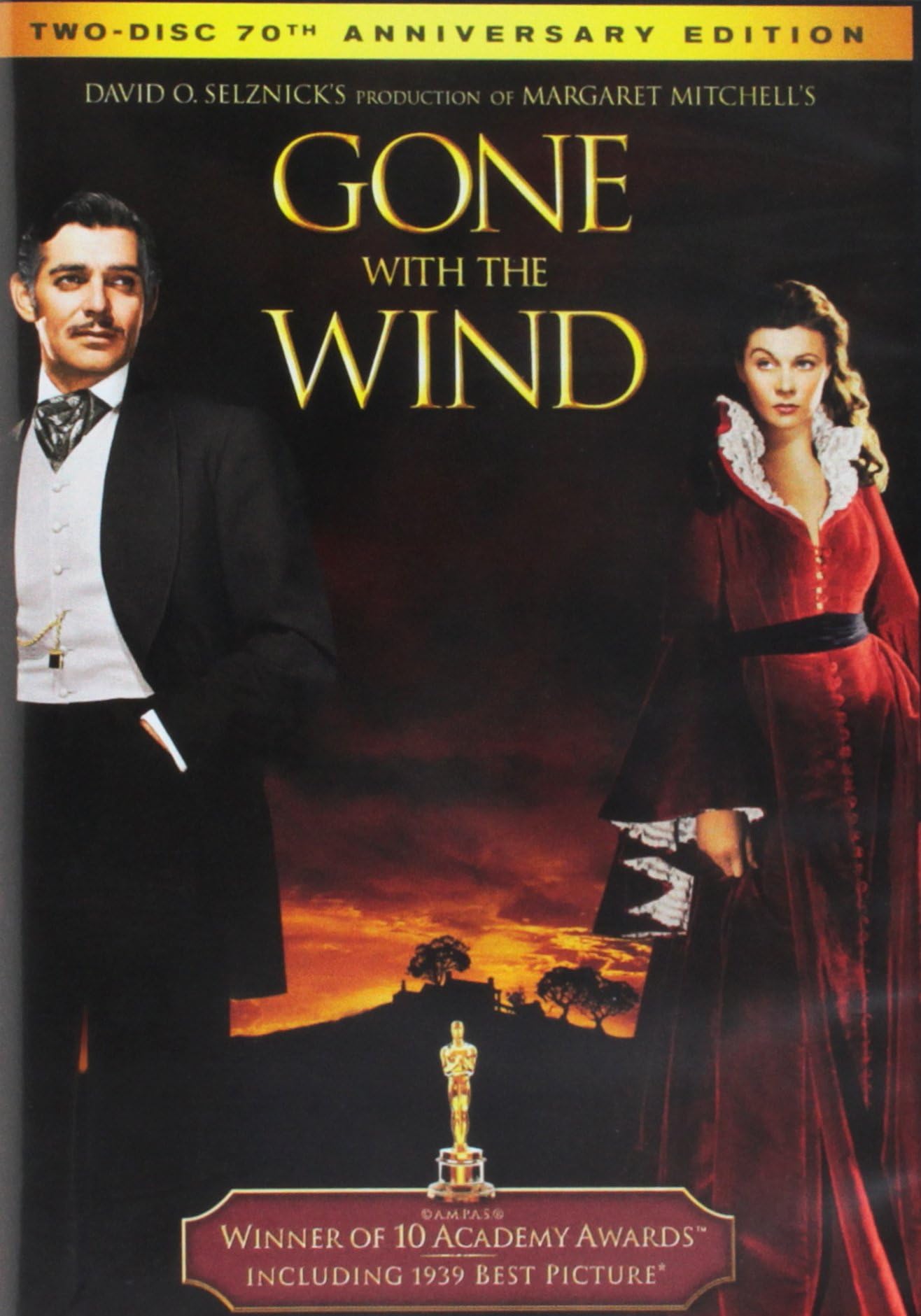


Period romance. War epic. Family saga. Popular fiction adapted with crowd-pleasing brilliance. Star acting aglow with charisma and passion. Moviemaking craft at its height. These are sublimely joined in the words Gone with the Wind . This dynamic and durable screen entertainment of the Civil War-era South comes home with the renewed splendor of a New 70th-Anniversary Digital Transfer capturing a higher-resolution image from Restored Picture Elements than ever before possible. David O. Selznick’s monumental production of Margaret Mitchell’s Pulitzer Prize-winning book can now enthrall new generations of home viewers with a majestic vibrance that befits one of Hollywood’s greatest achievements. Review: Good barebones Blu-Ray for those of us who don't want to pay for the fluff - First of all, I think it's great that barebones editions like this exist, when studios seem terribly keen on special editions of single movies that charge 2 and 3 times what a reasonable price for a single film is. This disc is currently only available at Target stores, but is hitting wider release on 2/2/10. So check back then if you want to get this from desertcart. It probably would not pay to buy this from the "other sellers" right now, because most are charging near the price of the multi-disc edition. OK, onto the disc itself. The Film: I must be one of those people who somehow had avoided seeing this film. Well, this Blu-Ray was my first exposure to it. And all I can say is, yes, this certainly belongs in the top 5 American movies ever made. It truly is epic and sweeping, with heaping helpings of history, romance, melodrama, and beauty. Both of the primary actors are very good, and they have an interesting chemistry on screen. Vivien Leigh's performance is a tour de force in that she is able to keep us caring about her character despite the character's many shortcomings. The supporting cast is more than competent as well, although I will say I wish Ashley could have tamed his obvious British accent a bit more than he did. I was particularly impressed by the significant roles played by black actors - for 1939, no mean feat. Granted, they are almost all slaves, but many of the actors invest their characters with great depth and feeling. Also very impressive was the portrayal of the Civil War from the Confederate perspective. The suffering of the soldiers and the effects this has on the populace are very starkly portrayed. Many visual compositions are quite beautiful, especially sunsets, the blazing infernos of burning Atlanta, and the exquisite matte paintings of the manors and estates. This truly is one of those movies everyone should see before they die. It's an unforgettable experience. At 3 hours and 53 minutes (a tad less if you speed through the overture, intermission, and exit music), it's quite a chunk of film to get through in one sitting. But the story is so absorbing, you may just find yourself wanting to. The Blu-Ray: This film is presented in a 1080p, 1.33:1 aspect ratio encode. This is the proper aspect ratio for the film, and thank goodness no one attempted to create a faux-widescreen image. While shots that contain optical effects suffer a bit in detail (due to the double and triple passes on the film elements to layer the effects), most of the film is impressively detailed. It's not going to beat you over the head as "high definition," but if you really look, you will see a lot of little things. The cloth of the costumes is particularly nice to look at. The early technicolor process is preserved well, with its slightly hazy but very lush color scheme. Reds and oranges in particular really pop off of the screen. Comparing this transfer with films of a similar vintage (e.g. Casablanca, The Wizard of Oz), it comes off very nicely. The audio is presented in both Dolby TrueHD and the original mono soundtrack. It is a tad quiet, and I watched this film at a level about 20% higher than most movies. It was, however, well balanced between dialogue, music, and effects, and the booming of cannon in the rear surrounds and subwoofer channels was quite impressive. I frequently check out the subtitles on home video, and wow, were these subtitles ever WAY off. I realize there is a lot of dialogue in this film, but literally 20 to 30 percent of it is lost in the transition to the subtitle track. I just don't get why studios do this, especially on a classic film like this. If I were a member of the deaf community, I'd be pretty peeved. Conclusion: Warner Bros. has really delivered the goods, with a respectful transfer of the film that both delivers on quality but also doesn't overdo things like Digital Noise Reduction and Edge Enhancement. This is a terrific Blu-Ray, and it's a classic film. And I don't mean classic in the way that some old films are a little boring or their writing doesn't stand up today, or it might not be appreciated by a modern audience. I mean, this is a CLASSIC, and anyone should be able to enjoy it mightily. Review: great movie - great actors great movie stays true to the past


| Contributor | Ann Rutherford, Barbara O'Neil, Butterfly McQueen, Clark Gable, David O. Selznick, Evelyn Keyes, Hattie McDaniel, Leslie Howard, Margaret Mitchell, Olivia de Havilland, Thomas Mitchell, Victor Fleming, Vivien Leigh Contributor Ann Rutherford, Barbara O'Neil, Butterfly McQueen, Clark Gable, David O. Selznick, Evelyn Keyes, Hattie McDaniel, Leslie Howard, Margaret Mitchell, Olivia de Havilland, Thomas Mitchell, Victor Fleming, Vivien Leigh See more |
| Customer Reviews | 4.8 out of 5 stars 30,804 Reviews |
| Format | Color, DVD, Dolby, Full Screen, NTSC, Original recording remastered, Special Edition, Subtitled |
| Genre | Drama/Love & Romance |
| Language | English |
| Runtime | 3 hours and 53 minutes |
M**N
Good barebones Blu-Ray for those of us who don't want to pay for the fluff
First of all, I think it's great that barebones editions like this exist, when studios seem terribly keen on special editions of single movies that charge 2 and 3 times what a reasonable price for a single film is. This disc is currently only available at Target stores, but is hitting wider release on 2/2/10. So check back then if you want to get this from Amazon. It probably would not pay to buy this from the "other sellers" right now, because most are charging near the price of the multi-disc edition. OK, onto the disc itself. The Film: I must be one of those people who somehow had avoided seeing this film. Well, this Blu-Ray was my first exposure to it. And all I can say is, yes, this certainly belongs in the top 5 American movies ever made. It truly is epic and sweeping, with heaping helpings of history, romance, melodrama, and beauty. Both of the primary actors are very good, and they have an interesting chemistry on screen. Vivien Leigh's performance is a tour de force in that she is able to keep us caring about her character despite the character's many shortcomings. The supporting cast is more than competent as well, although I will say I wish Ashley could have tamed his obvious British accent a bit more than he did. I was particularly impressed by the significant roles played by black actors - for 1939, no mean feat. Granted, they are almost all slaves, but many of the actors invest their characters with great depth and feeling. Also very impressive was the portrayal of the Civil War from the Confederate perspective. The suffering of the soldiers and the effects this has on the populace are very starkly portrayed. Many visual compositions are quite beautiful, especially sunsets, the blazing infernos of burning Atlanta, and the exquisite matte paintings of the manors and estates. This truly is one of those movies everyone should see before they die. It's an unforgettable experience. At 3 hours and 53 minutes (a tad less if you speed through the overture, intermission, and exit music), it's quite a chunk of film to get through in one sitting. But the story is so absorbing, you may just find yourself wanting to. The Blu-Ray: This film is presented in a 1080p, 1.33:1 aspect ratio encode. This is the proper aspect ratio for the film, and thank goodness no one attempted to create a faux-widescreen image. While shots that contain optical effects suffer a bit in detail (due to the double and triple passes on the film elements to layer the effects), most of the film is impressively detailed. It's not going to beat you over the head as "high definition," but if you really look, you will see a lot of little things. The cloth of the costumes is particularly nice to look at. The early technicolor process is preserved well, with its slightly hazy but very lush color scheme. Reds and oranges in particular really pop off of the screen. Comparing this transfer with films of a similar vintage (e.g. Casablanca, The Wizard of Oz), it comes off very nicely. The audio is presented in both Dolby TrueHD and the original mono soundtrack. It is a tad quiet, and I watched this film at a level about 20% higher than most movies. It was, however, well balanced between dialogue, music, and effects, and the booming of cannon in the rear surrounds and subwoofer channels was quite impressive. I frequently check out the subtitles on home video, and wow, were these subtitles ever WAY off. I realize there is a lot of dialogue in this film, but literally 20 to 30 percent of it is lost in the transition to the subtitle track. I just don't get why studios do this, especially on a classic film like this. If I were a member of the deaf community, I'd be pretty peeved. Conclusion: Warner Bros. has really delivered the goods, with a respectful transfer of the film that both delivers on quality but also doesn't overdo things like Digital Noise Reduction and Edge Enhancement. This is a terrific Blu-Ray, and it's a classic film. And I don't mean classic in the way that some old films are a little boring or their writing doesn't stand up today, or it might not be appreciated by a modern audience. I mean, this is a CLASSIC, and anyone should be able to enjoy it mightily.
M**N
great movie
great actors great movie stays true to the past
B**F
Near-Perfect Edition of Hollywood Classic...
It seems like a 'new, improved' edition of "Gone With the Wind" has appeared every couple of years, offering the 'ultimate' in picture and sound reproduction, and extras. It can become expensive keeping up, and frustrating (much like buying a classic Disney DVD, when you know a more complete "Special Edition" will soon render your "First Time on Video" copy obsolete), but the new GWTW Four-Disc Collector's Edition most assuredly deserves a place in your collection. First off, the picture and sound quality is astonishing. Warner's Ultra-Resolution process, which 'locks' the three Technicolor strips into exact alignment, provides a clarity and 'crispness' to the images that even the 1939 original print couldn't achieve. You'll honestly believe your TV is picking up HD, whether you're HD-ready, or not! This carries over to the Dolby Digital-remastered sound, as well. All of the tell-tale hiss and scratchiness of the opening credit title music, still discernable in the last upgrade, is gone, replaced by a richness of tone that will give your home theater a good workout. (Listen to the brass in this sequence, and you'll notice what I'm talking about...) The biggest selling point of this edition is, of course, the two discs of additional features offered, and these are, in general, superb. Beginning with the excellent "Making of a Legend" (narrated by Christopher Plummer), Disc Three offers fascinating overviews about the film, the amazing restoration, footage from the 1939 Premiere (and the bittersweet 1961 Civil War Centennial reunion of Selznick, Leigh, and de Havilland), glimpses of Gable and Leigh with dubbed voices for the foreign-language versions, the international Prologue (tacked on to explain the Civil War to foreign audiences), and a 1940 MGM documentary on the "Old South" (directed by Fred Zinneman) memorable today for it's simplistic view of the time, and stereotypical portrayal of blacks. Disc Four is a mixed bag; the long-awaited reminiscences of Olivia de Havilland are more chatty than informative (with the 90-year-old actress more interested in discussing her wardrobe than on-set tension...although a prank she pulled on Gable is amusing), and the Clark Gable Profile is superficial (A&E's biography of 'The King' is far superior). Things improve, however, with the insightful, sympathetic TCM biography of Vivien Leigh (hosted by Jessica Lange), and a WONDERFUL section devoted to brief bios of many of the GWTW supporting cast, narrated, again, by Christopher Plummer (although I wish the filmmakers would have included bios for Ward Bond, Victor Jory, Fred Crane, and George 'Superman' Reeves). All in all, the GWTW Four-Disc Collector's Edition isn't perfect, but offers so much terrific material that it is CERTAINLY the one to own!
J**N
Fabulous Movie Magic That Never Grows old!
GONE WITH THE WIND is now 75 years old. It still has the power to astonish, thrill and touch the viewer as if it were released last week. There are so many layers ot brilliance here that you can watch it countless times--which I've done--and still be thrilled by its amazing freshness, power and beauty. We have a cast that gives it their all, especially the fabulous Vivien Leigh portraying the most fascinating and vibrant heroine in movie history: Scarlett O'Hara. It's Leigh who provides the backbone to the whole movie as we first see her girlish and glorious in her white organdy gown, sitting on the front steps of her home Tara with the Tarleton twins. Through nearly 4 hours, we are galvanized to watch her evolve through profound periods of her life: a flirtatious Southern belle, to motherhood, to nursing the dying in Atlanta, thru starvation, desperation and finally to the wife of her admirer, Rhett Butler. Clark Gable was at his peak when this movie was made and its easy to see why he was the number one male movie star in the world. While we enjoy the performers, there's all the other qualities which have made this movie legendary: fabulous musical score by Max Steiner, unforgettable costumes--especially the ladies' gowns--by Walter Pluket. Victor Fleming's direction (although he was helped by several other directors) the screenplay, make-up, hair-styles and of course the master of it all: David Selznick. In the numerous books written about this movie legend, all authors agree that it was Selznick who shaped the massive production and made sure it bore his 'look." He wanted a visually opulent look, with rich colors. For his performers, he demanded that the femme leads would not be creatures of the Hollywood look of glamour. He ordered new tests for natural looking make-up. The women would not wear the false lashes, layers of pancake and lipstick and mascara that women characters in Hollywood historical productions were prone to wear. The sets, the various locales, the use of shadows and especially the unforgettable lighting were all deep concerns for Selznick. Just look at the sequence when Scarlett enters a room at Tara fo find her mother's body, waiting for burial. The eerie greenish lighting, the music--complete with the beating of a heart--is just one of the majestic moments in a film that will be around for another thousand years. My only complaint is that the commentary by film historian Rudy Behlmer is a travesty. Obviously reading from a script, he races through the movie giving the viewer a detailed account of each performer while his dialogue has nothing to do with the action on the screen. The worst moment: while we watch Scarlett O'Hara go a hill top and makes her vow: "As God is my witness..." Rudy is rapidly giving us the rundown on the life of Thomas Mitchell, who plays Scarlett's father! He gives us no comments about how complicated this sequence proved to be--the whole crew and Vivien Leigh had to visit this isolated area at 2 a.m. for several mornings to capture that blood-red sunset. Far better would have been to have the many experts on GWTW to help narrate the technical aspects of this spectacular production. All the main crew and cast members are now dead--with the eternal Olivia D'Haviland proving the exception. But we can always put this movie into our player and be thrilled once more at the movie miracle that David O. Selznick helped create on mostly the backlot of Selznick International Studio in 1939.
D**A
Gone with the winds
Awesome and best movie around
H**S
GWTW: At 74, still the box office champ....
Almost four years ago, on November 17th, the 70th Anniversary Edition of GONE WITH THE WIND (1939) was released in a special 5-disc boxed set. While a Hollywood classic, GWTW is not for everyone. GWTW is not for you if: 1) you think a movie must be as historically accurate as a history book; 2) you think a 1939 movie should reflect the values of the 21st century; 3) your attention span doesn't allow you to watch movies longer than two hours; 4) you can only accept politically correct films, particularly in terms of racial issues; 5) you can only accept special effects as they appear in (computerized) modern films; 6) your idea of great acting is to be found only in the slasher or teen films being made today. Some find GWTW a ridiculously overblown, exaggerated re-telling of the Old South. To others, Scarlett O'Hara is nothing more than a spoiled brat who never really grows up; or, by the time she shows a glimmer of doing so, it's too late. What one should keep in mind when watching GONE WITH THE WIND: it is not a documentary. Despite the obsessive care producer David O. Selznick lavished on historical accuracy as to the "look" of the period--the clothes, the interiors--the movie is not reality, but rather an historical romance set against the bloodiest war ever fought on American soil, a war in which at least 618,000 Americans died. (Some experts say the toll reached 700,000. The number that is most often quoted is 620,000. At any rate, these casualties exceed the nation's total loss in all its other wars, from the Revolution through Vietnam.) GWTW is a great--perhaps THE great--Hollywood example of the power of film: although battle scenes are never actually shown, the results of the war--the devastation, disease and death--are so powerfully depicted that people swear they "remember" seeing bloody combat in the movie. WITH ONE LOOK: Vivien Leigh as Scarlett, at the Atlanta church-turned-charnel house of diseased, dying and dead soldiers. With one reaction shot(see below)--her revulsion at a soldier's screams as his leg is amputated, without anesthesia--Vivien Leigh conveys the horrors--and the (never shown) bloody battles--of war. This power of film is perhaps why GWTW comes in for different criticisms. The movie is so real in its physical aspects--its "look"--that it is criticized for not being (historically) accurate in others. But, again, the movie is not a documentary. It is a m-o-v-i-e based on a novel; i.e. fiction. Not only is GWTW not a documentary on the Civil War period, it is not a history of slavery in America. It was criticized--as was the novel--for its treatment of blacks. But upon an objective viewing of the movie today, it is quite often the slaves--Mammy, Pork, Big Sam--who are the only characters with any sense. Of course, GONE WITH THE WIND, with its happy plantation slaves posed against bleeding robin's breast sunsets, has its enraging and embarrassing moments; the racist depiction is, regrettably, part of the nation's collective past. Caption: Hattie McDaniel as Mammy explaining to Melanie (Olivia de Havilland) that Rhett has locked himself in the room with his daughter Bonnie's corpse and has threatened to kill Scarlett if she buries the child. If this scene alone doesn't rip your heart out--largely due to McDaniel's performance--then pick up the phone and call the undertaker because you are most assuredly dead. Taken as cultural artifact of an earlier period of American movie-making, one has to look at it as anthropology tells us we must look at cultures not our own. That is, just as we must "judge" a culture on its own terms, we must look at a 70-year-old movie in terms of the times in which it was produced. Finally, GONE WITH THE WIND is an adaptation of a novel written by a Southern woman who, as a child, sat and listened to the stories the old Confederate veterans told about the old days before, during, and after The War. It is a love story, inspired in part by the novelist's grandmother, reflecting the attitudes left over from that long-ago time. Taken on its own terms, it remains the prototype of the Hollywood epic film. It achieved many firsts. Today, it remains--in terms of tickets sold--the all-time box office champ. ---Hoyt Harris, Lafayette, LA Gone with the Wind (70th Anniversary Ultimate Collector's Edition) Victor Fleming: An American Movie Master Frankly, My Dear: "Gone with the Wind" Revisited (Icons of America) Gone with the wind, the screenplay by Sidney Howard; based on the novel by Margaret Mitchell *** Vivien Leigh: A Biography David O. Selznick's Hollywood *** *** *** *** *** *** *** Two years after announcing he would bring "Gone with the Wind" to the screen, producer David. O. Selznick--after paying the publisher MacMillan a record sum for the rights--still did not have a script. He was still a couple of months away from getting MGM to loan Clark Gable in return for world distribution rights and half the film's box office. Despite a phenomenally costly, two-year, nationwide search for an actress---amateur or professional--to play the tempestuous, spoiled and fickle Southern belle Scarlett O'Hara, Selznick still didn't have his Scarlett, either. (In all, 1,400 hopefuls were interviewed, 90 given screen tests, and exactly one actually cast, in a minor role. Also considered: Katharine Hepburn (who lobbied for the part), Bette Davis, and even RKO Studio's loony suggestion of Lucille Ball. Charlie Chaplin's companion, Paulette Goddard, seemed to have the role locked up, but a massive letter campaign spearheaded by the Florida chapter of the Daughters of the Confederacy torpedoed it.) With or without a Scarlett, construction crews needed to get cracking on building sets for Selznick's epic--what many doomsayers were already calling "Selznick's folly." To make room for construction of a two-mile long re-creation of Old Atlanta, the back lot of Selznick International Pictures had to be cleared of old movie sets. Someone came up with the idea of burning the remnants of the set of KING KONG (1933) and filming it as the "burning of Atlanta," one of the great visual sequences in all of film. Just as Life itself so often does, it came down to one shot. There could be no retakes. Without a script, without stars for the two principal characters, on the night of December 10, 1938, the shooting of GONE WITH THE WIND finally began--stunt doubles for Scarlett O'Hara and Rhett Butler escaping the inferno on buckboard as Los Angeles firemen aimed their hoses at the raining embers. (The fire on the Culver City back lot--fed by an elaborate system of pipes pumping oil and water through the sets so that the fire could be raised or lowered at will--was huge and intense. Its red glow was so ominous on low-hanging clouds on this chilly December night that hundreds of L.A. residents called the fire department, wanting to know if MGM was on fire.) Because there could be no retakes, the lenses of every available Technicolor camera (there were no more than a dozen in existence) were trained on the one-chance, make-or-break scene. As the sets went up in flames, Selznick's brother, the agent Myron Selznick, brought a lovely British actress onto the scaffolding, a perch from which "General" David Selznick was watching the inferno. David looked into the eyes of this exquisite, dark-haired, green-eyed beauty. A British actress little known in the United States at that time, Vivien Leigh-- who had made her first stage appearance at the age of three, reciting "Little Bo Peep"--was 26. But Vivien Leigh's entrance was no accident. She had come to Hollywood from England ostensibly to be with her lover Laurence Olivier, one of Myron's clients, whom she would marry a year and a half later when his divorce--and hers--became final. But Vivien Leigh had also come to Hollywood to pursue the part of Scarlett. Both Selznicks already knew of Leigh. But it wasn't until this night--with the crimson glow of the burning movie set illuminating her face--that David O. Selznick first laid eyes on Vivien Leigh. Leigh reportedly auditioned for then-director George Cukor that very night. A week and a half later, on December 21 and December 22, her screen tests were made. Legend has it that George Cukor called her three days later on Christmas Day to tell her she had the part. She signed her contract on January 16, 1939. Principal photography began on January 26. The opening scene of "Gone With The Wind," in which the Tarleton Twins are talking to Scarlett about the war, was one of the most troubled scenes of the film. It was shot a total of five times. The first time was on Thursday, January 26, 1939. Selznick was not satisfied with this take because the Twins's hair, dyed red for the film, appeared "too orange" in Technicolor. The scene was shot again on Monday, January 30, but was not used because of the lighting. When George Cukor left the production, Victor Fleming took over; his first scene, shot on Wednesday, March 1, was the porch scene. But Selznick was not happy with the Twins' performances so the take was not used. Fleming shot the scene again on Monday, June 26. This take was not used because Vivien Leigh looked "exhausted." She took a vacation before returning to shoot the scene a final time on Thursday, October 12, 1939. It was the last scene shot with Vivien Leigh and is the version that appears in the final film. So, in the finished film, Vivien Leigh is almost nine months older at the beginning of the movie than she is at the end of the movie. Now, let's fast-forward thirteen months. January 29, 1940-- Los Angeles--Ambassador Hotel's Coconut Grove. It's Oscar night in Hollywood. With comedian Bob Hope emceeing, the Oscar ceremony is underway. One after another, the gold-plated statuettes--gold-plated, 92 percent tin now, but gold-plated solid bronze on this night--are showered on GONE WITH THE WIND. It won't be a "clean sweep," but the movie will set a record for most Oscars won. --William Cameron Menzies for his use of color. --Hal Kern and James Newcom for film editing. --Ernest Haller and Ray Renahan for color cinema photography. --Lyle Wheeler for art direction. Acclaimed author Sinclair Lewis announces the Academy Award for best screen adaptation: a posthumous Oscar (the first such Oscar ever given) to writer Sidney Howard. (A lover of the quiet rural life, Howard had died five months earlier while working on his 700-acre farm in Tyringham, Massachusetts. The screenwriter was crushed to death in a garage by his two-and-a-half ton tractor. He had turned the ignition switch on and was cranking the engine to start it when it lurched forward, pinning him against the wall of the garage. Apparently an employee had left the transmission in high gear. Sidney Howard died less than four months before the movie he scripted had premiered. He never saw the movie that he had written--with the help of many others, including his micromanaging, obsessed producer.) Mervyn LeRoy, who produced THE WIZARD OF OZ this same year, steps to the podium to present the next Academy Award. --Best direction to Victor Fleming--who had simultaneously directed OZ--for GONE WITH THE WIND. All Oscar nights since the first one in 1928 had been glamorous ones. But this night was special. It represented what history would soon realize was the zenith, the high-water mark of the studio system and the Golden Age of Hollywood. In the twelve months of 1939, more now-classic films were produced than in any year-- before or since. In addition to GONE WITH THE WIND, 1939 saw production of the following movies: * Edmund Goulding's DARK VICTORY (with three nominations and no wins) about a young heiress who is slowly dying of a brain tumor and ultimately accepts her death in noble fashion * Director Sam Wood's GOODBY MR CHIPS (with seven nominations and one win - Best Actor), a version of James Hilton's novel about a beloved Latin teacher/schoolmaster at an English public school (the Brookfield School for Boys) * Director Leo McCarey's tearjerker LOVE AFFAIR (with five nominations and no wins) - that he later remade as AN AFFAIR TO REMEMBER (1957) - about two lovers who promise to meet atop the Empire State Building * Director Ernst Lubitsch's delightful romantic comedy NINOTCHKA (with four nominations and no wins) about a cold Soviet official sent to Paris * Director Lewis Milestone's adaptation of the classic John Steinbeck tragedy "Of Mice and Men" (with five nominations and no wins) * Director John Ford's version of Ernest Haycox's story "Stage to Lordsburg", STAGECOACH (with seven nominations and two wins - Best Supporting Actor and Best Score) - the director's first film with star John Wayne - about a stagecoach journey by a varied group of characters * Director Victor Fleming's perennial favorite - the beloved fantasy film about a Kansas farm girl who journeys to a brightly colored world in THE WIZARD OF OZ (with six nominations and only two wins - Best Song "Over the Rainbow" (almost cut from the film by MGM executives) and Best Original Score) * Director William Wyler's best film version of Emily Bronte's romantic novel about doomed lovers in WUTHERING HEIGHTS (with eight nominations and only one win - Best Black and White Cinematography by Gregg Toland, who, the following year would shoot CITIZEN KANE for Orson Welles) * Director Frank Capra's film MR. SMITH GOES TO WASHINGTON (with eleven nominations and only one win - Best Original story) of Lewis Foster's story about a naive and innocent junior senator. But on this night the movie receiving Hollywood's glitter and gold was perhaps the most highly anticipated film in Hollywood history. The public had quickly made Margaret Mitchell's novel a best-seller after its publication in 1936. (It won the Pulitzer Prize for fiction in 1937.) Sales of the novel, at the virtually unprecedented price of three dollars, reached about one million by the end of that year. Once it was announced that Selznick planned to adapt it the screen, the novel's legion of fans eagerly gobbled up any news about the production. The public also began clamoring for their favorite stars to play specific characters in the book. Five months earlier---while the film was being edited---when Selznick was asked by the press how he felt about the film, he said: "At noon I think it's divine, at midnight I think it's lousy. Sometimes I think it's the greatest picture ever made. But if it's only a great picture, I'll still be satisfied." On September 9, 1939, Selznick, his wife Irene Mayer Selznick, investor Jock Whitney, and film editor Hal Kern drove out to Riverside, California, with all of the film reels to preview it before an audience. The film was still unfinished, missing many optical effects and most of Max Steiner's music score. They arrived at the Fox Theatre, which was playing a double feature of HAWAIIAN NIGHTS and BEAU GESTE. Kern called for the manager and explained that they had selected his theatre for the first public screening of GONE WITH THE WIND. The theater manager was told that after HAWAIIAN NIGHTS had finished, he could make an announcement of the preview, but was forbidden to say what the film was. People were permitted to leave, but the theatre would thereafter be sealed with no re-admissions and no phone calls out. The manager was reluctant, but finally agreed. His only request was to call his wife to come to the theatre immediately. Kern stood by him as he made the call to make sure he did not reveal to his wife the name of the film. When the film began, there was a buzz in the audience when Selznick's name appeared, for they had been reading about the making of the film for more than two years. In an interview years later, Kern described the exact moment the audience realized what was happening: "When Margaret Mitchell's name came on the screen, you never heard such a sound in your life. "They just yelled, they stood up on the seats...I had the [manually-operated sound] box. And I had that music wide open and you couldn't hear a thing. Mrs. Selznick was crying like a baby and so was David and so was I. Oh, what a thrill! And when (the words) "Gone with the Wind" came on the screen, it was thunderous!" In his biography of Selznick, David Thomson wrote that the audience's response before the story had even started "was the greatest moment of his life, the greatest victory and redemption of all his failings." After the film, there was a huge ovation. In the preview cards filled out after the screening, two-thirds of the audience had rated it excellent, an unusually high rating. Most of the audience begged that the film not be cut shorter and many suggested that instead they eliminate the newsreels, shorts and B-movie feature, which is eventually how GONE WITH THE WIND was screened and would soon become the norm in movie theatres around the world. With thirteen nominations, the most ever up until that time, GONE WITH THE WIND won 10 Academy Awards--8 regular, 1 honorary, 1 technical--a record that stood for twenty years, until BEN HUR won eleven in 1960. ***** ***** ***** ***** ***** ***** ***** ***** Quoting GWTW: Rhett: With enough courage, you can do without a reputation. Scarlett: Great balls of fire. Don't bother me anymore, and don't call me sugar. Scarlett: I can't think about that right now. If I do, I'll go crazy. I'll think about that tomorrow. Rhett: No, I don't think I will kiss you, although you need kissing, badly. That's what's wrong with you. You should be kissed and often, and by someone who knows how. Rhett: Did you ever think of marrying just for fun? Scarlett: Marriage, fun? Fiddle-dee-dee. Fun for men you mean. Rhett: I can't go all my life waiting to catch you between husbands. Scarlett: Rhett, Rhett... Rhett, if you go, where shall I go? What shall I do? Rhett: Frankly, my dear, I don't give a damn. Scarlett: Sir, you are no gentleman. Rhett: And you, Miss, are no lady. Scarlett: As God is my witness, as God is my witness they're not going to lick me. I'm going to live through this and when it's all over, I'll never be hungry again. No, nor any of my folk. If I have to lie, steal, cheat or kill. As God is my witness, I'll never be hungry again. Scarlett: Cathleen, who's that man staring at us? The nasty dog. Cathleen Calvert: Why that's Rhett Butler, he's from Charleston. Scarlett: He looks as if he knows what I look like without my shimmy. Rhett: Here, take my handkerchief. Never in any crisis of your life have I known you to have a handkerchief. Scarlett: Rhett, don't. I shall faint. Rhett: I want you to faint. This is what you were meant for. None of the fools you've ever know have kissed you like this, have they? Your Charles, or your Frank, or your stupid Ashley. Mammy: It ain't fittin'... it ain't fittin'. It jes' ain't fittin'... It ain't fittin'. Rhett: My darling, you're such a child. You think that by saying, "I'm sorry," all the past can be corrected. Gerald O'Hara: Do you mean to tell me, Katie Scarlett O'Hara, that Tara, that land doesn't mean anything to you? Why, land is the only thing in the world worth workin' for, worth fightin' for, worth dyin' for, because it's the only thing that lasts. Scarlett: I'll think of some way to get him back. After all...tomorrow is another day. Scarlett: I only know that I love you. Rhett: That's your misfortune. ---Hoyt Harris, Lafayette, LA
S**R
A classic movie
Gone With the Wind is a movie that causes a lot of division, especially with the rise of the infantile division we have had in the country for years. The truth is, it can both be a classic movie and have a problematic theme. But, it also has to be looked at through the lens of history. It is a movie that could be made the way it was in 1939 with the understanding that it would probably never be made the same way today. And that is not to say it shouldn't be made the same way today. It was set during the Civil War and told from the perspective of people in the south. Obviously, most people today would not agree with the perspective of the rich, slave-owning, southerners of that time, but it does not mean that how they were portrayed in the movie is not how they were. Also, the movie was a dramatic period piece, not a documentary. So, it was never going to show the evils of slavery in all their gory details. And, I do think to say that the movie glorified slavery does a couple of things. First, it ignores the fact that there were in fact slaves that had roles such as "Mammy", and it also diminishes Hattie McDonald's achievement in playing that role. The fact that she was a black woman living under the Jim Crow laws and facing the racism that she did and still won an academy award is frankly amazing. And. let's face it, even states that did not have Jim Crow laws were not devoid of racists by any means, so the fact that a black woman in the late 1930s/early 1940s would even be nominated for an academy award, much less win it, was quite something. All that said, no, the movie is never going to be banned, and anyone who thinks so is kidding themselves, if you want to find it, you will always be able to do so, and if a disclaimer at the beginning of it really triggers you, it has been released on DVD and Blu-Ray multiple times. As for the movie itself, as I said above, it is a drama set in the south during (and after) the Civil War. It stars Vivien Leigh as Scarlett O'Hara, who is basically a rich brat, who at the beginning of the movie is trying to steal her cousin's boyfriend. Clarke Gable plays Rhett Butler, who was an attendee at a party thrown at the O'Hara estate who did not buy into the fact that the war was going to be a quick and easy thing, and also, ultimately ended up gaining Scarlett's affection, by basically standing up to her and not taking any of her crap, and marrying her. The movie is partly a romance drama, but mostly about the ravages of war, telling how Scarlett had to grow up and transform from the bratty Southern Belle who was handed everything on a silver platter, to having to deal with the realities of war. The first part of the movie (up to the intermission) deals with the war and ends with Atlanta burning. The second part deals with the aftermath of the war, and the characters trying to put their lives back together. For those who get the movie on Blu-Ray, it looks and sounds great in the HD format. The HD transfer was very well done, and while it still has the Film-noir era look to it, the video transfer does look great. What kind of extras you get depends on the version of the movie you pick up. There is a multi-disc collectors edition that has about 19 hours' worth of bonus content. The version I have is the single-disc 70th Anniversary edition, and the only extra on it is a commentary track by Historian Rudy Behlmer. Overall, the movie is a timeless classic. It has many great quotable lines, and it tells a good story, although definitely from the perspective of the losing side in the Civil War. Chances are, if it were made today more of the evils of slavery would be shown to give it more context, and show exactly why the Civil War was being fought. And yes, the civil war was about slavery, pure and simple. If you read the articles of secession from any of the states that formed the Confederacy, that is plain as day, and to say otherwise is denying all reality. I do not think the movie glorified slavery as much as it glorified the south overall. But, again, taking the movie for what it is and considering the time it was made, it can both be a classic movie and a topic of debate at the same time. And, I think a healthy debate about what was good and what may have been problematic about the movies would not necessarily be a bad thing.
B**R
Blu-ray very nice -- film shows its age.
"Gone With the Wind" is probably the most remembered title in film history. Warner Bros. released this 3 hour, 53 minute epic on a single Blu-ray disc in all of its Technicolor glory. In addition to the great video clarity, we see it in its original 1.37:1 theatrical aspect ratio as opposed to the 1.33:1 ratio of the earlier DVD issue. The video quality of this Blu-ray disc is generally fine, the audio not so good. The dialogue track is generally subdued and a little muffled sounding and the music track is very poor in quality, sounding somewhat "watery" and distorted. Strangely this is not at all the case with the new Blu-ray of "Rebecca," a film released a year after GWTW also by the Selznick studio. It's a pity more couldn't have been accomplished in sound restoration as it was with "The Wizard of Oz." A matte shot early in the film shows transparent riders and wagons driving up to the Tara mansion, surprisingly the work of William Cameron Menzies, considered at the time to be one of the best matte artists in the business. "Gone With the Wind" has never been among my favorite films and I will sacrilegiously suggest that this story could stand to be remade although it probably never will be. I was never impressed by Vivian Leigh's delivery of the part of Scarlett O'Hara which I found rushed and superficial. I get the same feeling watching her portrayal of Blanche DuBois in "Streetcar." By the second half of the picture you get the impression that many of the actors are just trying to get through it. The performances of most of the African American actors are generally uncomplimentary to the Black race as was the custom in movies in those days. My compliments go to Olivia de Havilland for some of the best acting in the picture -- a performance of real emotion and pathos. Clark Gable is OK but looks and sounds exactly the same as he does in every one of his other films. He definitely does not come across as a man of his time in this film. Leslie Howard, a very fine actor, was simply too old for the part of Ashley Wilkes and his British accent sometimes got in the way. David Selznick was worried about Howard's age at the time and he was right to be worried. For me, the final hour of the film dissolves into pure soap-opera. The directing style(s) -- Selznick went through three directors for this film -- leave a lot to be desired. The camera moving from one wounded soldier in the hospital to another delivering their lines on cue seems extremely artificial by today's standards of film making. This style recurs in a few other scenes and becomes annoying. The burning and escape from Atlanta is well done, but given today's techniques could be accomplished more convincingly now. There are several scenes that are photographically breathtaking which completely dispel the idea that older films do not benefit from being released in the Blu-ray format.
Trustpilot
3 weeks ago
3 weeks ago