Desertcart purchases this item on your behalf and handles shipping, customs, and support to France.
๐ฏ Nail every project with confidence and precision!
The Zircon MultiScanner A250 is a professional-grade stud finder and wall scanner that detects wood studs, metal objects, and live AC wires behind walls with four versatile scan modes. Featuring Auto-Correcting Technology and a bright SpotLite Pointer with LCD display, it ensures accurate, safe, and efficient wall scanning for contractors and DIYers alike.


| Battery Type | 9V |
| Brand | Zircon |
| Color | Yellow |
| International Protection Rating | IP54 |
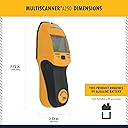
| Item Dimensions L x W x H | 7.72"L x 1.8"W x 3.23"H |
| Item Weight | 8 ounces |
| Material | Plastic |
| Material Type | Plastic |
| Power Source | Battery Powered |
| Product Dimensions | 7.72"L x 1.8"W x 3.23"H |
| search coil size | 4 inches |
E**O
Works great! A replacement for 30yo Zircon. Calibrates very fast.
I bought this to replace my previous Zircon stud finder that I had for about 30 years before it gave up the ghost. This one does about the same thing, but has more bells and whistles, such as showing the center of a stud rather than scanning back and forth. It also seems to be able to find things deeper and more accurately than the old one. I see a lot of comments on this and other stud finders about the need to calibrate, or the unit does not always detect the studs correctly. "Calibration" is what the stud finder MUST do to be able to detect things behind the wall. This sets a basis for the unit to know what the "normal" wall looks like: how deep the Sheetrock/wall material is, how dense it is, etc., so it can detect changes to this. If you don't let the unit calibrate, it WILL NOT WORK! To "calibrate" simply hold the unit against the wall and push the button until the unit beeps. 2-3 seconds, then scan while holding the button down.
A**R
It does what is says.
I like this device because it checks the interior of a wall for the 4 most typical obstacles in a wall... Particularly it works for finding live electrical wires because it's a safety issue, and because it can find piping so you don't wind up with a wet wall. I would caution that the located spots are not precise (it generally finds a wider area that the obstruction itself) but it is accurate enough to cause caution in making the opening.
A**.
Deep penetration Wonโt work through tile.
Didnโt work for why we purchased. Deep penetration setting didnโt show studs through tile.
T**H
Mr Magoo of stud finders
I have several projects coming up and thought it was time to upgrade my trusty old Zircon Studsensor 4.0 Pro stud finder to a fancy new digital one. I lost count the number of times I've used the old Zircon and how many studs it has found. It's been a terrific tool! But this new Zircon A250? Very disappointing. And yes, I do the calibration step as required. It misses studs the old Zircon locates with no problems. The new Zircon set to Deep Scan may sometimes catch a faint whiff of a stud the old Zircon has no trouble locating on the regular scan mode. These are just basic interior walls with a skim coat of plaster on them. Well, thought I, maybe the brand new, name brand battery I put in the new stud finder is flaky so I tried another new battery. Nope, no better. Next, I swapped batteries between the old and new Zircons. Nope, still no contest, the Studsensor 4.0 Pro for the easy win. Looks like my search for a more modern stud finder continues. Or maybe I'll just stick with the trusty old-school Zircon Studsensor Pro 4.0 and do the AC scanning another way. I'm happy others have had great success with their A250, unfortunately I'm not one of them.
M**R
Works as described.
Great deal on a very accurate tool.
C**N
Does linoleum cause a problem?
I needed a better stud finder to find the studs beneath a linoleum flooring. I set to "Deep Scan" after the normal scan didn't seem to work. I think it found a few electrical cables, but was not consistent finding the studs. I thought I found one, then searched for the next one either right or left, 16" centers. Nothing definite. I have access to the underneath in the basement, so I know they are on 16" centers and I know the direction of travel. So, why doesn't it work better. Has no problem finding them in the walls, which is good, and better than my old finder. So, I'll keep it, but I'll have to find a different way to find the stud positions for the squeaky sections under the linoleum. Added 3/5/2020: I went underneath the floor and drilled a locater hole 1 inch from the stud. Came up and marked the edges of the stud (1.5") based on the 1" offset from the locator. Used the finder in the marked area, and did not get any solid indication at all! It did give me a signal strength indication, but not definite enough. Went to the wall adjacent and: Perfect! Found the stud and located the wire as well. I think the subfloor/linoleum is causing the issue.
A**Y
Works very well to identify studs behind porcelain tile shower wall
I can confirm that this product helped me identify studs in my shower wall. I needed to put up grab bars. It took a little work to check and re-verify several times where the studs were, because sometimes the readings were slightly off. But in the end, I was able to accurately identify the stud locations and get my grab bar installed. I have porcelain tile by the way.
M**1
This Stud Finder is a STUD!
Much better than my other stud finders. Already used it and it is MUCH MORE accurate. Great it points out the edges of the stud.
B**S
better than the bosch
read more clearly than the bosch.
Trustpilot
2 weeks ago
2 weeks ago