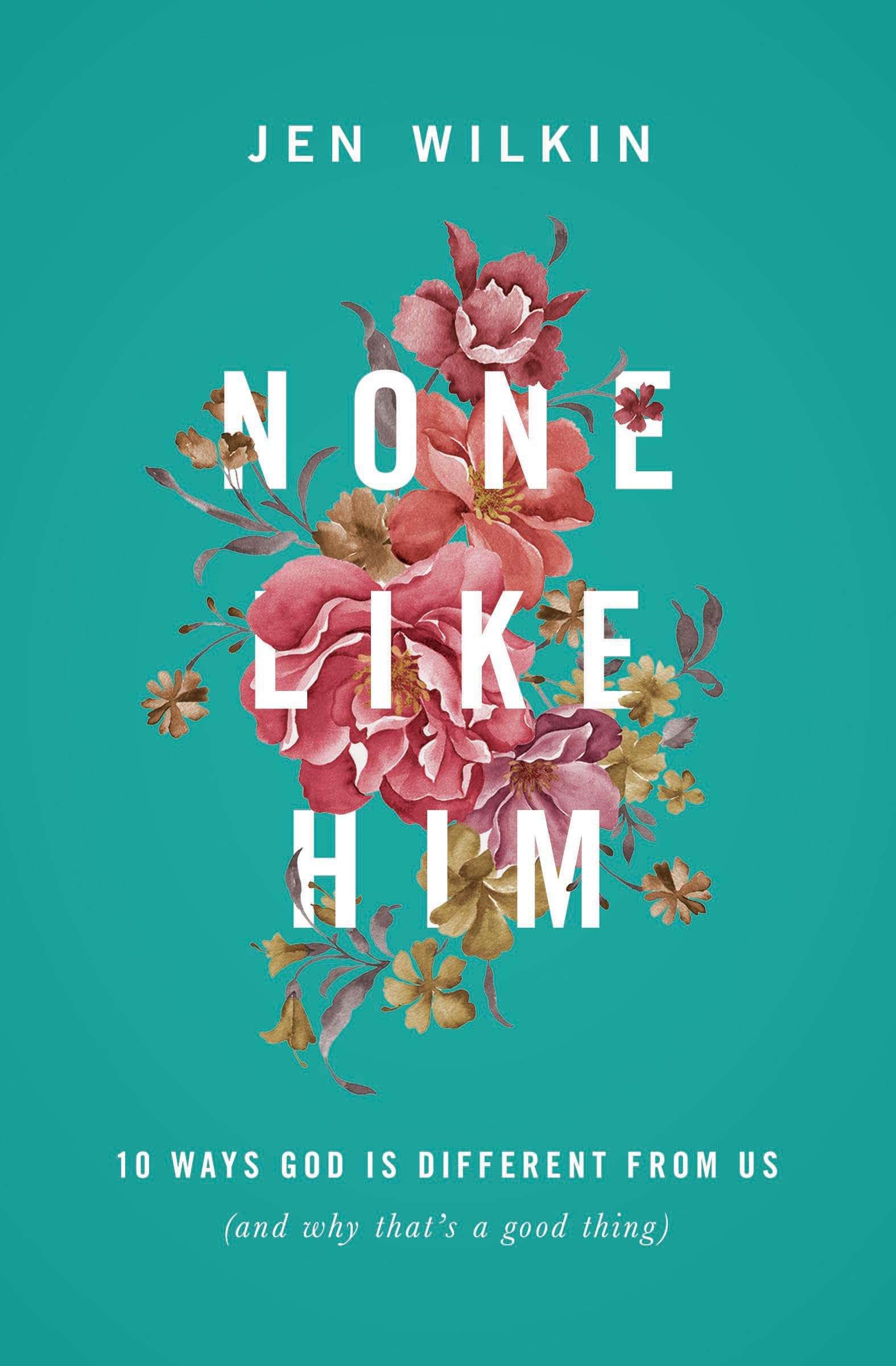
None Like Him: 10 Ways God Is Different from Us (and Why That's a Good Thing)
Product ID: 28017714
Desertcart purchases this item on your behalf and handles shipping, customs, and support to France.
Over 100,000 Copies Sold God is self-existent, self-sufficient, eternal, immutable, omnipresent, omniscient, omnipotent, sovereign, infinite, and incomprehensible. We're not. And that's a good thing. Our limitations are by design. We were never meant to be God. But at the root of every sin is our rebellious desire to possess attributes that belong to God alone. Calling us to embrace our limits as a means of glorifying God's limitless power, Jen Wilkin invites us to celebrate the freedom that comes when we rest in letting God be God. Explores ten attributes of God that humans do not share, explaining why our limits are a good thing Includes verses for meditation and reflection questions at the end of each chapter Written by a popular blogger and author Author’s previous book, Women of the Word , sold more than 50,000 copies in the first twelve months Review: Insightful book that works great for women's bible study groups. Highly recommend. Sound teaching. - Jen Wilkin is an insightful and inspiring Christian author. My women's study group has used several of her books and always find her to bring fresh perspectives on following Christ and in considering God. I have never detected anything concerning about her theology. Even my husband, who is usually quite particular, finds her books helpful and enjoyable to read. Review: Jen Wilkin's materials need to be added to every Christian's library - In my opinion, Jen Wilkin is one of the most important teachers of our time. In a time where Christian resources and a plethora of ideas abound, we need solid exposition and teaching, and Jen Wilkin is that. If she is anything, she is faithful to the Word of God. Her materials do not reek of fluff and silly alliteration or other literary devices. In contrast, her illustrations are meaningful and relatable, bringing depth and context to the point at hand. Wilkin is at once profound yet accessible. After working through Tozer, Grudem, and Pink in studying God's character and attributes, her book is a welcome change, well organized and easily grasped. Readers should know that this book is a study of the 10 Incommunicable Attributes of God (attributes true only of Him) whereas her new release, "In His Image" is a study of his communicable attributes (attributes true of God and of the believer). Early on in this book she provides a list of both of these. His incommunicable attributes that are discussed in this book are: 1. Infinite 2. Incomprehensible 3. Self-Existent 4. Self-Sufficient 5. Eternal 6. Immutable 7. Omnipresent 8. Omniscient 9. Omnipotent 10. Sovereign Each chapter is followed with verses for meditation and questions to journal through. Could easily be used for a book club and/or women's study. I'm using it as a resource to develop materials for our upcoming women's retreat at church. Cannot recommend it highly enough.


| Best Sellers Rank | #4,834 in Books ( See Top 100 in Books ) #91 in Christian Women's Issues #114 in Christian Theology (Books) |
| Customer Reviews | 4.8 out of 5 stars 3,799 Reviews |
T**.
Insightful book that works great for women's bible study groups. Highly recommend. Sound teaching.
Jen Wilkin is an insightful and inspiring Christian author. My women's study group has used several of her books and always find her to bring fresh perspectives on following Christ and in considering God. I have never detected anything concerning about her theology. Even my husband, who is usually quite particular, finds her books helpful and enjoyable to read.
M**N
Jen Wilkin's materials need to be added to every Christian's library
In my opinion, Jen Wilkin is one of the most important teachers of our time. In a time where Christian resources and a plethora of ideas abound, we need solid exposition and teaching, and Jen Wilkin is that. If she is anything, she is faithful to the Word of God. Her materials do not reek of fluff and silly alliteration or other literary devices. In contrast, her illustrations are meaningful and relatable, bringing depth and context to the point at hand. Wilkin is at once profound yet accessible. After working through Tozer, Grudem, and Pink in studying God's character and attributes, her book is a welcome change, well organized and easily grasped. Readers should know that this book is a study of the 10 Incommunicable Attributes of God (attributes true only of Him) whereas her new release, "In His Image" is a study of his communicable attributes (attributes true of God and of the believer). Early on in this book she provides a list of both of these. His incommunicable attributes that are discussed in this book are: 1. Infinite 2. Incomprehensible 3. Self-Existent 4. Self-Sufficient 5. Eternal 6. Immutable 7. Omnipresent 8. Omniscient 9. Omnipotent 10. Sovereign Each chapter is followed with verses for meditation and questions to journal through. Could easily be used for a book club and/or women's study. I'm using it as a resource to develop materials for our upcoming women's retreat at church. Cannot recommend it highly enough.
J**2
DO yourself a favor and read this book!
Jen Wilkin's latest masterpiece, *None Like Him*, is like a spiritual wake-up call, flipping our perceptions of God upside down! If you're after a warm and fuzzy take on Christianity, you might want to grab a tissue because this book is a whole different ballgame. I dove in knowing God is not just another buddy, but wow, did it hit me how often I tried to play God in my own life! I was trying to snatch up His divine qualities like they were on sale, leaving me with a hefty dose of conviction! Wilkin brilliantly lays out ten ways God is totally one-of-a-kind, diving into His limitless nature and mind-blowing power. And just when you think it's all about Him, she flips it back to us, revealing our sneaky little desire to be like Him. This struggle kicked off with Eve in the garden and is still going strong today—talk about a divine dilemma! In my book, everyone should grab a copy of this gem. It’s a thought-provoking and eye-opening journey into our relationship with the Big Guy upstairs!
C**N
Great book
Great book ! Helps to make you realizes and understand Gods attributes.
K**N
Deep truths that we all need to hear.
Outstanding truths based in scripture help us to better understand who God is and who we are - and are not. This is a must read for a believer ready to take their walk with God to a new level.
M**J
Amazing and much needed read!
This book is brilliantly and simply written. I thought In His Image was my favorite, but this one is my new favorite. It reminds me of my limitations but how blessed I am to be connected to a limitless God! The questions at the end of each chapter inspire much needed introspection. Thanks for writing this masterpiece of a book! A must read for every believer and non-believer. If you believe yourself to be all that, prepare to be humbled in the best way!
T**S
Modern rewrite of Tozer's Knowledge of the Holy . . .
Wilkin writes an interesting and practical exposition of the attributes of God. In keeping with usual treatments of God's incommunicable attributes she mostly emphasizes unlikeness to God’s infinite attributes, and pointing out the need for repentance from covetous desires to be like his infinite self. Here is a fact type summary of each chapter, removing all her illustrative stories and biblical texts. 1. God is infinite, limitless and immeasurable, yet he measures and sets boundaries in the universe, on the earth, or on the human body, and specifies ark, temple and moral boundaries. We, like Adam & Eve, test and despise moral boundaries and seek to have limitless love or power for ourselves or desire others have it for our benefit. Instead we should embrace our limitations, measure ourselves, our sin and our circumstances like him. 2. God is incomprehensible, infinite mystery, yet gives sufficient knowledge to be saved and sanctified, yet we should always seek more discoveries of his beauty. Only God can know our hearts completely, yet forgives and accepts us. Yet we often deceive ourselves and cannot understand our neighbor, thus we should be more charitable to him. God’s Word can diagnose and help us know ourselves. 3. God is self-existent, independent, uncreated with infinite creativity, creating from nothing all things by the power of his word, thus is the owner of all things with all the rights and responsibilities to those things. He can do things beyond our expectations when we have lost hope. He created us in Christ as new creatures. Yet we are only dependent, contingent steward-rearrangers, combining existing materials he created into new forms as servants using our gifts. We should look at creation and see his eternal power and divine nature. God gave us the right to life and the duty to protect life as God’s image-bearers, which also defines our value. We sinfully seek ownership and claim our own ability to create things from nothing without giving him glory (e.g. Nebuchadnezzar, Daniel 4, our children, our jobs, our ministries). 4. God is self-sufficient, infinite provider, the I AM, who cannot be tempted, controlled, coerced, blackmailed or manipulated. Yet by God’s design, we constantly need material, spiritual and relational things. After the fall our neediness makes us susceptible to sinful pursuits, or being controlled, manipulated or taken advantage of. We hope to achieve self-sufficiency, sinful independence from others in the family or the body of Christ, evidenced by prayerlessness, forgetfulness of God’s past provision, anger when we feel needy, failure to feel a need for forgiveness, avoidance of Christian community, hiding needs from others, lack of accountability, lack of humility and exhaustion. Christ faced all types of human neediness yet without sin. Christ met all types of human physical needs, but pointed to higher spiritual needs. Be quick to ask for help from others and receive it when given. Offer to meet other’s needs before they ask. 5. God is eternal, infinite days, and works in time to accomplish all his will making everything beautiful in its time. He is able to establish the work of our hands for eternal results (mercy to the needy is more important than material storage), laying up treasure in heaven. We are shaped and limited by the perspectives prevalent in our own history, culture and generation and cannot find out what God has done. We accuse God of not acting at the right time or doing something at the wrong time. We need to number our days and redeem the time past by avoiding excessive nostalgic views (coveting the past) by present thankfulness for the past or regret about past sins with the forgiveness of the Gospel, redeem time future by avoiding excessive anticipation (coveting the future) by present thankfulness or fear that causes anxiety and prepare wisely saying “if the Lord wills,” and redeem the time present by avoiding laziness (there will always be more time) to work in season and busyness (there will never be enough time) to rest in season. 6. God is immutable, infinitely the same in his attributes, character, plans and warnings and promises. 1 Corinthians 13 love is about God’s love, using superlatives of “always” and “never”. Yet we are constantly changing, aging, knowledge, emotions and tastes. We hope for positive things to stay the same, but they don’t, so we are sad or frustrated. We claim our habits and sins cannot change, but it’s a lie. What we really need is to trust God who stays the same and gives us holy desires to glorify God. We inaccurately accuse others of inability to change, using superlatives like “never” and “always”. We fear negative changes in society, but we need to fix our thoughts on the unchanging God. 7. God is omnipresent, infinitely unbound by place and space and needs no upgrade. His parenthood of us as children never experiences any separation. Surveillance cameras reveal some things, but God’s camera is always on everywhere. Yet we are limited, bound by space, gravity, height, genetics, and struggle to perceive his presence with us as a warning against sin (which is first always against him because it is done in his sight) and the amazing quality of grace and merciful presence. We covet limitlessness. Modern technologies (internet, phone) have helped us supersede some spatial limits, but these can also cause misunderstanding and lead us to ignore being present where we are. We should be satisfied with where God has placed us. 8. God is omniscient, with infinite knowledge, who never needs to learn anything, who never forgets. Yet humanity is required to learn from the day of conception. Yet we suffer from information overload on internet and smart phone media, coveting knowledge we do not need, (when we should ask if this knowledge helps us love God and people better), only creating more anxiety, limiting our ability to make decisions with fear that our information is insufficient to decide. We sinfully wish for knowledge of the future which only God can manage. We meddle in other people’s business. We desire omniscience over our children, but need to let go of them to God’s care, casting our care upon him because he cares. We should think on things that are lovely and praiseworthy. 9. God is omnipotent, with infinite power, needing no rest. Since his power is joined with goodness, we can be comforted by it. He entrusts us with various levels of strength, beauty, wealth, charisma and other gifts, and the indwelling Spirit, so that we will love God, overcome sin, help and protect the weak, seek inner beauty. Instead, we often use them to elevate ourselves and injure others. Jesus is our example in handling power, beauty, wealth and charisma, but uses it according to God’s will, not ours, especially for the purpose of salvation from sin. 10. God is sovereign, with infinite rule and authority to act to do all he purposes. All the other attributes qualify him for ruling well. God works all things for our good. Yet we want our rule, our desire and our own kingdom come, though unqualified for it. All his rules are good for us and bring him glory. God entrusts rule to governments, but is still in control over them. We must rule over our bodies as those bought with a price, but show caution in an idolatrous pursuit of health. We must rule over our possessions as stewards, but show caution in hoarding or compulsive buying, and accept that material possessions will get damaged or broken. Any in authority must steward relationships by good boundaries, and show caution against any forms of abuse or manipulation. We should steward our environment, but exercise caution in compulsive rituals that attempt to control all the variables and prevent anything bad from happening. Conclusion: We need awe of God’s greatness more than a boost in self-esteem. We need to share God’s hatred for sin and ask God to judge it. In Wilkin’s exposition, while she rightly highlights antithesis, the differences between God and man, and rightly warns of the sin of coveting God’s infinite glory for our own, we can notice some sections of the summary above help us see what I would call derivative parallels to humanity created in God’s image. In an effort to lead the reader to awe of God’s greatness, she mutes parallels of these infinite, all-____ attributes with a human likeness and mostly dissects them from any direct relationship to what it means to be renewed into Christ’s likeness. This traditional dissection helpfully distinguishes between God as transcendent Creator-Ruler and man as created. But the modern day reader would benefit from reconsidering this traditional dissection. For example of a typically defined incommunicable attribute, God is everlasting, without beginning or end, seeing all time equally vividly, yet seeing events in time and acting in time. Yet Scripture points out that God gives us eternal life or eternal death which seems to be derived from his everlasting rule over time. God is unchangeable, immutable (usually defined as incommunicable), but faithfulness seems a likely derivative subset of his immutable purposes and is called a fruit of the Spirit (Gal. 5:22). “And we all, with unveiled face, beholding the glory of the Lord, are being transformed into the same image from one degree of glory to another. For this comes from the Lord who is the Spirit”(2 Cor. 3:18). As we study the full revelation of Christ’s glory, and look for logical connections between a set of original divine and derivative human glory, we will notice many more transforming derivative attributes that come from the LORD’s original divine attributes. So why do I give the book four stars? Wilkin offers a nice readable summary of significant attributes and compares God with contemporary aspirations and our superman idolatries, warning us against something like the resulting chaos in the movie Bruce Almighty when Bruce seems to get something like omnipotence with a minor sprinkling of omniscience (hearing prayers and spying on people). Wilkin cites her debt to A.W. Tozer on page 16, presumably meaning the one she quotes from in numerous citations throughout the book, his classic The Knowledge of the Holy: The Attributes of God: Their Meaning in the Christian Life, and there does appear to be some similarities with Tozer's chapter structure and the chapter flow of Tozer's ideas as the seeds of what Wilkin wrote about but with modernized illustrations and applications. Tozer's book has lots of depth and Wilkin appears to have drawn from that depth. Why take away one star? I am committed to Reformed theology (such as in the Westminster Confession of Faith) as the best way to interpret Scripture and my expectation of books published by Crossway is that generally I will read authors in that interpretive tradition. Wilkin was writing admirably about God's infinite glory up to chapter 10, then (in my estimation) basically in one paragraph undercut the entire thesis of her book (and appears to take the same position as Tozer in her own words) by claiming that "The Bible consistently affirms God's total sovereignty and man's free will. . . . God draws us to salvation. We must respond to his call from our own free will. If we humans do not have a free will, then God is unjust to punish sin. Indeed he is responsible for it. . . . How committed are you to the myth of your own sovereignty?" (Loc. 1757-66 Kindle edition). With the total thrust of her book pointing out the ways man covets God's infinite attributes and needs to repent of this imaginary pursuit, I find it ironic that her thrust was not applied to this very matter of free will, for is not the mistaken view of total human free will to choose salvation just another idolatrous wish to be like the sovereign God and choose one's own destiny?
D**S
a must read for any Christian
Reminded me and convicted me - what an Awesome God who desires for us to know him, not just a book for women
P**S
None Like Him, absolutely !
I have long sought to temper my presentation of the Attributes of God with real life examples to bring home the wonders of knowing Him. Jen Wilkins book is a Master Class in this. Every Christian should read, and re-read it.
L**N
Delightful
Jen Wilkin has written a winsome and compelling read in None Like Him. There is so much to delight about in knowing how and why God is so different from us and why that's a good thing. In many ways, it helps creation rediscover it's purpose and awe in its Creator. Certain parts of the book spring to life and register an imperative reminder that only God can be God and we cannot even if we tried. It liberates, transforms and incites us to know who we are and who God is. Excellent read!
R**.
OK
Muy buen libro!
D**A
Muy buen libro.
Perfecto, lo estuve buscando en muchas partes, y aquí lo encontré super bien. El tamaño excelente, y muy linda la portada. El contenido aún no lo leo, aparte de que sirve para practicar el inglés.
D**S
Awesome book.
Awesome book.
Trustpilot
2 weeks ago
1 week ago