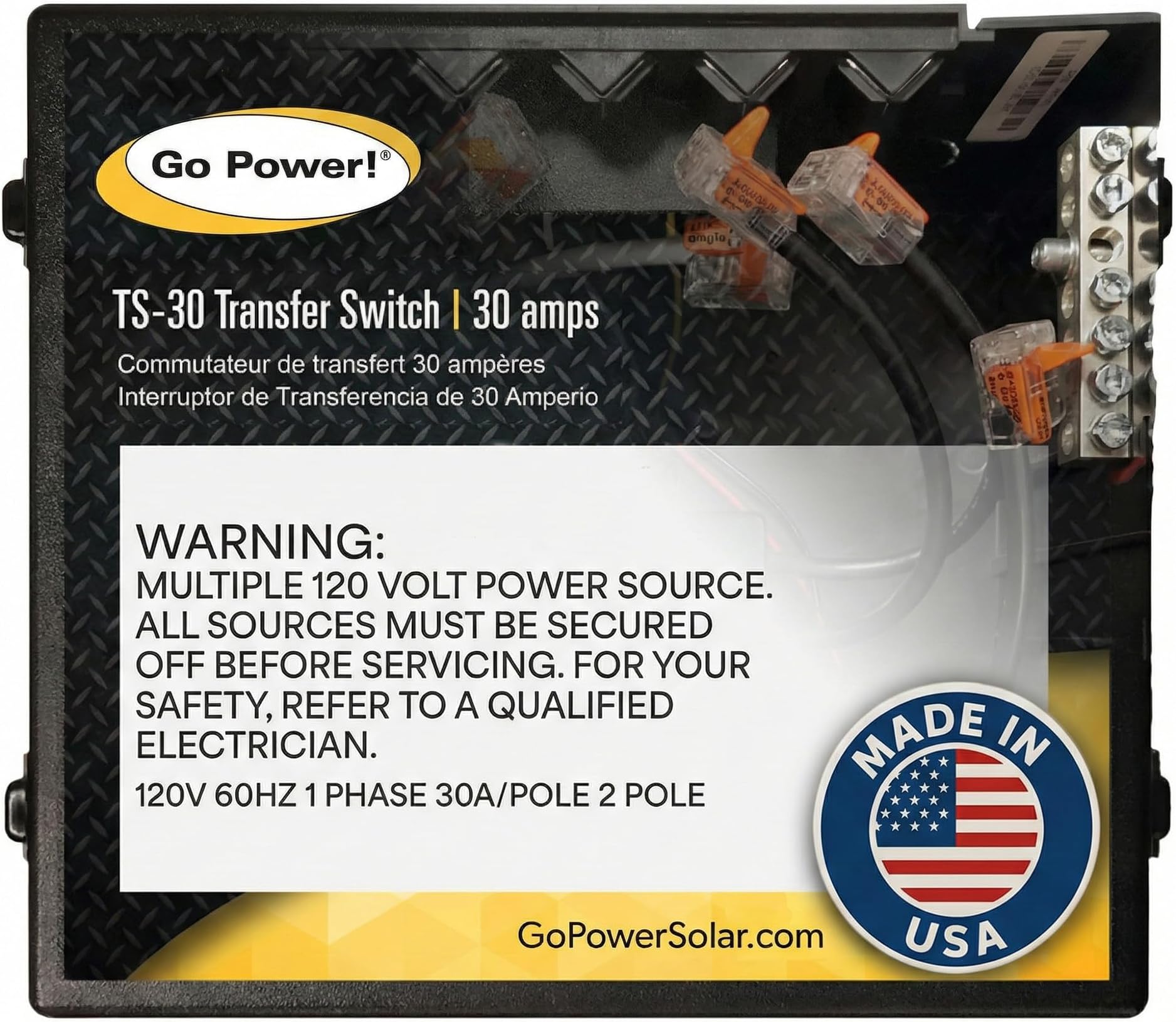

Go Power TS-30 30 Amp Automatic Transfer Switch, Dual Source Compatibility
Product ID: 2415248
⏳Generator delay switch
⚡30A dual power handling
🛠️Quick knockout installation
Desertcart purchases this item on your behalf and handles shipping, customs, and support to France.
⚡ Power up smartly, switch seamlessly!
The Go Power TS-30 is a compact, automatic 30-amp transfer switch engineered for dual power source compatibility. Ideal for RVs, boats, and off-grid setups, it features easy knockout installation, a generator delay switch to prevent surges, and built-in safety interlocks to protect connected devices during power transitions.


| ASIN | B00153EYTO |
| Batteries | 1 Unknown batteries required. |
| Best Sellers Rank | #60,870 in Patio, Lawn & Garden ( See Top 100 in Patio, Lawn & Garden ) #32 in Outdoor Generator Transfer Switches |
| Brand | Go Power |
| Bulb Type | LED |
| Customer Reviews | 4.6 4.6 out of 5 stars (1,110) |
| Date First Available | October 2, 2001 |
| Item Weight | 1 pounds |
| Item model number | TS-30 |
| Lift Type | Automatic,Automatically |
| Manufacturer | Go Power! |
| Manufacturer Part Number | TS30 |
| Mirror Lighting Type | Non-Illuminated |
| Model | TS-30 |
| OEM Part Number | TS-30 |
| Product Dimensions | 9.65 x 7.28 x 4.75 inches |
J**T
Great Auto-Transfer Switch with instant failover, and instant failback (if configured to do so).
I replaced a manual transfer switch that I had in my shed that had Shore and Solar power connected. As the batteries ran out of power and the voltage dropped too low, the inverter would trip / the inverter alarm would go off and it would cut power from the shed. Not a huge deal as there's nothing essential in there, it was more my experimenting with solar, for lighting, the shed fan, and recharging of the mower battery. I just got tired of running outside switching back and forth from shore the solar setup that powers the two sealed 'car batteries'. This a automatic transfer switch did the job perfectly. I remember seeing these a few years ago when I first toyed with building a 'solar shed', but I don't remember why I didn't go with this over the EZ Generator Switch (https://www.amazon.com/gp/product/B00FADDE0A) - especially since this one is cheaper. Probably just because I didn't need to hard wire it and I could plug a cord directly into it from the inverter. One thing that I remember not liking was the 15 second delay in returning to the Primary power supply, but after re-reading / researching this topic, they've addressed that issue with the addition of some jumper pins coming off of the little circuit board that's at the bottom of the unit. I just found an old 'jumper cap' from an old computer (like this here: https://www.amazon.com/ZYAMY-2-54mm-Standard-Circuit-Connection/dp/B077957RN7) to bridge the pins and then tested. It would instantly failover to the secondary and instantly failback to the primary after that. Easy day. The updated instructions from their web site (https://s3-us-west-2.amazonaws.com/catsy.549/MOBI_MAN_GP-TS-30.pdf) show how to do it (see page 5). My setup is as follows: Solar Panels --> Charge Controller --> 2 Batteries --> 1000w Inverter --> Primary / 'Dominant' Supply on the TS-30 Automatic Transfer Switch. House Power --> Secondary / 'Default' Supply on the TS-30 Automatic Transfer Switch From there the Load goes to a Two Circuit Panel ( https://www.amazon.com/gp/product/B00002N7MM ), that has a 15 amp circuit breaker that goes to the load. So far so good - now I just need to figure out why the GFI that's in the basement between the main panel and the garage trips during transfer. The shed gets it's 'shore power' from an exterior outlet that's connected to the garage and that GFI is part of the circuit. UPDATE: At first I thought it was due to load, but then realized that it would trip the GFI in the basement when changing from 'shore power' back to Solar... In both Solar and Shore mode, the outlets in the shed work fine. In further testing, it looks like the basement GFI only trips when going back to Solar, but ONLY if switching back and the inverter alarm was previously going off for something like a low voltage alarm while powering chargers overnight. When the sun comes back up and the batteries are back to 12+ volts, the alarm still stays on. Have an e-mail in to Renogy about this to try to get it all sorted out.
I**N
Quick connectors made installation much easier. Works flawlessly.
I added this to my trailer when I expanded my solar system and added an inverter. It switches to and from shore power as it should. My default mode of camping is off grid so I inverted the signal leads and now it will wait for shore power or generator to get up and running for a few seconds before cutting over allowing for no interruption in power. Installation was so much easier thanks to the quick connectors inside. It really helps if you're working in a small space which made it worth the extra expense.
E**.
Does Its Job
This automatic transfer switch (ATS) was part of a project for our travel trailer, which also involved installing a 3,000 watt inverter. I agree with at least one other reviewer that the ATS could have been made somewhat smaller in size. One of the common uses for a 30-amp ATS is for travel trailers and RVs, where space is nearly always at a premium. I'm not sure that the Go Power ATS needed to be nearly the size of a lunch box, but we were able to find a place for it...barely. Instructions could have been better, but the PDF available at both Amazon and on their web site helped clarify things. It's pretty easy to do some preliminary testing with an ohm meter to verify which wires are normally open (NO) and which are normally closed (NC). Note that the "thing" which is commonly referred to as a "converter" is typically really an integration of three different components: The circuit breaker panel, the bank of fuses, and the actual converter, which charges the battery. In the discussion below, I'm calling the "converter" a ... "converter" and the overall converter / circuit breakers / fuses I'll call the Panel. If you're running an inverter in a travel trailer / RV, it does no good to have the converter powered up and attempting to charge the very same battery from which it is drawing power. Some people solve this problem by simply turning off the circuit breaker in the Panel which powers the converter. This will work but it's not an optimal solution. The instructions for the Go Power ATS does show the Converter in their wiring diagram, so it's natural to wonder if their ATS also does some magic to turn off the Converter when running under battery power. It does not. After looking at their wiring diagram for a while I figured out what they're trying to say: The Converter should be wired directly into shore power (before it gets to the transfer switch), and not be part of the circuits which the ATS is controlling. I have a WFCO Panel (from Amazon), and it's easy to see where the hot wire from the circuit breaker powers the actual Converter. I disconnected that wire from the circuit breaker and put it on an in-line, high-voltage fuse (from Amazon), and then wired that into shore power BEFORE it gets to the ATS. That solves the problem. When running on the inverter (i.e. batteries in my install) the converter never "sees" 120 volts, so it doesn't come on. When running on shore power, the converter is powered on and functional. With my implementation, the in-line fuse sits within the Panel box, right next to the actual converter. The other connection to shore power was made within the ATS. The idea is that all wiring connections are being made within an electrical box, which is good practice. Hopefully this helps to clarify a few things about how to install the ATS and have the converter operational only when it makes sense.
G**G
A good automatic switch, easy to install, good construction, works exactly as the specifications dictate.
This is a great device for RV's and camping trailers although it can be used for many other applications as well. This transfer switch uses a solenoid and a spring to switch between AC power sources and to fallback to the default. With 30 amps you can attach up to a 3,500 watt generator or inverter to it. There are nice 6" pre striped wire leads that you just need to attach your wires to with wire connectors. The box is made of a strong material and is much bigger than the device in side so there is plenty of room to fit your wires and wire connections. There are no fuses in this automatic transfer switch so you will want to make sure that you get 30 amp fuses to add between your feed sources and this box. On the left side there are push through, one way, wire feed holes with ears that are pretty stiff so I have found that I need to pre expand them with a flathead screwdriver before trying to feed the wire through. There is a wiring diagram sticker under the lid to make it easy to install and the instructions make sense. This switch is made to automatically switch between grid or shore power to generator power and back. Because this device expects a generator to power its second circuit there is a 30 second delay after sensing power before switching to the generator circuit. This is a nice added feature that allows your generator to warm up before having to power a heavy load however if you intend to use this on an AC inverter instead of a generator then the 30 second delay is not necessary and is just long enough of a delay that you have time to think something is broken before it engages. I wish there was a simple switch to quickly turn on or off this feature but there are ways to bypass it if you need, just ask your installing electrician. This device makes a good strong click when it switches between sources. I like the click because it is a great indication that the switch is working however it is just loud enough to startle some and if you do not know what it is then it can be somewhat worrisome. These switches are stackable if you have 3 or more power sources just use the output from the first as the shore power input to the second. I have used these on a few projects and they have worked great every time. I highly recommend them as long as your electrical usage needs do not exceed 30 amps.
R**T
Works well
I purchased this to help control an inverter that I was installing in my travel trailer. The inverter and switch needed to go into the same compartment that housed the breaker/fuse panel and converter. The panel can be accessed (with difficulty) by removing 4 screws. I did not pay attention to the dimensions of the switch and this could have been a big mistake. The switch is not a solid-state device (as I had irrationally assumed) but an electrical contactor with some relays. Fortunately for me, I was able to wedge it into position and had just enough room for the install. The switch did not come with any instructions but there is a diagram inside the cover. The cover comes off fairly easy, but if you do not notice the instructions on how to remove it (moulded into the cover) you will really struggle like I did for a while. I hooked up the wiring as indicated, connecting the inverter to leads identified for a generator. This was a mistake. This switch (basically a normal seeking auto bus transfer switch) defaults to the generator connections. Fortunately, one of the reviews on Amazon gave the web site for a manual for the switch. I downloaded the PDF and it gave several wiring scenarios, including mine. I then went back into the enclosure and switched my shore power leads with my inverter leads. Now, when shore power is restored, the switch automatically returns to shore power as the source. Interestingly, If you are switching three sources, the manual shows using two switches together and how to hook them up to prioritize your sources. I also purchased a switch to remotely turn the inverter on and off (JR Products 12005 White Single SPST On-Off Switch with Bezel). I found it to be pretty easy to connect the switch in parallel with the inverter's power switch using control wire that I ran through a cooling vent in the inverter. Now if I am boondocking or loose campground power, all I have to do is open the breaker for the converter, AC and other loads that I do not want to power, then turn on my inverter. After a short time delay, the inverter comes on line and is powering my entire trailer, making it easy for me to pick and choose which 120v items I want to use.
M**T
Doesn't switch quite fast enough to keep a Dell computer running.
I have built a 5.1 KWH UPS using 400 AH of Lithium batteries, a Progressive Dynamics 60 amp lithium converter, a Go Power 2 KW pure sine wave industrial inverter and this transfer switch. During prolonged power outages it will run my internet, phones and a computer for about 40 hours. I wired the transfer switch to energize its relay when 120 volts is available from the grid. When grid power is lost, the relay looses energy, opening to use the inverter power. Although the relay switches very fast, when going from grid (relay energized) to inverter power, the Dell computer will shut off. When going from inverter power back to grid power, the relay is fast enough to keep the Dell computer running. I know this is out of the design specs of the transfer switch but worth noting. Since I leave the inverter on all the time, my workaround is to run the computer directly off the inverter, everything else off the transfer switch. I do like the 30 second delay when returning back to grid power. Sometimes the grid will flicker intermittently for a few seconds when the power comes back on and this feature prevents the transfer switch from switching until the grid power has some time to stabilize. Lasty, the transfer switch that is pre wired is way too expensive. The transfer switch you wire (same switch) is a steal for what it does. I have been testing the UPS components for several weeks without any hiccups at all. I finished the entire assembly and installed it into its working location and it is running as expected.
W**E
Paid for itself in two weeks!
We installed this along with 4 Walmart Deep Cycle 120 Amp Hour Batteries. (didn't need 4, but had them from other applications). Plugged the Sump Pump into the system. Put a BatteryMinder trickle charger on the system. When the street/shore power is on, the trickle charger is charging the batteries and running the sump pump. When the power goes out it switches the power to the 1200 inverter running from the battery array. We tested it a few times to make sure it would switch and switch back. Setup was a bit hairy so I suggest you have someone install it who knows home wiring. The diagram on Amazon of the wiring isn't correct. I had to phone the company and they sent me photos of the proper wiring for my application. Two weeks later we left on vacation. The ground was saturated with the recent rains. While driving to the east coast my daughter called and said the storms took out the neighbors trees which hit and broke the utility pole with the transformer in half. Lines laying out in the street, neighbors with flashlights wondering the streets looking for people with generators they could borrow to keep their basements from flooding. The generators that were available were too heavy to move easily. The power was out for 12 hours before linemen could get a new utility pole and transformer online. The system and transfer switch worked perfectly. I had my daughter monitor the setup and give us feedback while we were at the beach 900 miles away. Once the power came back online, the system took about 1 day to fully recharge. Had I not installed it, I would have had a flooded basement and well over $500 worth of damage, and dozens of hassles that the insurance probably wouldn't have covered (no flood insurance). Get one and have peace of mind while at work or on vacation.
E**K
Seamless power switching, easy install
Does exactly what it should—switches sources smoothly and reliably. Compact, straightforward, and it’s been one less thing to worry about. Love when a product just behaves.
T**D
Automatic transfer switch
Something every off grid cabin should have , works real good
J**E
Muy buena calidad y funciona como debe.
Todos los materiales son de buena calidad y los contactos para juntar los cables son del tipo T que, para mi gusto, son los más fáciles de usar. La transferencia es casi instantánea cuando se va la luz de la fuente primaria (en mi caso la luz de la calle) para pasar la alimentación a la corriente de la fuente alterna (en mi caso un inversor conectado a un banco de baterías). A veces se pierde momentáneamente la señal de wifi de mi router pero esto sin afectar la señal del modem. Cuando regresa la luz de la calle hay un lapso de aprox 30 segundos antes que la alimentación regrese a la corriente de la calle, pero esto no implica que se pierde la luz durante 30 segundos, simplemente se sigue alimentando con la corriente del inversor y 30 segundos después se vuelve a transferir instantáneamente a la luz de la calle. Esta función es para permitir a un generador de volver a arrancar para las aplicaciones que los usan, como en los barcos, pero no afecta en nada la operación de sistemas que alternan entre la luz de la calle y cualquier fuente alterna.
K**L
Highly recommend
Very easy to install. I have a 2002 Dodge Ram camper van that had the factory deep cells and a 3 pole battery isolator under the hood. I disconnected it and changed my house battery to a 200 amp lithium. In doing this i needed to re-connect my distribution panel and shore power. The ATS is what was needed and everything is working as it should. I hard wired my 2000 watt inverter to the ATS using the yellow 12 gauge (looks like the orange) wire because 10/3 didn't fit the inverter connections. The other two connections in the ATS was wired with 10/3 wire because that is what is used for the shore power cable. I highly recommend this product.
V**.
Rapido envio
Me gusto mucho el producto lo usa para relevar dos fuentes de energia lo recomiendo hace bien su travajo
A**S
Great transfer switch
Works, has multiple inputs (shore, generator, inverter, charge options) impressed on transfer time. Great product. Recommend if using in an off grid application.
Trustpilot
2 months ago
1 month ago