We remain fully operational. Our teams are working around the clock to ensure your deliveries continue safely.

DOWNLOAD THE APP


Customer Services
Copyright © 2025 Desertcart Holdings Limited
DOWNLOAD THE APP
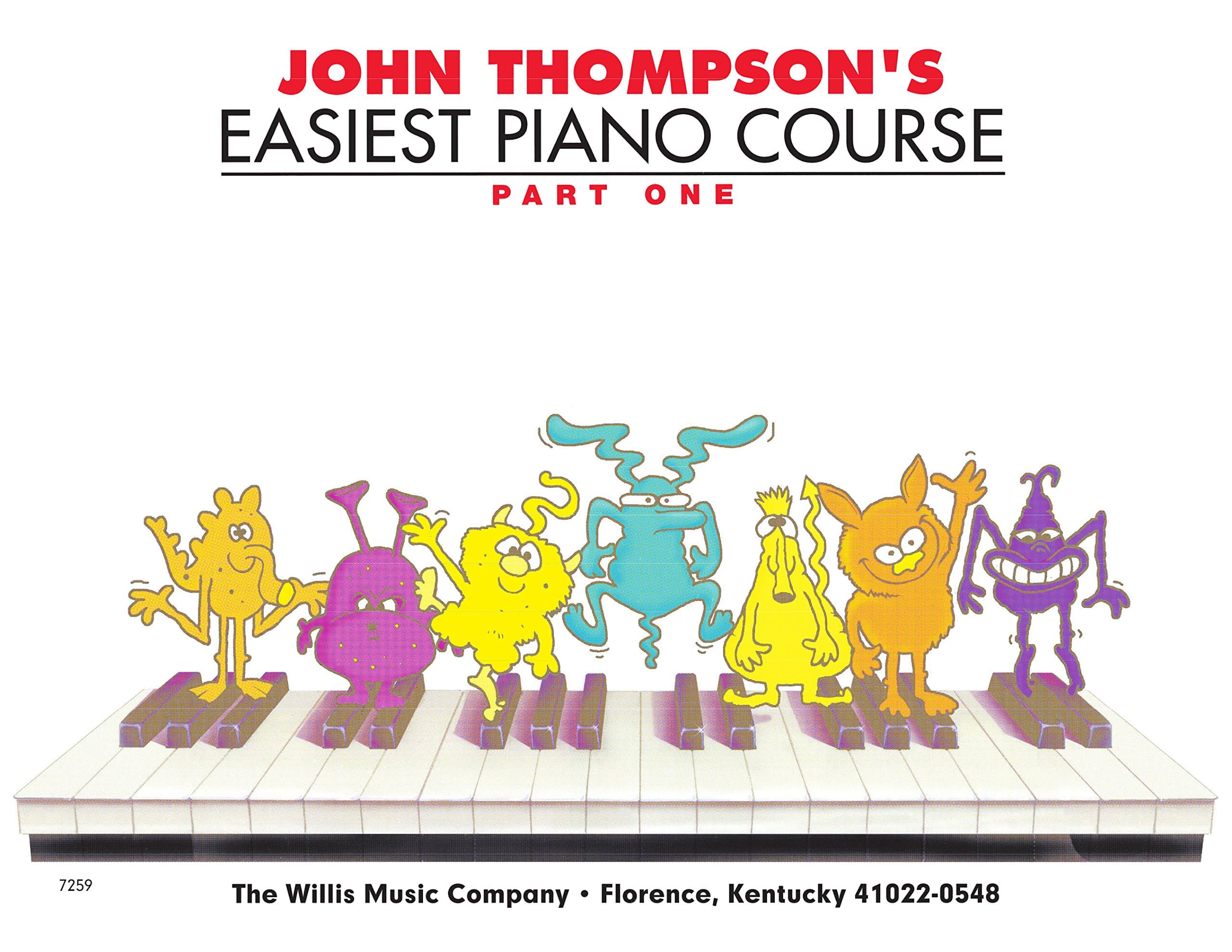
John Thompson's Easiest Piano Course - Part 1 - Book Only - Kindle edition by Thompson, John. Download it once and read it on your Kindle device, PC, phones or tablets. Use features like bookmarks, note taking and highlighting while reading John Thompson's Easiest Piano Course - Part 1 - Book Only. Review: Easy to read - Great book for the beginner. Has everything you need to get started. Review: Great for beginners of all ages - I'm a piano teacher, and I love this book! I find that students as young as 5 or 6 can understand it, and my 3 and 4 year olds are usually ready for this book after a few months of preparatory "games." I use this for all my beginners who are teenagers or younger (teenagers usually don't appreciate the "monster" characters, but they get over it). I'm also thinking about starting all new adult beginners with this book, since I haven't found an adult book I like as well. Many other books start with "pre-reading" songs, which use note symbols combined with finger numbers, then move to note symbols with letter names, then finally to notes on a staff. This book uses the "begin the way you intend to continue" theory, and starts students off reading notes on the staff right away instead of confusing them by making them learn 3 different systems of notation. Other books also teach "position playing," where students may learn to read notes in C position, then notes in G position, then F position, and so on. The danger of position playing is that students just learn to recognize patterns, and some of my transfer students who had used this method can't play anything unless they are first told where to put their hands. Part One of this John Thompson series stays in one position, but right away in Part Two they have to start learning new notes and moving their hands around, so if they can't read the notes they can't play the song. I love how Part One introduces one note at a time, and simplifies the first song that uses a new note or concept, so students truly learn all of the notes and concepts but aren't overwhelmed. There are a few things I don't like about this series. Part One is very good, and I can't complain too much about it--the first few songs are very boring without the CD, but I can't find any way to make them more interesting without also making it more difficult. Part Two introduces eighth notes too early for many students, and key signatures are introduced right after sharps and flats, which confuses most students. Part Three introduces new notes early in the book, but then doesn't use them in any of the songs that follow. Overall though, it's a great series and I intend to keep using if for all of my future beginners.
| Best Sellers Rank | #782,548 in Kindle Store ( See Top 100 in Kindle Store ) #16 in Piano & Keyboards #37 in Music Instruction & Study (Books) #304 in Piano Music |
A**N
Easy to read
Great book for the beginner. Has everything you need to get started.
M**C
Great for beginners of all ages
I'm a piano teacher, and I love this book! I find that students as young as 5 or 6 can understand it, and my 3 and 4 year olds are usually ready for this book after a few months of preparatory "games." I use this for all my beginners who are teenagers or younger (teenagers usually don't appreciate the "monster" characters, but they get over it). I'm also thinking about starting all new adult beginners with this book, since I haven't found an adult book I like as well. Many other books start with "pre-reading" songs, which use note symbols combined with finger numbers, then move to note symbols with letter names, then finally to notes on a staff. This book uses the "begin the way you intend to continue" theory, and starts students off reading notes on the staff right away instead of confusing them by making them learn 3 different systems of notation. Other books also teach "position playing," where students may learn to read notes in C position, then notes in G position, then F position, and so on. The danger of position playing is that students just learn to recognize patterns, and some of my transfer students who had used this method can't play anything unless they are first told where to put their hands. Part One of this John Thompson series stays in one position, but right away in Part Two they have to start learning new notes and moving their hands around, so if they can't read the notes they can't play the song. I love how Part One introduces one note at a time, and simplifies the first song that uses a new note or concept, so students truly learn all of the notes and concepts but aren't overwhelmed. There are a few things I don't like about this series. Part One is very good, and I can't complain too much about it--the first few songs are very boring without the CD, but I can't find any way to make them more interesting without also making it more difficult. Part Two introduces eighth notes too early for many students, and key signatures are introduced right after sharps and flats, which confuses most students. Part Three introduces new notes early in the book, but then doesn't use them in any of the songs that follow. Overall though, it's a great series and I intend to keep using if for all of my future beginners.
S**G
Finally found it!
I tried multiple piano books that were recommended in US through my own google search (step by step, Alfreds basic, etc) but it was packed with information from the beginning, made my confusing, and wasn't easy for me to understand. Because of that I couldn't enjoy learning piano at all (I self learn). Gave up all the time. I saw a youtube about piano books used in UK and this one was recommended to learn from the basics! I love it! This is the only one that was so helpful to understand from the basics for someone like me who never learned piano! It explains every little thing from what is clef, what does the number means next to clef, what is measure, what is C, which you use right hand, what is tie, what is rest etc but ONE by ONE! Every page you flip, they teach you new notes or thing like that. It wont try to teach you all at once. One by one. My 5 and 7 years old does well with this book because its so user friendly!
C**A
Good purchase.
It is too good for children to learn.
A**A
A delightful First book for a future Pianist!
A delightful First book for a future Pianist! 35 years ago, my mother bought this book for me and I had a wonderful time learning from it. With such a wonderful experience, I had to purchase it for my son age 5 as his first book. It teaches you the very basics of learning the notes on the keys and it has some pages for theory practice. However, if you are looking for a book that teaches you to count and number the fingers (such as Faber or Alfred's method), this isn't the book for you. This does not show fingering via a diagram. Therefore, it may delay your learning by a few lessons, but you will mostly certainly learn. Another point is that some people may find some of the accompanying images offensive as they depict segregation era. Remember this was printed in 1955. John Thompson has an updated version of this very book and doesn't have any of these images.
Y**G
good book
very good book
M**A
Cheap
Perfect
G**O
Highly recommended
Excellent book. Pedagogically very coherent and clear, children love it.
Trustpilot
1 month ago
1 month ago