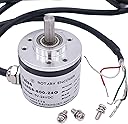
Taiss/Incremental Rotary Encoder DC 5-24v Wide Voltage Power Supply 6mm Shaft Optical AB 2 Phase Quadrature Encoder 600P/R
Product ID: 143532675
⚡Wide 5-24V DC power range
🔄600 pulses per revolution precision
⏱️Up to 6300 RPM mechanical speed
Desertcart purchases this item on your behalf and handles shipping, customs, and support to France.
🔧 Turn Precision Into Power – Never Miss a Beat!
The Taiss Incremental Rotary Encoder delivers high-resolution 600 pulses per revolution with AB two-phase quadrature output, supporting a wide DC voltage range of 5-24V and mechanical speeds up to 6300 RPM. Its compact 38x35.5mm size and 6mm shaft make it ideal for precise industrial and scientific applications, backed by a 1-year quality assurance warranty.

| Customer Reviews | 4.3 out of 5 stars 79 Reviews |
A**R
They make modifications easy
Pretty decent encoders. If you want to use 5V directly they have provisions on the PCB. The regulator has a solder bridge between the input and output. Simply connect the bridge with a ball of solder or with a 0805 0 ohm resistor. Like wise on the back of the PCB there are two 0805 locations for pullup resistors. I used 10K and the output works great when connected to a DRO.
P**E
Smooth operation with a small amount of rotation resistance
I'm using this in computer peripheral application, and it works as specified. I'm powering it with 8V using a boost converter from the 5V supplied by the USB bus, and it works fine on this supply. I haven't measured how much it draws.
J**N
reliable with rewiring
As others have said, this needs more than 5V for stability and has open collector outputs. If you rewire power to the output of the regulator instead of the input, and move the outputs to these handy through holes on one side, you'll get 0 to about 2.6 volts on the outputs, which works nicely with my microcontroller without pullups.
D**.
Good encoder but will not work with 5v
Product works fine but the specified 5v input is not correct. Product will not work at this voltage. I was able to make it work with a 12v supply.
W**T
Looks good, but TOO EARLY to tell for certain
Amazon always pounces on me to provide a review less than 24 hours after I receive a given item. So I'm giving half a review, which reflects the fact that I've only had time to evaluate half of my experience. Delivery was very quick! Build quality *APPEARS* to be good. Very good in fact, given this encoder's very reasonable price. But beyond that, I can't say much further. This unit came with no instructions and no technical data to answer any of my questions (such as maximum RPM, operating conditions, etc.). And I couldn't find this information about this encoder online. I'm still a long way from being able to try/use this encoder in a real project. I have high hopes for this encoder. But I can't give any hardcore information because it didn't include any useful
L**S
Crazy precise at a great price!
I usually don't write product reviews, but this encoder works and it works well. I used it with the hardware quadrature decoder on the Arduino Due and even at 1000 RPM, it does not skip a pulse. I bought the 600p/r version and was under the impression that it was total quadrature rising/falling edges, but it turned out to just be the rising/falling edges of a single phase. This means that the resolution is actually 2400 total rising and falling edges pulses per revolution.
A**N
Surprisingly good for the price
If you are having problems using this at 5V, it's because there is a generic LM7805 as a regulator for the internal power supply. The regulator will be in drop out unless you give it around 7V. This should be rated for 7V-24V. They are not suitable for 5V operation. The outputs are also open collector so you will need pullups to your desired logic level to get signals out of these. Attached are some pictures of the nice internal construction and the quadrature output signal.
S**E
Great longevity so far
I use this is a commercial application with a 65mm wheel and arduino mega. The wheel has literally rode over 20 miles of product and the rotary encoder is still reading very accurately.
Trustpilot
1 week ago
2 weeks ago