Buy anything from 5,000+ international stores. One checkout price. No surprise fees. Join 2M+ shoppers on Desertcart.
Desertcart purchases this item on your behalf and handles shipping, customs, and support to France.
⚡ Elevate your power game — small board, big voltage impact!
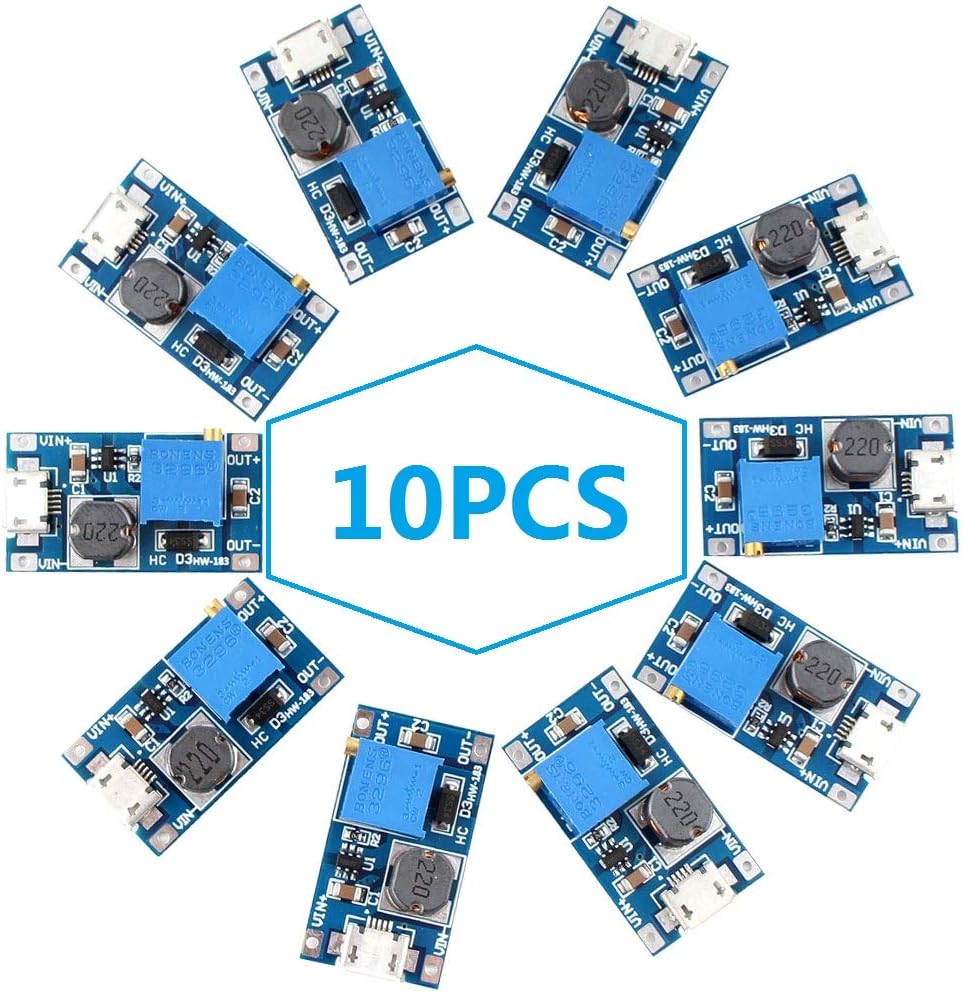
The Eiechip DC-DC Step Up Converter MT3608 is a compact, high-efficiency USB-powered voltage booster that converts 2V-24V input into a customizable 5V-28V output at up to 2A. Designed for DIY enthusiasts and professionals alike, it features advanced safety protections and a micro USB interface, making it the go-to module for powering and upgrading electronics with precision and reliability.


| ASIN | B07RNBJK5F |
| Best Sellers Rank | #75,843 in Tools & Home Improvement ( See Top 100 in Tools & Home Improvement ) #277 in Power Converters |
| Brand | WOWOONE |
| Color | mt3608-10pcs |
| Customer Reviews | 4.3 4.3 out of 5 stars (652) |
| Input Voltage | 2 Volts |
| Item Weight | 0.04 Pounds |
| Manufacturer | Eiechip® |
| Mfr Part Number | B8-M-MT3608-10pcs |
| Model Number | MT3608 |
| Number of Outlets | 1 |
| Output Voltage | 5 Volts |
| Plug Type | Type A |
| Power Source | Battery Powered |
| UPC | 745302144082 703931863873 |
B**G
Great Product ! Did the job easily ! Great Company to Deal with
Great Product, Great price and as important Great Company to Deal with (package got rough handling and three ferrite inductors were broken and issue was graciously handled by Putian Xiuyu Duoyu Trading Co. Ltd. JUST REMEMBER TO TURN THE POT 15 CW 'LAPS' before powering. Great device, tried in several circuit ideas. Already packaged one to convert 110V led gooseneck lamp to battery operation for safety (no cords) Lamp is mounted to mini parts sled on table saw. Hacked LED series strings for multiple 24V strings and added 1/8 W resistors to lamp The Boost converter ran without hesitation or much heat at 24V 1A until battery cuttoff engaged, about 1.9 hrs. More time than I need to spend on saw at one session. LEDS did not flicker or show any light artifacts from boost converter (used as received - directly connected to battery manager module. Because of low heat, just used board attached to enclosure as heat sink. Easy Peasy. Bob
C**J
Pretty Good
I purchased these to modify a small LED motion light that originally uses 4 AAA batteries for a total of 6V brand new to use 18650 cells and up the voltage to 6.3V. With a single cell the light worked properly but was slightly dimmer compared to when using 4 brand new AAA batteries due to the lower voltage, and with using 2 18650's in series the brightness was excellent but made the LED's a little hotter than normal due to the higher voltage. So that's where the Step Up module comes in and does an excellent job of providing stable voltage. In addition to working properly, with the micro usb port I could just power the light with a usb power source if I wanted to which is nice to have.
A**C
Reliably steps up voltage to desired output
I am specifically using these to step up 3v to either 5v (for USB devices) or 12v (for a strip of LEDs). I've set up two so far, and they work pretty well. The pot is very sensitive, so that you can bump it up by tenths of a volt or less. The pads are pretty easy to solder to. The power delivery is relatively clean, I have some flicker on the LED strip, but that seems to resolve itself fairly rapidly - for sensitive applications you might want to run through a capacitor to clean things up a bit. The unit is moderately efficient, but becomes quite warm - when converting from 2xAAA Lithium batteries (3v) to 12v, with an approximate draw of 200mA the converter (both the top of the transformer and bottom of the board) temps at about 116F within three minutes or so of operation. Pretty warm, warmer than I would typically like. I might try hooking up a 9v instead to see if this knocks the temps down a bit, or if that fails, adding a thermistor to mitigate the risk of a thermal event. Would recommend for general experimentation though.
A**E
All 10 work fine but not at high 100s of mA
Did quick test of all 10. I did all my tests with 5v in, 12v out. Used oscilloscope to examine the output. First into 165ohm load for about 73mA. All worked fine with maybe 40mv of switching noise at 1.2Mhz. I picked one at random to check further. Using a 20ohm load for 600mA, device would occasionally cutout for a fraction of a second. Chip very hot to the touch. Although 600mA and 12V is shown on the datasheet as permitted. It is at the high end. I switched to a 30ohm load for 400mA and seems OK. The chip is hot to the touch. The datasheet goes up to 800mA for 12V out so the product description is misleading when it says 2A. Probably the most amps out is the datasheet curve that shows for 13V in and 18V out - it goes to 1.7A. For 400mA, there was many volts of ripple on the output. Adding 10uf capacitor across the output fixed that problem. So all in all, these seem fine but probably stay below the middle of the datasheet ranges of power output for best results.
H**S
These Work as Advertised and are Stable
I bought these about 3 months ago and followed the tips on turning the pot several times clockwise, then with a DMM, turn the pot counter clockwise until the desired voltage reads. I got these for various uses, but mostly to step up the voltage to a 12vdc 120mm fan (from 5vdc) on a RPI custom case I repurposed out of a PC power supply. They work PERFECTLY! Granted, PC fans do not draw hardly any current, so I did not expect the module to get hot, and it doesn't. I used the module to supply 9vdc from 5vdc. 12VDC spun the fan too fast and I did not need that amount of air flow. This is the simplest use of this module of course. I have not run it through anything more demanding yet, but it was a cheap and reliable fix for a design issue where a component needed more voltage than the project's supply voltage. I will buy more. None of the 10 I received failed at all.
F**S
Good try for very small loads, but couldn't maintain 12V at 0.8A
I probably shouldn't complain given the ridiculously cheap price of this unit. The vaguely worded output is claimed to be "5V-28V 2A." To me, that should be able to handle 12 V at 0.8A. I followed the 15 turns on the pot per instructions. Provided 5V input via the micro-USB connector. Used the pot to set the voltage to 12 V under no load with my multimeter. Then attached a 12V blower that draws 0.75 A, and it ran, but the blower seemed underpowered based on sound and feel. Checked the voltage and it had dropped to 11.1 V. Very slowly turned the pot on the unit to higher voltage to try to get back to and the unit could not get back to 12V. Voltage started oscillating wildly. Repeated this multiple times with the same results. So, for the price, I think you get what should expect, but not exactly what you paid for. To my surprise, I then tried this other unit from Amazon, and it did the job: https://smile.amazon.com/gp/product/B074R7FDCR/ref=ppx_yo_dt_b_asin_title_o03_s01?ie=UTF8&psc=1
F**K
2A limit on either side.
Let's be real. These are tiny cheap boards. But they work pretty great. Hook it up to your supply voltage, and start turning the potentiometer. They also work all the way down to ~2.1v! (I needed 2.4 volts so these were perfect!) There is one big caution though... they cannot be run in parallels to increase the current. It doesn't matter how well you tune the potentiometer, or if you physically solder the inputs and outputs in parallel. So if you need more current, you'll have to keep searching. At around 2.2A they start blinking.
S**D
Good
T**K
Work great for my experiments.
E**Z
Funciona muy bien, su salida muy estable!
M**4
Just make sure to rotate the potentiometer before powering on. If you do that, then they work flawlessly! Great product, consistent and well built.
T**0
It really works, it's very interesting. Good to power basic electronics such as fans. Do not use it with sensitive electronics, these devices tend to create interference and undesirable spikes, not suited for sensitive components such as amplificators or any audio equipment. Beware to use a potentiometer when pairing something with it, you surely don't want to fry something.
Trustpilot
1 month ago
2 weeks ago