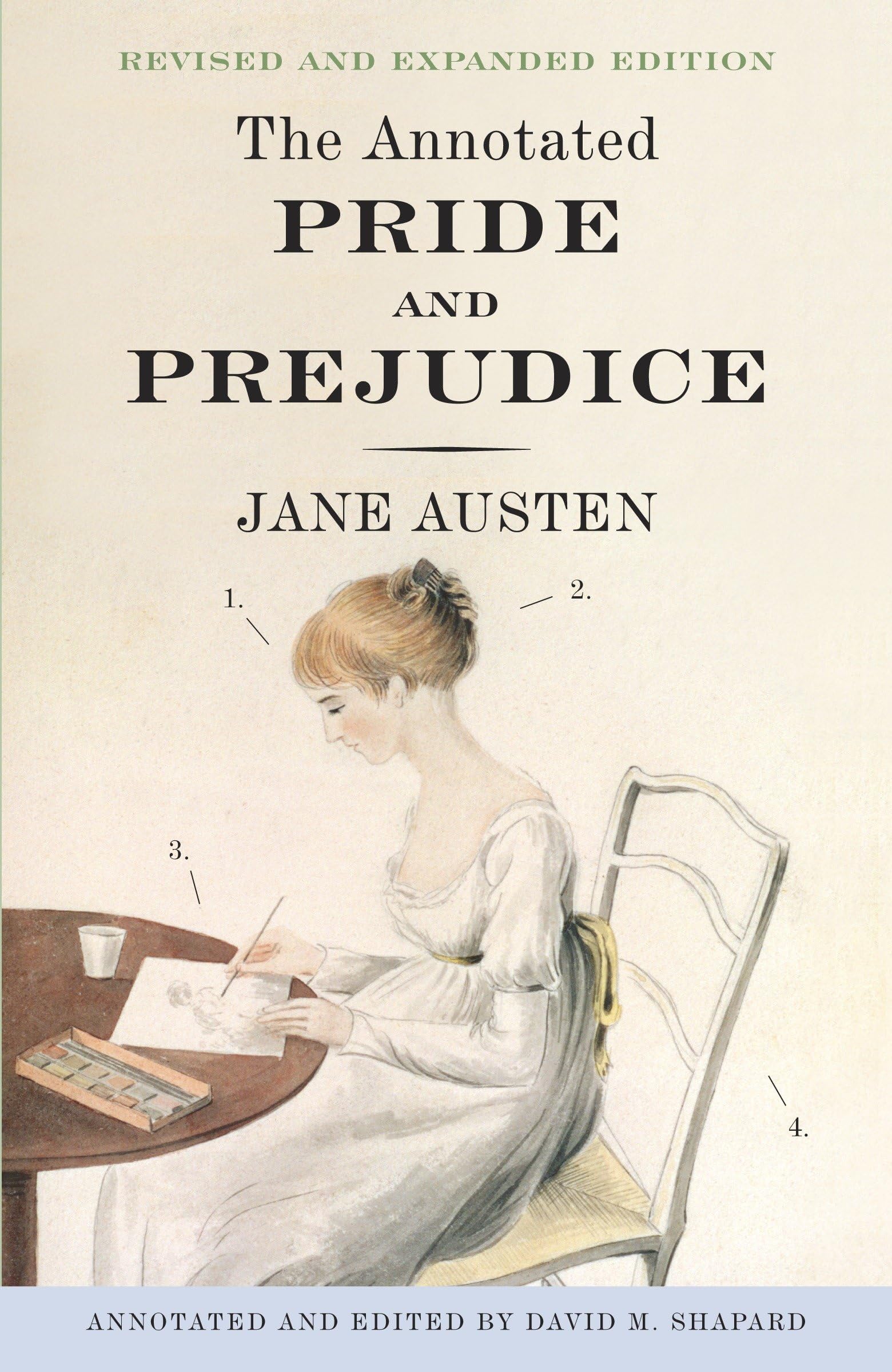
The Annotated Pride and Prejudice
Product ID: 12962155
📚Extensive annotated insights
🖤Classic black & white illustrations
🚚Free shipping on qualifying orders
Desertcart purchases this item on your behalf and handles shipping, customs, and support to France.
📖 Elevate your Austen experience—because true fans read between the lines!
The Annotated Pride and Prejudice by David M. Shapard is a meticulously annotated edition of Jane Austen’s beloved classic, featuring insightful commentary, historical context, and black & white illustrations. Designed with a unique side-by-side layout for effortless reading, this used copy in good condition offers a deeper understanding of the novel’s characters and themes. Highly rated by over 880 readers, it’s a must-have for literary enthusiasts seeking to enrich their Austen journey.

| Best Sellers Rank | #7,826 in Books ( See Top 100 in Books ) #313 in Classic Literature & Fiction #818 in Literary Fiction (Books) #3,291 in Genre Literature & Fiction |
| Customer Reviews | 4.6 4.6 out of 5 stars (882) |
| Dimensions | 5.2 x 1.35 x 8.01 inches |
| Edition | Expanded |
| ISBN-10 | 0307950905 |
| ISBN-13 | 978-0307950901 |
| Item Weight | 1.62 pounds |
| Language | English |
| Print length | 739 pages |
| Publication date | March 13, 2007 |
| Publisher | Vintage |
M**)
Enriching My Understanding, Appreciation, and Love for Pride and Prejudice
With all my reviews of annotated editions, my ratings and comments are based on the annotations and observations made by the editors and not Jane Austen’s magnificent and beloved masterpieces. I hope you find this breakdown helpful! THE INTRODUCTION: There is plenty of astute analysis to explore in Mr. Shapard’s introduction, but my favorite points he brought up pertained to what makes Jane Austen’s novels unique for her time, and specifically what makes Pride and Prejudice unique when compared to her other novels. I haven’t read much of Frances Burney or Samuel Richardson, but I greatly appreciate learning that, compared to their works, Jane Austen’s novels are more rooted in verisimilitude and that she distinctly gives her characters the freedom of choice. In addition, while I may have concluded on my own that P&P is the Jane Austen novel most focused upon romantic relationships (how many marriages take place?), I did not make the realization that it was the only novel where both the hero and heroine make crucial errors. I think the realism she shows with these characters and the journey of their mistakes and growth might have a lot to do with why Pride and Prejudice is so many readers’ favorite. THE ANNOTATIONS AND ILLUSTRATIONS: The annotations for the text are plentiful, informative, and analytical. Word usage, customs, Regency references are all thoroughly explained. But what I really enjoy is when David M. Shapard shares his own insights, revelations, and commentary. I love the personal touch, and I appreciate that his notes include more of his own deductions and scrutiny, and not just other scholars quoted. The illustrations are appropriately selected and placed. One downside of this edition versus Harvard University Press is the absence of color images on a large scale. These images, while printed clearly and crisply are black and white. SOME THINGS I LEARNED/NOTICED: - Mr. Bingley is Young!: It might be my own mistaken memory or how oftentimes Austenesque novels portray Darcy and Bingley as mates from university, but I completely forgot that Mr. Bingley is 22! That puts some of his immaturity and weaknesses of character into a different perspective! - A Clergyman’s Lot: Because of an influx of ordained clergyman, only 20% of clergymen received an appointment within five years of being ordained, and some never did and worked as assistants their whole lives! No wonder Mr. Collins is so excessive in his praise and gratitude of Lady Catherine! - Elizabeth is Contrary: She holds Mr. Darcy’s implacable resentment against him, but sister-friend has some implacable resentment of her own. Also, while she is disappointed with Charlotte’s marital prudence, she openly forgives and defends Mr. Wickham’s marital prudence when he is in pursuit of Miss King. - The Lucases Be Plentiful: Not all are prominent in the story, but with the mentions of daughters and sons added together there are at least seven children in total! Again, this puts a new light on Charlotte’s situation and actions. - Elizabeth’s Evolution: Talk about understanding and witnessing a character’s journey through their emotions and the turning of their mind and/or heart! Jane Austen’s representation of Elizabeth Bennet’s evolving feelings for Mr. Darcy is brilliant and perfect. I really appreciate how it is laid out, how it happens gradually and believably, and how Elizabeth becomes aware and reanalyzes her own character. Plot twist: Mr. Darcy isn’t the only one guilty of pride and vanity! - The Proposal Scene: Even though I’ve read and seen it take place numerous times before, it still fills me with such awe and admiration. There is such fiery emotion, such intensity in their words and actions. It is so vibrant with strong feeling. It may be blasphemous to say, but I don’t know if I yet to see it portrayed on screen as magnificently and powerfully as it is portrayed on page. - Pemberley Shades: I need to laugh at myself for this one! When Lady C made her exclamation about the “shades of Pemberley” being polluted, I was thinking shades like window covering, and that the Elizabeth’s inferior relations would dirty and befoul them. But it looks like the term would more likely apply to the grounds of Pemberley and all the shades of light and darkness produced by trees. COMPARING HARVARD UNIVERSITY PRESS AND DAVID SHAPARD EDITIONS: It is a super tough decision to make because I equally loved Patricia Meyer Spacks’ Pride and Prejudice: An Annotated Edition – her comments are equally astute and insightful, but I feel like I may have learned a bit more and delved into P&P a little bit deeper with David Shapard’s annotations. So my vote is once again for David Shapard. CONCLUSION: I emphatically urge all Austenesque readers and Jane Austen admirers to read annotated editions of Jane Austen’s novels. The reading experience will be time-consuming, but the gift you give to yourself is immeasurable. What could be better than broadening your understanding and appreciation of Jane Austen’s genius? If you have yet to read any annotated editions of Jane Austen’s novels, I’d recommend starting with The Annotated Pride and Prejudice by David M. Shapard, because it may very well be the best. Austenesque Reviews
3**S
Mostly great and helpful annotations
This review deals only with the annotations. I'm not going to talk about the text of this edition itself, because I assume most readers of an annotated version are familiar with it. For the most part, I really loved the notes. It turns out that despite having read P&P multiple times, there were things that I had misunderstood, and the background information (which comprises mostly historical context and/or literary influences) added depth. After the annotation, I had a greater appreciation for the incredibly layered, complex, subtle, and amazingly well-thought-out book P&P really is--and I had always assumed that it WAS all of those things. I also loved how the annotations were presented. The text appears on the left page, and the notes on the right, which is not a layout of annotations I have seen before (seems most are either marginalia, footnotes, or endnotes). At first, I thought this would make for an awkward and unnatural reading, but after a page or two, I got into a nice rhythm. The layout made for very easy simultaneous reading of both--no flipping back and forth, the print was clear, and you could skim the annotations before or after reading the text on that page to get a sense of then, then delve into them at the appropriate part of the text. The one thing I will fault the annotations for are the word definitions. The vast majority of them are words that anyone who has read P&P more than once or has an above average vocabulary would have figured out from the context; e.g. it's not that difficult to figure out that want=lack in the context of the book. But even more annoying than that is that the same word is defined in the same way over and over and over again; e.g. every time the word "pale" is mentioned (and it's used a surprising number of times), there is an annotation pointing out that it means fencepost or border. Anyone with half a brain, after seeing pale used in that way once, would have been able to figure out the correct usage (fencepost vs. light in color) from the context after that. The editor states that this is done because it's meant to be a reference work and the repeated definitions are included to aid in understanding when only specific parts are consulted. But I still found it distracting and a bit insulting, and I felt disappointed when I stopped my reading of the text to read an annotation that it was yet again only another repeated definition. Despite my rambling on the definitions, this is still a 5-star annotation. The easy reading and overall helpfulness of the notes make this edition a great way to develop an even greater appreciation for our beloved Pride and Prejudice.
L**S
Making the Classic Readable
So many books lately have invoked Jane Austen’s classic work Pride and Prejudice that I felt I had no choice but to read it. But I resisted for over six decades because face it, the story is hard to understand in the style and language it was written in. Enter The Annotated Pride and Prejudice. David M. Shapard made this amazing story not only understandable, but enjoyable. The footnotes are equal in length to the book itself. The notes cover word meanings and usage, explanations of practices common to the times, and, when relevant, reminders of where in the storyline the reader finds themselves. If you have avoided this classic as I had, buy this book on Amazon right now. Thanks to the following authors for finally spurring me on. Becky Monson – Desperately Seeking Mr. Darcy Jennifer Peel – Without Pride and Prejudice
D**E
I have almost given up reading Classics unless they are fully annotated. This series covers 4 volumes by Jane Austen. Everything you thought to ask as you read the text (plus lots more) is explained in detail on the right-hand page, including language explanations, historical references, diagrams, maps, chronologies, and historical pictures. Really this is the way to go. Now I have to buy all the volumes and hope they will publish other authors as well. It takes at least twice as long to read the novel, but you will be all the richer for the time spent.
D**F
I love this work by Jane Austen, but the Kindle version offered here is NOT an annotated version. It's just your plain edition, which you could get for free from other places like The Guttenberg Project, or something. I feel robbed.
N**N
参考文献に挙げられていたので買い求めました。注釈がたくさんついているので、P&Pの原作を原語で自分の解釈で楽しみたい人におすすめします。
S**O
De lo mejor que una fan de Jane Austen puede comprar. Esencial si te gusta orgullo y prejuicio, deberían traducirlo al español pero bueno sigue mereciendo la pena.
S**B
"It is a truth universally acknowledged, that a single man in possession of a good fortune must be in want of a wife." So begins Jane Austen's wonderful 'Pride and Prejudice' when the arrival of the wealthy Mr Bingley and his even wealthier friend, Mr Darcy, causes a stir in the village of Longbourn, and particularly in the Bennet household. Mr and Mrs Bennet have five unmarried daughters, no male heir, and their estate is entailed on a pompous clergyman relative, a certain Mr Collins. Mrs Bennet, therefore, is desperate to see at least two of her daughters married - namely the beautiful Jane, and the attractive, independently-minded Elizabeth. Two pretty and intelligent young women; two rich, eligible men - what could go possibly wrong? This is a sparklingly witty, beautifully written and cleverly composed story which is a pleasure to read from start to finish. Elizabeth Bennet is a wonderful creation; Darcy is suitably proud, difficult and complex; Mrs Bennet is an absolutely awful, but brilliantly conceived character who could give masterclasses in how to embarrass one's own children; Lady Catherine de Bourgh is wonderfully snobbish and horribly condescending; Elizabeth's cousin, Mr Collins, is a toe-curlingly ingratiating character; and the remainder of the cast add greatly to this amusing, romantic and very entertaining story. I have been reading Jane Austen since I was eleven years old and I cannot remember how many times I have read and enjoyed this book - but one of the main purposes of this review is to to mention this particular edition which has been annotated by David Shapard and which has the notes printed on the facing page of each page of text, along with pictures and diagrams of people and objects from the early 19th century. Of course if you are familiar with language and traditions from this period, you will not need this particular edition, but I bought a set of these annotated Jane Austen novels for a young teenaged relative of mine who has not been brought up in England and needed more explanation than is available in most editions. She is finding this edition particularly helpful and it has helped her to enjoy the story much more than she otherwise would have done. 5 Stars.
Trustpilot
3 weeks ago
1 week ago