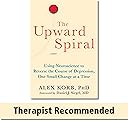
The Upward Spiral: Using Neuroscience to Reverse the Course of Depression, One Small Change at a Time
Product ID: 12791579
Desertcart purchases this item on your behalf and handles shipping, customs, and support to France.
Depression can feel like a downward spiral, pulling you into a vortex of sadness, fatigue, and apathy. In The Upward Spiral, neuroscientist Alex Korb demystifies the intricate brain processes that cause depression and offers a practical and effective approach to getting better. Based on the latest research in neuroscience, this book provides dozens of straightforward tips you can do every day to rewire your brain and create an upward spiral towards a happier, healthier life. Whether you suffer from depression or just want a better understanding of the brain, this book offers an engaging and informative look at the neuroscience behind our emotions, thoughts, and actions. The truth is that there isn’t one big solution to depression, but there are numerous simple steps you can take to alter brain activity and chemistry. Some are as easy as relaxing certain muscles to reduce anxiety, or getting more sunlight to improve your mood. Small steps in the right direction can have profound effects―giving you the power to become your best self as you literally reshape your brain, one small change at a time. Review: For the discerning depressive - I don't want to make any unscientific claims here, but I've found that a lot of the people I know who are depressed are also pretty smart. Which means that self-help books by celebrity rehab graduates and costumed spiritual gurus aren't going to be of any help. Another unscientific conjecture: in my experience, depressives tend to have finely tuned aesthetic sensibilities, which means reading clunky technical literature is a daunting challenge, particularly through the fog of one's symptoms. The Upward Spiral stands out from the pack for three significant reasons: 1. It's based in evidence. This book isn't made up of snake oil panaceas, or Hallmark platitudes, or overblown pep-talk rhetoric. It's built on a foundation of clinical trials and observations of the brain, as up-to-date with contemporary neuroscience as possible. 2. It reads well. The problem with writing based on scientific evidence often ends up being that the prose is dry and boring, or patronizingly dumbed-down, or frustratingly abstract. Korb is no Adam Phillips, but he writes about the structure and function of the brain more clearly than anyone else I've read in the past, frequently deploying effective analogies to familiar objects and ideas. 3. It includes advice. Another problem with some science-based texts is that knowing what synapses fire at what time doesn't really help you figure out what to do outside your skull. Korb gives a suggestion on practically every page. This book isn't going to cure you. It addresses a specific aspect of depression: the way symptoms reinforce themselves and inspire new ones, resulting in the downward spiral that drags you down to your deepest depths. The optimistic implication of the title is that just like a small trigger can drag you down, an effective intervention can start enough momentum to carry you up. I'm of the belief that if you're depressed, you probably have to figure out how and why it started, and determine what specific patterns of thought originated as a result. That means seeing a therapist or analyst, possibly for a long time. But in the meantime, you have to get yourself out of bed every day, and this book gives you some idea how. To my knowledge, it's the best of its kind. Review: Still Think About This Book Every Day (A Decade Later) - When I was floundering and wondering what was going on, I read a ton of self-help books. This is the one I still think about every day, more than ten years after I first picked it up. It’s relatable, doable, gives you the vocabulary to name things so you can make conscious decisions about them, and shows you the framework to do the little steps to get you on an upward spiral instead of getting sucked down by depression. I’ve recommended it to so many people, because it really is one of the best books I’ve found to give you the tools to actually help yourself.

| Best Sellers Rank | #570,636 in Books ( See Top 100 in Books ) #5 in Postpartum Depression #18 in Mood Disorders (Books) #22 in Depression (Books) |
| Customer Reviews | 4.7 out of 5 stars 1,029 Reviews |
E**C
For the discerning depressive
I don't want to make any unscientific claims here, but I've found that a lot of the people I know who are depressed are also pretty smart. Which means that self-help books by celebrity rehab graduates and costumed spiritual gurus aren't going to be of any help. Another unscientific conjecture: in my experience, depressives tend to have finely tuned aesthetic sensibilities, which means reading clunky technical literature is a daunting challenge, particularly through the fog of one's symptoms. The Upward Spiral stands out from the pack for three significant reasons: 1. It's based in evidence. This book isn't made up of snake oil panaceas, or Hallmark platitudes, or overblown pep-talk rhetoric. It's built on a foundation of clinical trials and observations of the brain, as up-to-date with contemporary neuroscience as possible. 2. It reads well. The problem with writing based on scientific evidence often ends up being that the prose is dry and boring, or patronizingly dumbed-down, or frustratingly abstract. Korb is no Adam Phillips, but he writes about the structure and function of the brain more clearly than anyone else I've read in the past, frequently deploying effective analogies to familiar objects and ideas. 3. It includes advice. Another problem with some science-based texts is that knowing what synapses fire at what time doesn't really help you figure out what to do outside your skull. Korb gives a suggestion on practically every page. This book isn't going to cure you. It addresses a specific aspect of depression: the way symptoms reinforce themselves and inspire new ones, resulting in the downward spiral that drags you down to your deepest depths. The optimistic implication of the title is that just like a small trigger can drag you down, an effective intervention can start enough momentum to carry you up. I'm of the belief that if you're depressed, you probably have to figure out how and why it started, and determine what specific patterns of thought originated as a result. That means seeing a therapist or analyst, possibly for a long time. But in the meantime, you have to get yourself out of bed every day, and this book gives you some idea how. To my knowledge, it's the best of its kind.
K**R
Still Think About This Book Every Day (A Decade Later)
When I was floundering and wondering what was going on, I read a ton of self-help books. This is the one I still think about every day, more than ten years after I first picked it up. It’s relatable, doable, gives you the vocabulary to name things so you can make conscious decisions about them, and shows you the framework to do the little steps to get you on an upward spiral instead of getting sucked down by depression. I’ve recommended it to so many people, because it really is one of the best books I’ve found to give you the tools to actually help yourself.
C**R
Great book!
I'm not even done reading this book and I'm already giving it a five star review! this book is wonderful because it breaks down which part of the brain causes different aspects of depression such as pessimism or the mental filter that we use to only remember the painful experiences of the past, lack of motivation, etc. The author does so without getting too highly scientific about Brain chemistry yet explains how each of the brain parts interact with each other in the depressive cycle and make suggestions about simple things we can do to improve depression and how those brain parts create an upward spiral. Nothing he suggests I do sounds too overwhelming or difficult. this book has already really helped me a lot and gives me new information that I did not know before. This book doesn't just give you the same old information about depression. It's worth buying it and reading it because it's not the same all basic information about depression he approaches it in a different way. The benefit of all this is twofold: First, it gets me doing some of the simple tasks that help me improve depression in my brain. Second, it gets me to really realize that depression is truly an illness of brain chemistry so it helps me give myself a break and not beat myself up because I have depression and that helps my depression right there. When I'm caught in a depressive downward spiral I tend to beat myself up & that makes my depression worse right there. But, I remember the concepts in this book, that it's a brain disorder so I'm more gentle with myself and realize it's not my fault I'm depressed anymore than if I had cancer and that helps my depression improve!
B**B
Basic but Informative
This is a good guide to the basic mechanisms of depression and would be useful as a primer on the neuroscience of depression, or for a family member or friend of a depressed person who wants to gain a better understanding. I think it would also be useful in making small habit changes for someone who has chronic mild depression or is unmotivated or feels stuck. For the “advanced depressive” like myself it doesn’t offer any groundbreaking advice. The actionable advice is things like exercise and being more social. There were a couple writing things that galled me. The author is worried his writing level is out of the readers depth, and constantly reassures them he’ll break things down simply, or uses distracting metaphors. I found this kind of condescending and would prefer information to be offered in a more neutral and straightforward way. I don’t think the average person would be intellectually overwhelmed by the book, considering it offers pretty basic information about brain structures. I wanted to know more about how things like inflammation, glutamate, and NMDA work since I am pretty sure the cause of my depression lies in genetic factors related to these. Since the author is not a sufferer himself, the examples of being sad in college feel a little trivial and situational. I also wondered about the assertion that nothing was “fundamentally wrong” with the depressed brain followed by descriptions of various things that did seem to be wrong with it, as well as the assertion the depressed brain looks no different on an MRI.
T**R
Great book!
This was a very informative book. It contained good information about how the brain works and how it's affected by outside influences. But it doesn't stop there--it also gives great advice on small changes we can make that will have positive influences on our brain and on our mood.
J**Y
Just what I need.
So far, has. Even very insightful, plan to listen to it a few times over the next few months. Explaining how the brain works, we function differently, helps with what works best for you.
N**H
This book is a miracle !!!!
This book has truly turned out to be a miracle in my life !!!! It is simply a must must read book for anyone suffering from depression or similar disorders. Amazing, impressive and extremely useful. I had severe depression, intense mood changes and racing thoughts. The tools mentioned in this book have made my life much better. My preoccupation reduced, depression reduced and no more intense mood changes. From the beginning itself the author introduces to the tools one can use and the author has clearly explained how different regions in the brain cause various painful symptoms and has given ways to improve the regions themselves thereby improving the symptoms at their root. The information about neurotransmitters helped me in telling my doctor which medication would help me and she put me on that and it helped me a lot ! I am still in the middle of reading this book. The book is written very well, to the point and clear. A lot of knowledge with practical solutions. I think this book may be unique regarding its contents. Alex Korb is brilliant. I am very grateful to Alex Korb. Thank you !!
C**Y
Excellent
Am so thankful for this gem. Have suffered from mental disability and major depression for years. This book has been a guide and source of hope for me. Practical and easy to implement , this book has served as a catalyst for positive change in my life. I am humbly grateful for this book , maybe not perfect but good enough...
V**.
Understanding how brain works makes all the difference.
This book is so much fun reading it. A real self help and it is for everyone who wants tips and tricks to manipulate brain in a good sense.
P**I
Brilliant book
I am not at all into "self-help" books but this is amazing. It's full of small suggestions, which when taken into account, can really make a difference. It changed my life, for the better. It can take some time to do that but it can be done. I think this is the main message of the book
A**A
Great book
Amazing book ,easy to read and understand how the brain works when depressed and/or anxious. Packed with practical guides on how rewire your brain even when it feels harder sometimes but practice is key.
A**A
Must read
Must-read for those who has issues with bad mood, or depressive moods. It really helped me to structure knowledge about ways to make me feel better.
M**A
Great practical advise everyone should know
Everyone should know about depression as it can happen at any time of life and great to know how to help a loved one going through it. This Book helps understanding how the brain works when suffering with depression and gives many practical advise on how to get out of the downward spiral.The author writes with empathy .
Trustpilot
2 weeks ago
2 months ago