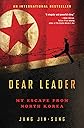


Dear Leader: My Escape from North Korea
Desertcart purchases this item on your behalf and handles shipping, customs, and support to France.
Description
THE STORY THEY COULDN'T HACK: In this international bestseller, a high-ranking counterintelligence agent describes his life as a former poet laureate to Kim Jong-il and his breathtaking escape to freedom. As North Korea’s State Poet Laureate, Jang Jin-sung led a charmed life. With food provisions (even as the country suffered through its great famine), a travel pass, access to strictly censored information, and audiences with Kim Jong-il himself, his life in Pyongyang seemed safe and secure. But this privileged existence was about to be shattered. When a strictly forbidden magazine he lent to a friend goes missing, Jang Jin-sung must flee for his life. Never before has a member of the elite described the inner workings of this totalitarian state and its propaganda machine. An astonishing exposé told through the heart-stopping story of Jang Jin-sung’s escape to South Korea, Dear Leader is an “impossibly dramatic story…one of the best depictions yet of North Korea’s nightmare” ( Publishers Weekly ).
Specifications
| Asin | 1476766568 |
| Dimensions | 5.5 x 1.1 x 8.38 inches |
| Edition | Reprint |
| Isbn 10 | 9781476766560 |
| Isbn 13 | 978-1476766560 |
| Item Weight | 11.2 ounces |
| Language | English |
| Print Length | 368 pages |
| Publication Date | January 27, 2015 |
| Publisher | 37 Ink |
Reviews
User
Mr. Jang scoops you up and takes you on his journey to freedom. A most beautifully written book.
This was the most beautifully written and moving account I've ever read of an escape from N. Korea. It is an incredible story from a man who enjoyed a life of privilege compared to the privation that the majority of NK is suffering. One can see why Mr. Jang was such a well respected poet laureate (and at such a young age) from his home country. He is an incredible writer. This book moved me to tears so many times. So often, I visualized his pain and despair, his courage, and his indescribabe exhilaration when he finally succeeded in his hard fought quest for freedom.All Americans should read books about this country because while we complain about our own petty suffering, most of us have really no idea what true human suffering is all about. It's interesting because I was in the midst of a deep depression when I picked up another book (Nothing to Envy by Barbara Denick) about regular North Koreans and that book--plus the subsequent (perhaps 20) others I read, lifted me complete out of my depression.This is a fascinating read. Most people in his position would have never dreamed of escaping such a privileged existence--if only for the sake of loved ones.<SPOILER ALERT>It was only *after* he had given a forbidden book to a trusted friend who had subsequently lost it, did he and his friend realize they had no other solution but to escape. For them to stay would have certainly meant their detention at one of the famous 'gulag' prisons of NK but it would have likely meant the persecution of his loved ones. I believe his primary motive for leaving NK was to spare his family--although I cannot imagine how he must suffer to this day wondering about their health and safety.The book really does read like a thriller--I couldn't put it down. My tears at the end of this book were for Mr. Jang's final successful escape into the South Korean embassy in Beijing, as well as the tears I shed for his friend who wasn't able to successfully complete the journey with him. My heart broke for his friend, while it rejoiced for Mr. Jang. Never has an account of escape, determination, a will to survive, and gratitude moved me to such an extent. I also can't stop wondering what might have happened to the lovely Cho-rin, who helped him in a way that all of us should help a fellow human being. I admired her so much from Mr. Jang's account of their fateful meeting.All of us have a duty to stop ignoring the suffering of so many. I want to do more--in what shape or form that comes, I am not yet certain but I believe in fighting for wonderful causes and I can't think of a cause more worthy than helping these oppressed and suffering people.Mr. Jang, congratulations on your wonderful, well-received book that deserves every accolade it has gotten. Congratulations on the personal happiness you have found with your wife and a new baby. I am so happy you made it to freedom so you could share your incredible, heroic story. Moreover, thank you for spreading the word of the plight of so many North Koreans. We in the west tend to forget how truly lucky we are. I am a better person for having read this book. Amazing.
User
Thug State
At times, North Korea seems like an indecipherable enigma, impervious to attempts by outsiders to understand or to find rationales for its actions. At other times, the Kim family state seems straightforward: a land ruled by a gang of thugs who regard the state’s resources (including its people) as its personal possession and plaything, and who cynically deploy crude and simplistic anti-colonial and anti-Western ideological slogans as a substitute for policy. Jang Jin-Sung’s book tends to support the latter view, depicting a regime run by a paranoid and power-hungry leader who cares little for what happens to anyone but himself.Jang’s book is part memoir, part exposé. The core of the book is an account of Jang’s decision to escape North Korea, along with a friend. Jang, a poet personally honored by “Dear Leader” Kim Jong-il, had been working in a department of the Workers’ Party responsible for relations between the two Koreas—which really meant anti-South Korean espionage and propaganda. Part of his job was to write poems in a South Korean “voice” praising North Korea and the leadership of Kim Jong-il. In order to do his job, he was part of a select group of Party members allowed access to South Korean newspapers, books, and magazines, as well as Western consumer products sent in as foreign aid. Though he was not part of the true power elite, he was in many ways a regime insider. His observations, therefore, have an aura of both credibility and disillusionment.Beyond the dramatic story of Jang’s escape, survival in China, and eventual relocation in South Korea, the book contains valuable and damning observations on North Korean history and politics. Jang had access to party insiders, as well as to historical documents unavailable to most people. So while his account is that of a very young man, it carries the conviction of the disillusioned and recently-enlightened, which one can see in his wide-eyed outrage when the shackles fall from his eyes and he sees the Kim regime for what it is. Jang offers valuable insights on a variety of topics, including Kim Jong-il’s rise to power and the ruthless competition with his father and the elder Kim’s allies that accompanied it, leading in turn to further ruthlessness and the rise to dominance of the Organization and Guidance Department within the Korean Workers’ Party. Jang also discusses the kidnapping of Japanese citizens to train North Korean spies, and the North Korean view of diplomacy as essentially a counterintelligence operation, which partly explains why Western governments find diplomacy with North Korea such a frustrating undertaking.Jang is a romantic, and naïve in many ways. He says that reading a book of poetry by Lord Byron was one of the key factors in his disillusionment/enlightenment, as Byron’s openness in expressing emotions stood in stark contrast to the bottled-up North Korean society in which the only acceptable object of devotion was the state as embodied in the person of the leader. The heart of the book is Jang’s account of his decision to leave North Korea after some contraband materials to which he had access but which he allowed to pass out of his hands were discovered. He had to leave quickly, without much preparation, accompanied by the friend to whom he had loaned the materials. They carried little with them other than the clothes they were wearing, a notebook full of Jang’s poems, and some cash, which would come in handy later. They were lucky to escape the scrutiny, and the guns, of North Korean border guards, but their story of escape and survival is not simply a tale of crossing the Tumen River that forms North Korea’s northeastern border with China. Jang chronicles just how difficult it can be for an escapee even after crossing the river. The South Korean consulate in the Chinese city of Shenyang and many Korean churches were no help. Jang spent a month on the run, during which time he had to rely on luck and the kindness of individuals to survive and eventually make his way to freedom. That he did make it is a testament to how deeply motivating the desire for freedom can be. This is perhaps a useful reminder for any of us who accept our liberties too casually. Jang’s epilogue is both a moving conclusion to the story and a sober reflection on what the presence of thousands of North Korean escapees means.On occasion the book reads a bit too much like a translation, or maybe the translator is just rendering too literally in English Jang’s way of expressing things in Korean. But that’s a small thing. This book is well worth reading for anyone interested in the inner workings of North Korea, and how one North Korean of a sensitive frame of mind found the desire, then the need, and ultimately the courage to leave in the hope of liberating body, mind, and heart. In addition to Jang’s own story, the book reinforces the conclusion that North Korea is not just a failed state, but what might be called a diminished state. The friend who urged me to read this book said that it convinced him of what he already thought—that North Korea is really run by just a very small number of people. It’s hard to argue with that. For Kim Jong-il, as for his son after him (the current ruler), it appears that being “leader” is an ego trip for which his whole country of roughly 25 million people pays a horrible price.
User
A Must Read
I would give this book 10 stars if that were possible. This book stands out far above all other "North Korea escapee" books due to the amazing North Korean intelligence background of the author and the fact that he is a talented writer and poet. This book should be required reading for everyone in our State Department, our Congress, and our Executive Branch. It reads like a novel yet is the fascinating real-life story of the (utterly amazing) experiences of the author as the trusted Poet Laureate to the Dear Leader who at the same time served in said Leader's Intelligence apparatus, playing the most amazing mind games on the population of North Korea. He had moral scruples, however, and, in his intelligence role, uncovered information that ultimately led to his needing to escape the country for his life. Importantly, there is also a historical perspective here about the many times the Dear Leader has lost most of his power and is at risk of being ousted yet uses negotiations with South Korea and the U.S. to play for time and strengthen his position and thus stays in power, continuing his repression of the North Korean people.
User
Gripping, Creates a Picture in Your Mind
Excellent book. I am not a real fast reader & a book has to keep my interest or I won't finish it. I could hardly wait to see what happened in each chapter. It holds your interest & the story is remarkable! I loved that this author was in the the "Dear Leader's" hierarchy so he knows of what he speaks. A small criticism (that did not take away from my 5 star rating) is that somewhere in the translation of this book, certain words were not words we would use in the U.S., but you could still figure out what they meant. Another small issue I had was I got bogged down somewhere in the middle of the book with all the descriptions of the different agencies within the North Korean Govt'. He would name the agency & then use abbreviated letters as he described them in the story. I lost track of what was what & what stood for what, but again, it did not last long & did not take away from the story. This is a wonderful, first account story of a man who successfully escaped North Korea & all the hardship he went through in China attempting to get to South Korea. You wondered if he would ever make it, even though you already knew he would. That is how good the book was! Made me so glad I am an American & not North Korean.
User
A 21st Century Masterpiece
If you are a fiction-only reader, I assure you that, even though Dear Leader is a true story, it is indistinguishable from a great novel. The story has the pacing and revelations of The De Vinci Code. It depicts two dystopian societies that are, dare I say, more intriguing than those in 1984 and Brave New World. As with the Hunger Games or Divergent, you will quickly find yourself emotionally invested in Jang’s fate and that of his friends. This is the best narrative I have read in years, and the fact that it is a memoir makes it all the more heart-wrenching and profound.Jang allows readers to live in his head and see through his eyes in a way few memoir writers do. For example, Twelve Years a Slave, Man's Search for Meaning, Angela’s Ashes, and The Diary of Ann Frank are indisputably great and intimate memoirs, but they do not involve an awakening that one's dearly held articles of faith---beliefs around which everyone one knows has been required to organize their lives-- are an elaborate deception. Another unique difference is that Jang makes a decision to pursue truth despite the risk to himself and those he loves. Under North Korean law, it is a capital offense to seek information about the outside world. After the offender is executed, his family and closest friends are imprisoned indefinitely unless they prove they had no knowledge of the crime. Lastly, Jang has the soul of a poet and understands the value of words. Even though this book was written in Korean, Jang writes beautifully and chooses his words thoughtfully. His memoir is not merely a call to action or a tribute to the innate curiosity and courage at the core of all people. Jang writes with his reader in mind, and he wants to give a small gift to each reader who joins him on his journey.Having read Dear Leader three times in six weeks, I now feel fascinated by Asian culture and guilty that I have misunderstood one third of the world's people for my entire life. Jang Jin-sung is responsible for my awakening. To help correct my deficiency, I am listening to Great Courses lectures on The Great Minds of the Eastern Intellectual Tradition and on The Foundations of Eastern Civilization. I hope other readers will be similarly inspired to explore East Asian culture.
User
A North Korean elite’s escape from North Korea
This was an eye-opening book about the inner workings of North Korea. In 2024, I read “Nothing to Envy”, which is about six different North Korean defectors. Jang’s story offers a different perspective, because of his membership in the North Korean elite—a member of the “Admitted” and one of the 8 poet laureates tasked with writing epic poetry about the Kim dynasty.The book opens with Jang’s privileged upbringing, which included the opportunity to learn piano and pursue music. He later won a poetry competition and his poem was singled out for distribution in the country by Kim-Il Sung.Jang talks about the information he had access to as a member of the Admitted. Although tightly controlled, he had access to South Korean media and food. He wrote poetry in imitation of the South Korean language and style to persuade North Koreans that South Koreans were in awe of the North.It was during this work that Jang uncovered “truths” about the regime. For example, he says he views records that Kim Jung-Il usurped power from his father—it was not the pre ordained inheritance as the outside world may have believed. He uncovered policies that made him feel sick such as the Scrutiny and Shenyang Incident or the practice of kidnapping foreign nationals to become spies for North Korea.Jang shares perspectives of the regime and explains how not all is what it seems. In reality, he says that the OGD holds power in North Korea. Your title does not necessarily denote your power in North Korean society.The second half of the book focuses on the escape from North Korea itself and the early days of his hiding in China and how he was able to find freedom in the South Korean embassy in Beijing.It is a harrowing story. And a miraculous one. Jang finds himself in destitute and poverty which makes him reflect on what he had seen in North Korea, including a desperate woman’s sale of her daughter for 100 won.His friend, Young-Min, did not make it to freedom and ultimately jumped to his death while under Chinese arrest.There are stories of the humanity and generosity of people including Mr Shin and Cho-Rin. Jung is a wonderful writer and has a wry sense of humour. His initial observations of the differences between North Korea and China were tragically funny. He observes for example that a crumpled portrait of Mao on a Chinese farmer’s wall would have been enough to sentence the man to a gulag in North Korea if Kim’s portrait had been defiled in that way.Jang tells his story well building up tension and suspense. The story arc involving his stay at Cho Rin’s uncle and the betrayal by the uncle’s nephew, and his confused feelings about Cho Rin, leads you into a lull of temporary peace until Chinese police appear at the apartment looking for Jang.In a movie like sequence of events, Jang hits out at the police and escapes. A phone call with Mr Shin notifies him of Young-Min’s death. His friend whose loss of the forbidden magazine landed them in hot water in the first place. And also the friend who rescued his poems from North Korea.Jang plucks up the courage to call a South Korean newspaper to offer exclusive stories of North Korea. A mobile phone in a rubbish bin. A meeting with a mysterious man at a cafe. Finally ending up in the embassy flying the South Korean flag. Jang says that for the protection of other North Koreans seeking freedom, he cannot explain how he walked into the South Korean embassy.Jang shares his views about how the regime views its “allies” and “enemies” and how they are presented in mass media in North Korea.
User
This book is a must read.
Just amazing. I served as a young infantry lieutenant on the Korean DMZ in the mid 80s. I thought I had an understanding of the tyrants ruling the north. I didn't understand anything. It was and is so much worse than anyone can comprehend. The nightmare the masses must endure trying to survive in N. Korea is horrific. The ruling Kim dynasty is in many ways more evil than Stalin or Hitler. They have no aspirations for their country or people. They could not care less how many millions of their countrymen starve to death, as long as the ruling elite stay in power. This book describes in detail the many techniques the Kims use to keep their people isolated from the rest of the world, keep their people subservient, and maintain power. One can assume similar methods are used by other totalitarian regimes like those in Cuba, Iran, Syria, China, and maybe Russia. This is a great book. Some chapters during Mr Jang's month long escape through China get a little slow, but push through it. He mixes some of the best stories and lessons of N. Korea in with the experience of his escape. It's truly fascinating. This book will make you smarter, understand how those on the other side of democracy operate.
User
A profoundly insightful book on daily and professional life under the Kim Yung Un reign of terror
After having read many books about North Korea: the politics, history and personal accounts of both visitors and escapees, this book offers one of the best insights into daily life, the inner workings, and the route to freedom.Mr.Jang Jin-sung shares details of how one navigates daily life, including university and his very unusual professional life. It is difficult for me, a westerner, to imagine all of the deadly traps, threats, and demoralizing episodes that a North Korean must contend with at every stage of their lives. When I try to imagine myself in his position, survival seems very unlikely.The descriptions and explanations of his professional life were beyond anything I had every read before. It has changed how I will interpret any news report or current event involving North Korea.The translation is very good and adds to the gravitas.
User
Very interesting
very good indeed I surely indicate for people interested in current affairs and life in North Korea! It's worth it
User
Loved it!
If you are looking for a book that talks about how North Korea works from the inside and how it counter engages the outside world this is the book you want to read.All the story is told by a young man who quickly climbed and became an important person who had not only knowledge of the country worked from its roots, but also knowledge to state secrets, which will give you a better glimpse of the most unknown country in the world.
User
Exzellentes Buch, leider etwas 'out-of-date'
Jang Jin-sung ist einer der hochrangigsten Flüchtlinge, welche es je aus dem hermetisch abgeriegelten Nordkorea in die Freiheit geschafft haben. Dieses Buch beschreibt wichtige Ereignisse im Leben des Hofpoeten Jang, welcher zweimal Kim Jong-il persönlich traf und den Status eines "Unantastbaren" in Nordkorea genoß. Ein aus dem Ministerium geschmuggeltes südkoreanisches Buch wird dem hochrangigen Parteimitglied zum Verhängnis und zwingt ihn, sein privilegiertes Leben aufzugeben und eine lebensbedrohliche Flucht nach China zu wagen. Was Jang nicht wissen kann: In China fangen seine Probleme erst so richtig an...Meine Ausgabe [Erstauflage] ist ein grösseres Paperback mit sehr groß gewählter Schrift, gut geeignet für schlechte Augen. Im Vergleich zu Barbara Demick's Buch "Nothing to envy" wirkt die Druckschrift geradezu riesig, fast wie ein Kinderbuch. Dementsprechend schnell arbeitet man sich durch die ca. 350 Seiten durch, ein verregnetes Wochenende genügt.Die literarische Qualität ist gut, besonders möchte ich die Leistung der Übersetzerin ins Englische hervorheben, der Text wirkt organisch und flüssig. Herr Jang war Poet, Verfasser patriotischer Gedichte zur Glorifizierung der Kim Dynastie. Dementsprechend gelungen sind seine Kurzgeschichten und Annekdoten, nur stört mich manchmal, daß fast übergangslos geschichtliche Erläuterungen eingebaut sind und den Lesefluß etwas stören. Wahrscheinlich sind bei einem seltsamen Land wie Nordkorea mehr Erklärungen notwendig als anderswo. Jang arbeitet mit diversen Rückblicken und so schwenkt die Geschichte immer zwischen dem Jahr 2004 [dem Jahr der Flucht] und früheren Jahren hin und her. Gleichwohl sind die Einsichten in die nordkoreanische Verhandlungstaktik schockierend und sollten von allen aktuellen Staatslenkern gründlich studiert werden !Ja: das einzige Problem dieses Buches ist, daß es nicht mehr ganz aktuell ist. Einsichten in die Machtstrukturen und die Psyche der Administration Kim Jong-il sind zwar wertvoll, zumal von einem Insider, aber heute haben wir 2014 und sein [dritter] Sohn Kim Jong-un ist [nicht wirklich] an der Macht. Die aktuellen Zusammenhänge, den Machtverlust der Kim Familie und den Staatsstreich durch die elitäre, wenngleich verborgene "Abteilung für Organisation und Führung" der Kommunistischen Partei bekommt man nur in wenigen, dünnen Sätzen am Ende des Buches angedeutet.Nordkorea wird seit Ende 2013 praktisch von einer Junta aus hohen Parteifunktionären und Kim Jong-il Weggefährten regiert, welche sich gegen das konkurrierende Netzwerk des Onkels von Kim, Jang Song-thaek, im Machtkampf durchgesetzt haben [Kim Jong-il is ja Ende 2011 verstorben, ohne seine Nachfolge zufriedenstellend gelöst zu haben]. Der "Kleine Prinz" ist nur noch symbolisches Staatsoberhaupt und lebt ansonsten im goldenen Käfig zusammen mit seiner putzsüchtigen kleinen Tingeltangelsängerin, Ri Sol-ju.[vgl. dazu die Webseite von Jang Jin-sung: newfocusintl.com]Man muß keine Angst vor dieser englischsprachigen Ausgabe haben, alles wirkt leicht leserlich und verständlich. Wer schon andere englische Bücher gelesen hat, wie "Lord of the Rings" oder "Nothing to envy", wird keinerlei Schwierigkeiten haben.
User
Essential for understanding North Korea
At times, jokes are made about the peculiar and extravagant regime of North Korea. This book offers insight into the reality of a dreadful regime focused on preserving the Kim dynasty’s tyranny. Well-written and engaging to read.
User
amazing book
This book gives so much!- Good insight into how North Korea is controlled and the terrible suffering that the people of this country have to endure- Incredible true story of the writer's previous lift in North Korea and his struggles during his escape- Some Information about comtemporary North KoreaGreat as an informative book, which can show the terrible realities of ruthless regimes and human suffering but also written beautifully, it's a factual book but has the qualities of an enthralling novel, which you simply cannot put down. A powerful book that helps the reader connect with the writer and indeed in a sense seems to make the reader connect with every North Korean. You can tell that it's written by a master of words....a poet.All I can say is God Bless you Jang Jin-Sung, thank you for going through what you did and being brave enough to write about it as you do, you are making a difference and I am glad you have brought your story to me.
Common Questions
Trustpilot